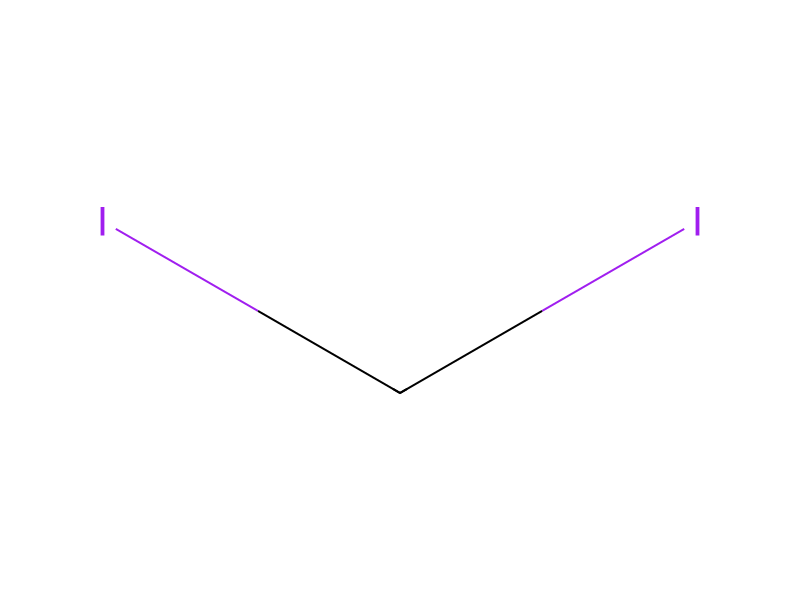
Diiodomethane → 4-Bromo-2-chloro-1-(1-methylcyclopropyl)benzene
Reaction equation

[Br:1][C:2]1[CH:7]=[CH:6][C:5]([C:8]2([CH3:11])[CH2:10][CH2:9]2)=[CH:4][CH:3]=1.C([Zn]CC)C.FC(F)(F)C(O)=O.C(I)I.BrC1C=CC(C(C)=C)=C([Cl:37])C=1>>[Br:1][C:2]1[CH:7]=[CH:6][C:5]([C:8]2([CH3:11])[CH2:10][CH2:9]2)=[C:4]([Cl:37])[CH:3]=1Participants
6


Procedure
The title compound was synthesized in analogy to 1-bromo-4-(1-methylcyclopropyl)-benzene (described in example S87) using diethyl zinc (2.59 ml, 1M solution in hexane, 2.59 mmol), trifluoroacetic acid (200 μl, 2.59 mmol), CH2I2 (209 μl, 2.59 mmol) and 4-bromo-2-chloro-1-isopropenylbenzene (300 mg, 1.30 mmol). The isolated residue was purified by flash column chromatography (100% pentane) to give 4-bromo-2-chloro-1-(1-methylcyclopropyl)-benzene (280 mg, 88%) as a colorless oil. 1H NMR (CDCl3, 300 MHz): δ 7.48 (d, J=2.0 Hz, 1H), 7.30 (dd, J=2.0, 8.5 Hz, 1H), 7.22 (d, J=8.5 Hz, 1H), 1.32 (s, 3H), 0.81-0.73(m, 4H).
Workup
- customThe isolated residue was purified by flash column chromatography (100% pentane)
Sources & evidence
- ORD record
- ord-fed0807de11241acbc8d9ca1adf70f83
- Source dataset
- uspto-grants-2007_08
- Patent number
- US07259183B2
Reaction notes
Loading…