2-ethylhexanoic acid tin(II) salt → Poliglecaprone
Reaction equation

[C:1]1(=[O:8])[O:7][CH2:6][CH2:5][CH2:4][CH2:3][CH2:2]1.[CH2:9]1[O:16][C:14](=[O:15])[CH2:13][O:12][C:10]1=[O:11].CCCCC(C([O-])=O)CC.CCCCC(C([O-])=O)CC.[Sn+2]>C(O)COCCO>[C:1]1(=[O:8])[O:7][CH2:6][CH2:5][CH2:4][CH2:3][CH2:2]1.[CH2:9]1[O:16][C:14](=[O:15])[CH2:13][O:12][C:10]1=[O:11]Participants
Reactant 3

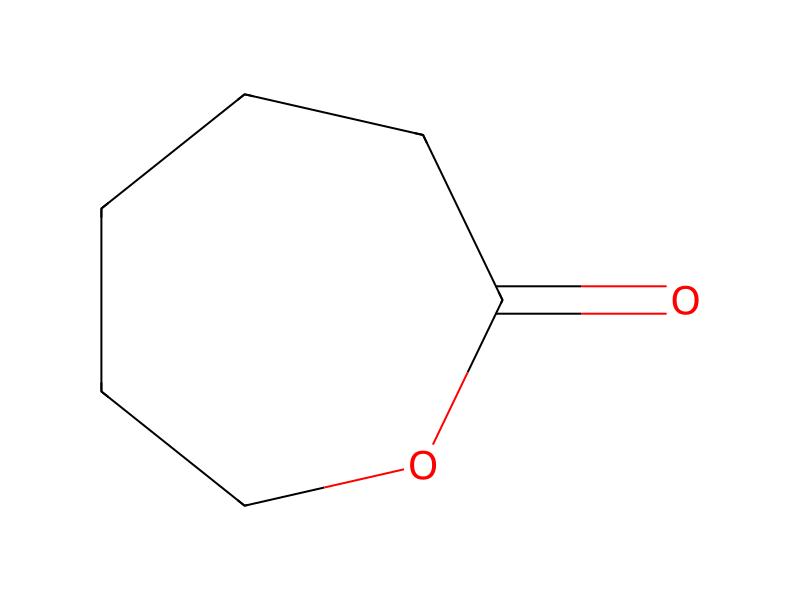

Product 1

Reagents, catalysts & solvents 1

Conditions
- Temperature
- 190 °C
Procedure
A flame dried 500 ml single-neck round-bottom flask is charged with 102.73 gm. (0.90 mole) of ε-caprolactone, 127.68 gm (1.10 mole) of glycolide, 0.228 ml (1.20 mmole/mole of total monomer) of distilled diethylene glycol and 0.135 ml stannous octoate (0.33 molar solution in toluene). The flask is fitted with a flame dried mechanical stirrer and appropriate adapters to provide a closed system. The reactor is purged three times before being vented with nitrogen. The reaction mixture is heated to 190° C. under nitrogen, and maintained at this temperature for about 16 to 18 hours. The copolymer is isolated, ground, and devolatilized (15 hours/110° C./0.1 mm Hg) to remove any unreacted monomers. A weight loss of 2.6% is observed. The inherent viscosity (I.V.) of the copolymer is 1.89 dl/g in hexafluoroisopropanol (HFIP) at 25° C. at 0.1 g/dl. The molar ratio of polycaprolactone(PCL)/polyglycolide(pGA) is found to be 44/56 by NMR. This copolymer has a glass transition temperature (Tg) of -11.9° C., and melting point of 51.9° C. by DSC.
Workup
- customA flame dried 500 ml single-neck round-bottom flask
- additionis charged with 102.73 gm
- customThe flask is fitted with a flame
- customdried mechanical stirrer
- customappropriate adapters to provide a closed system
- customThe reactor is purged three times
- temperaturemaintained at this temperature for about 16 to 18 hours
- customThe copolymer is isolated
- custom(15 hours/110° C./0.1 mm Hg)
- customto remove any unreacted monomers
- customat 25° C.
- customa glass transition temperature (Tg) of -11.9° C., and melting point of 51.9° C.
Sources & evidence
- ORD record
- ord-4c95fe819e534b74a7ab762dd2d005bd
- Source dataset
- uspto-grants-1998_02
- Patent number
- US05713920
Reaction notes
Loading…