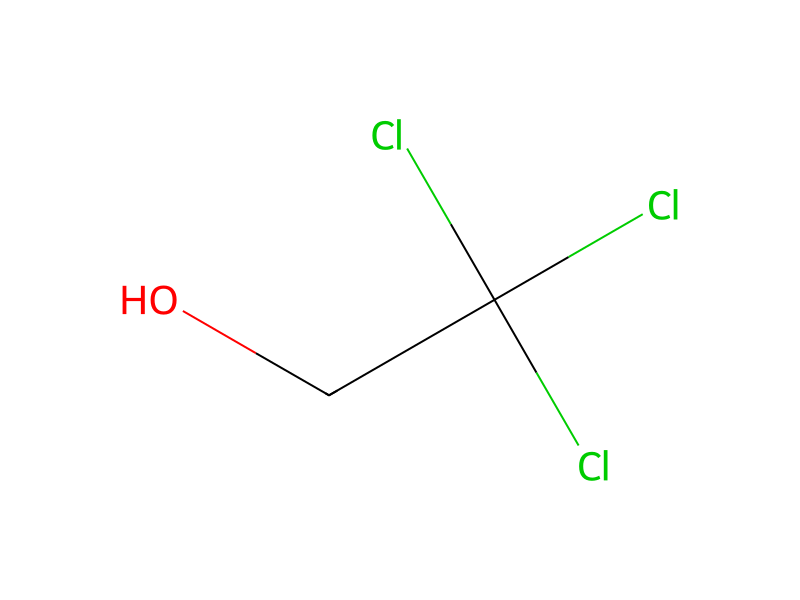
Trichloroethanol → HCID 23374563, compound
Reaction equation

[Cl:1][C:2]1[CH:3]=[C:4]([C:8]2([NH:12][C:13](=NC#N)NC3C=NC=CC=3)[CH2:11][CH2:10][CH2:9]2)[CH:5]=[CH:6][CH:7]=1.C1(P(N=[N+]=[N-])(C2C=CC=CC=2)=[O:31])C=CC=CC=1.C(N(CC)CC)C.[Cl:48][C:49]([Cl:53])([Cl:52])[CH2:50][OH:51]>>[Cl:1][C:2]1[CH:3]=[C:4]([C:8]2([NH:12][C:13]([O:51][CH2:50][C:49]([Cl:53])([Cl:52])[Cl:48])=[O:31])[CH2:9][CH2:10][CH2:11]2)[CH:5]=[CH:6][CH:7]=1Participants
5



Conditions
- Temperature
- 71 °C
Procedure
According to the procedure of Ninomiya et al. (Ninomiya, K., Shioiri, T., and S. Yamada, Tetrahedron 30:2151 (1974)), a mixture of the product from Step 2 (1.4 g, 6.65 mmol), diphenylphosphorylazide (2.10 ml, 9.63 mmol) and 1.25 ml (8.95 mmol) of triethyl amine was stirred for 15 minutes and then heated to 71° C. over 60 minutes; 2,2,2-trichloroethanol (0.925 ml, 0.00962 mol) was then added and the mixture was heated at 95° C. for 20 hours and at reflux for 4 hours. The mixture was concentrated and the residue chromatographed over 200 ml of silica gel (230°-400 mesh) by gravity elution with 75% CH2Cl2 /Hexane to give 2.07 g (87.4%) of the titled product.
Workup
- temperaturethe mixture was heated at 95° C. for 20 hours
- temperatureat reflux for 4 hours
- concentrationThe mixture was concentrated
- customthe residue chromatographed over 200 ml of silica gel (230°-400 mesh) by gravity elution with 75% CH2Cl2 /Hexane
Sources & evidence
- ORD record
- ord-d11287bd7edf48f3b6596c6aac4991b3
- Source dataset
- uspto-grants-1996_10
- Patent number
- US05567722
Reaction notes
Loading…