Acetone → p-(Benzyloxy)phenethyl alcohol
Reaction equation

[C:1](=[O:4])([O-])[O-].[K+].[K+].[CH2:7](Cl)[C:8]1[CH:13]=[CH:12][CH:11]=[CH:10][CH:9]=1.[CH3:15][C:16]([CH3:18])=[O:17]>[Br-].C([N+](CCCC)(CCCC)CCCC)CCC>[CH2:7]([O:17][C:16]1[CH:18]=[CH:9][C:8]([CH2:13][CH2:1][OH:4])=[CH:7][CH:15]=1)[C:8]1[CH:13]=[CH:12][CH:11]=[CH:10][CH:9]=1Participants
Reactant 3



Product 1
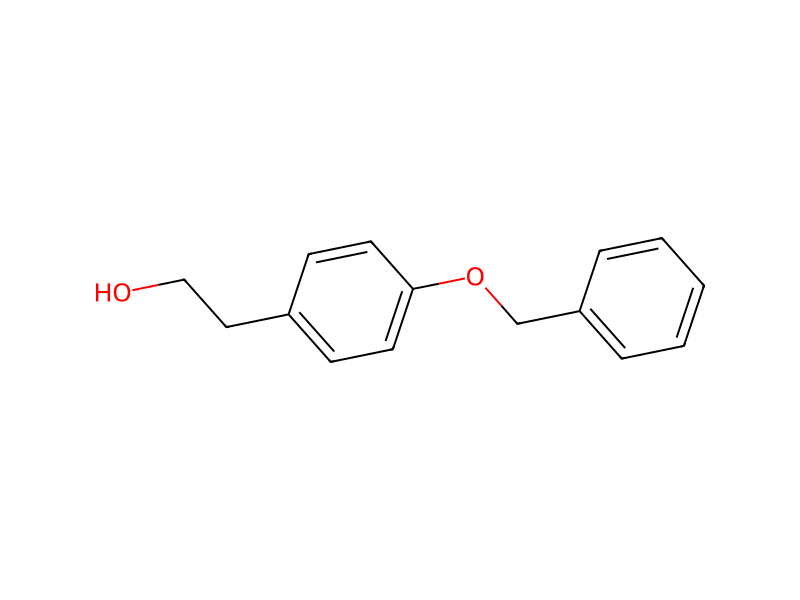
Reagents, catalysts & solvents 1

Procedure
To a flask equipped with a magnetic stirrer, reflux condenser and nitrogen inlet was added 13.8 grams of 2-(4-hydroxphenyl)ethanol, 14.5 grams of anhydrous potassium carbonate, 33.0 grams of tetrabutylammonium bromide, 12 mL of benzyl chloride and 200 mL of acetone. The reaction mixture was heated at reflux for 3 days, and then cooled to room temperature and filtered. The filtrate was concentrated in vacuo, diluted with 500 mL of dichloromethane, and washed with 2% aqueous sodium hydroxide and then with saturated brine. The organic layer was dried over anhydrous magnesium sulfate, filtered, and concentrated in vacuo. The resulting product was purified by chromatography on silica gel, eluting with dichloromethane, to yield 20.0 grams of the desired product as a white solid.
Workup
- customTo a flask equipped with a magnetic stirrer
- temperaturereflux condenser and nitrogen inlet
- temperatureThe reaction mixture was heated
- temperatureat reflux for 3 days
- filtrationfiltered
- concentrationThe filtrate was concentrated in vacuo
- additiondiluted with 500 mL of dichloromethane
- washwashed with 2% aqueous sodium hydroxide
- dry with materialThe organic layer was dried over anhydrous magnesium sulfate
- filtrationfiltered
- concentrationconcentrated in vacuo
- customThe resulting product was purified by chromatography on silica gel
- washeluting with dichloromethane
Sources & evidence
- ORD record
- ord-57dd78eb2679407e82be9dba2f862fcf
- Source dataset
- uspto-grants-1996_10
- Patent number
- US05569310
Reaction notes
Loading…