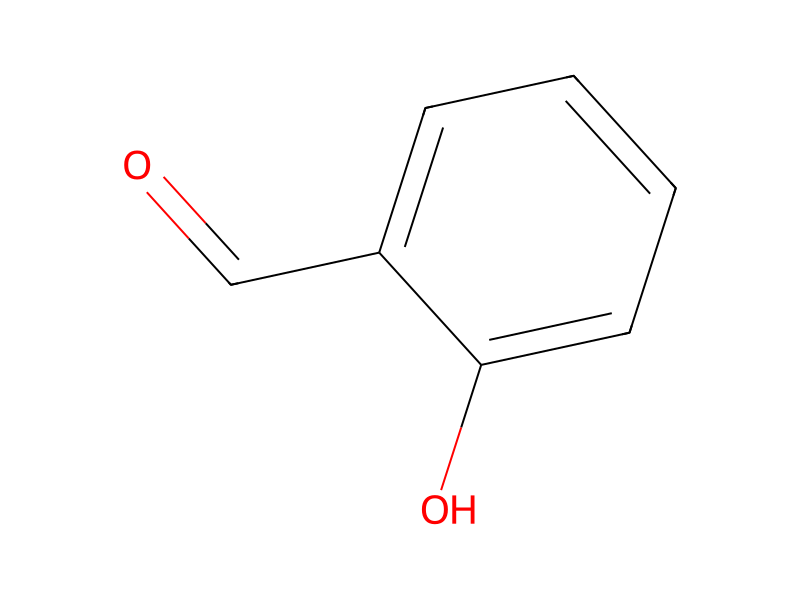
Hydrochloric Acid → 5-(Chloromethyl)-2-hydroxybenzaldehyde
Reaction equation

[CH:1](=[O:9])[C:2]1[C:3](=[CH:5][CH:6]=[CH:7][CH:8]=1)[OH:4].[Cl:10][CH2:11]C1C=CC=C(C=1)C=O.C=O.Cl>>[Cl:10][CH2:11][C:7]1[CH:6]=[CH:5][C:3]([OH:4])=[C:2]([CH:8]=1)[CH:1]=[O:9]Participants
5




Procedure
The salicylaldehyde is convened to the 5-chloromethylbenzaldehyde by combining the aldehyde with aqueous formaldehyde (37%) and concentrated hydrochloric acid, at a reduced temperature in the range of -10° to +10° C. or thereabouts. Gaseous HCl is then bubbled through the solution to saturate with HCl after which the solution is stirred for a period sufficient to effect the reaction at a reduced temperature, one which is about that of the temperature at which the reactants were combined initially. The product, the 5-(chloromethyl)-2-hydroxybenzaldehyde, should be formed as a white precipitate which can be recovered by conventional means.
Workup
- customin the range of -10° to +10° C.
- customGaseous HCl is then bubbled through the solution
- concentrationto saturate with HCl after which the solution
- customthe reaction at a reduced temperature, one which
Sources & evidence
- ORD record
- ord-7b2ae60820514fec831f7a77ccc9ca35
- Source dataset
- uspto-grants-1996_10
- Patent number
- US05569677
Reaction notes
Loading…