Acetic Acid → HCID 43560304, compound
Reaction equation

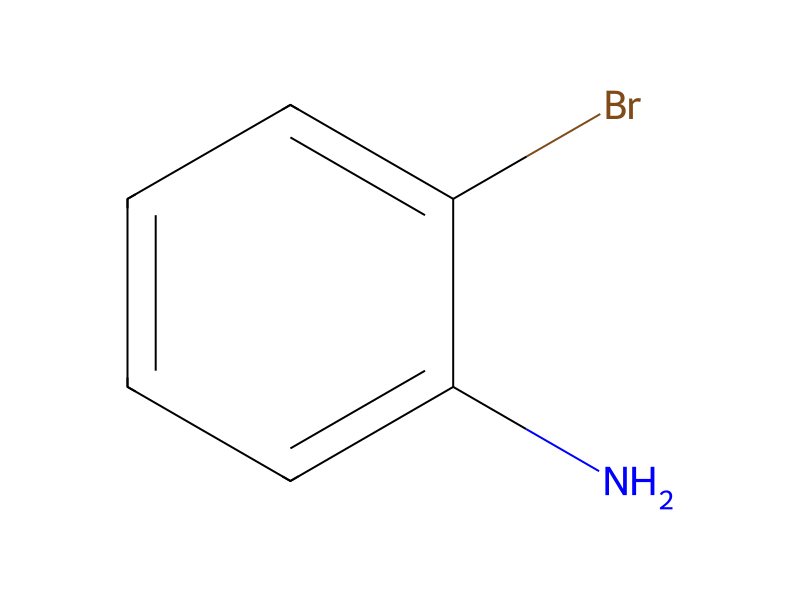
[Br:1][C:2]1[CH:8]=[CH:7][CH:6]=[CH:5][C:3]=1[NH2:4].[CH:9]1([CH:12]=O)[CH2:11][CH2:10]1.C(O)(=O)C.C(O[BH-](OC(=O)C)OC(=O)C)(=O)C.[Na+]>ClCCl>[Br:1][C:2]1[CH:8]=[CH:7][CH:6]=[CH:5][C:3]=1[NH:4][CH2:12][CH:9]1[CH2:11][CH2:10]1Participants
Reactant 4



Product 1

Reagents, catalysts & solvents 1

Conditions
- Temperature
- 50 °C
Procedure
A 100 mL flask was charged with 2-bromoaniline (1.720 g, 10.00 mmol), cyclopropanecarbaldehyde (0.374 mL, 5.00 mmol), acetic acid (2.86 mL, 50.0 mmol) and dichloromethane (50 mL). The mixture was heated at 50° C. for 1 hour. The mixture was then cooled in an ice bath and the sodium triacetoxyborohydride (2.119 g, 10.00 mmol) was added in portionwise over a few minutes. After 15 minutes, the ice bath was removed and the mixture was stirred for 2 hours at ambient temperature. The reaction mixture was quenched with 2.5 M sodium hydroxide (16 mL) and then partitioned between saturated sodium bicarbonate solution (100 mL) and ethyl acetate (100 mL). The layers were separated and the organic layer was dried over anhydrous sodium sulfate, filtered, and concentrated.
Workup
- temperatureThe mixture was then cooled in an ice bath
- customthe ice bath was removed
- customThe reaction mixture was quenched with 2.5 M sodium hydroxide (16 mL)
- custompartitioned between saturated sodium bicarbonate solution (100 mL) and ethyl acetate (100 mL)
- customThe layers were separated
- dry with materialthe organic layer was dried over anhydrous sodium sulfate
- filtrationfiltered
- concentrationconcentrated
Sources & evidence
- ORD record
- ord-da02df5e14fe4f5fa4b263a5d0032252
- Source dataset
- uspto-grants-2015_03
- Patent number
- US08980879B2
Reaction notes
Loading…