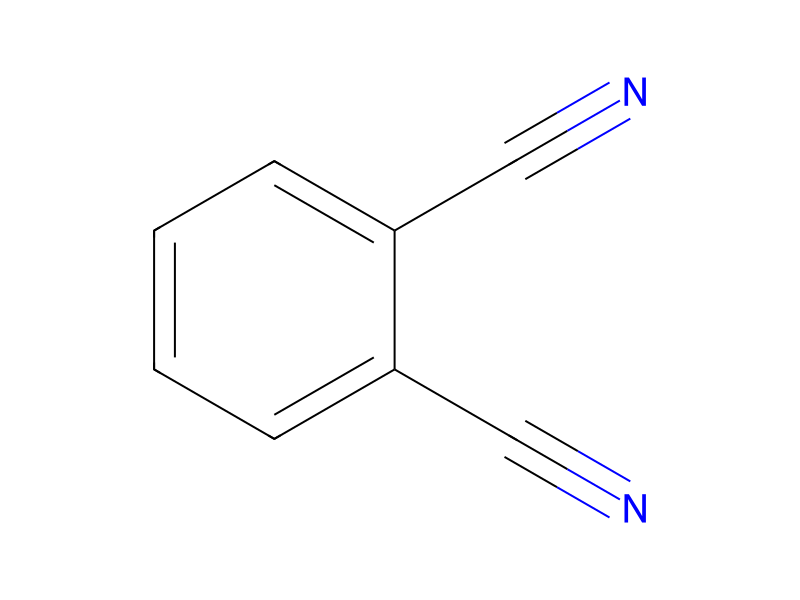
Hydrochloric Acid → Phthalonitrile
Reaction equation

OC1C=CC(C(C2C=CC(O)=CC=2)(C)C)=CC=1.[OH-].[Na+].ClC1C=CC(C(C2C=CC(Cl)=CC=2)=O)=CC=1.[N+]([C:39]1[CH:40]=[C:41]([C:47]#[N:48])[C:42](=[CH:45][CH:46]=1)[C:43]#[N:44])([O-])=O.Cl>C1(C)C=CC=CC=1.CS(C)=O>[C:47](#[N:48])[C:41]1[C:42](=[CH:45][CH:46]=[CH:39][CH:40]=1)[C:43]#[N:44]Participants







Conditions
- Temperature
- 140 °C
Procedure
To a 2000 mL, three-necked flask fitted with a thermometer, a Dean-Stark trap with condenser, and a nitrogen inlet were added bisphenol A (100 g, 0.438 mol), sodium hydroxide (38.5 g, 0.964 mol), toluene (25 mL), and dimethylsulfoxide (DMSO) (500 mL). Toluene was used to control the refluxing azeotropic removal of water and to control the temperature of the reaction content. The resulting mixture was degassed with nitrogen at ambient temperature and the Dean-Stark trap was filled with toluene. The mixture was refluxed at 135-145° C. under a nitrogen atmosphere for 6 to 18 h or until no more water was observed being collected in the Dean-Stark trap. At this time, the reaction mixture was cooled to 20° C. and 4,4′-dichlorobenzophenone (38.5 g, 0.153 mol) was added and the mixture refluxed until NMR or FTIR indicated that all of the 4,4′-dichlorobenzophenone was consumed. The toluene was then slowly distilled off causing the temperature to rise to 180° C. in the reaction vessel to enhance the yield of the intermediate hydroxyl salt and high conversion to this intermediate. The mixture was cooled to 50° C. At this time, 4-nitrophthalonitrile (99.1 g, 0.573 mol) was added in one portion and the reaction mixture was heated at 80° C. for 6-8 h. The mixture was allowed to cool to ambient temperature and poured into a 5% aqueous HCl solution resulting in the formation of a solid. The material was broken up and collected using a Büchner funnel. The white solid was washed with 200 mL of a 5% aqueous KOH solution, with 200 mL portions of distilled water until neutral, with 200 mL of a 5% aqueous HCl solution, and finally with 200 mL portions of water until neutral. The isolated solid was vacuum dried to yield the 2:1 oligomeric phthalonitrile and the bisphenol A phthalonitrile composition (192 g, 97% yield). IR [cm−1]: ν 3077 (C═CH), 2232 (CN), 1586 (C═C), 1478 (aromatic), 1306 (aromatic), 1308 (C—O), 1245 (CH3), 1162 (C—O), 929 (C—O), 847 (aromatic).
Workup
- customTo a 2000 mL, three-necked flask fitted with a thermometer
- customthe refluxing azeotropic removal of water
- customThe resulting mixture was degassed with nitrogen at ambient temperature
- additionthe Dean-Stark trap was filled with toluene
- customwas observed being collected in the Dean-Stark trap
- temperatureAt this time, the reaction mixture was cooled to 20° C.
- temperaturethe mixture refluxed until NMR or FTIR
- customwas consumed
- distillationThe toluene was then slowly distilled off
- customto rise to 180° C. in the reaction vessel
- temperatureThe mixture was cooled to 50° C
- temperaturethe reaction mixture was heated at 80° C. for 6-8 h
- temperatureto cool to ambient temperature
- customresulting in the formation of a solid
- customcollected
- washThe white solid was washed with 200 mL of a 5% aqueous KOH solution, with 200 mL portions of distilled water until neutral, with 200 mL of a 5% aqueous HCl solution
- customdried
Sources & evidence
- ORD record
- ord-b6265cf59f854256b6b4777582ea9023
- Source dataset
- uspto-grants-2015_03
- Patent number
- US08981036B2
Reaction notes
Loading…