Dichloromethane → {3-Methyl-[1,2,4]triazolo[4,3-a]pyridin-7-yl}boronic acid
Reaction equation

Br[C:2]1[CH:7]=[CH:6][N:5]2[C:8]([CH3:11])=[N:9][N:10]=[C:4]2[CH:3]=1.C(Cl)Cl.[B:15]1(B2OC(C)(C)C(C)(C)O2)[O:19]C(C)(C)C(C)(C)[O:16]1.CC([O-])=O.[K+]>C1C=CC(P(C2C=CC=CC=2)[C-]2C=CC=C2)=CC=1.C1C=CC(P(C2C=CC=CC=2)[C-]2C=CC=C2)=CC=1.Cl[Pd]Cl.[Fe+2].O1CCOCC1>[CH3:11][C:8]1[N:5]2[CH:6]=[CH:7][C:2]([B:15]([OH:19])[OH:16])=[CH:3][C:4]2=[N:10][N:9]=1Participants
7
Reactant 4



Product 1

Reagents, catalysts & solvents 2


Conditions
- Temperature
- 100 °C
Procedure
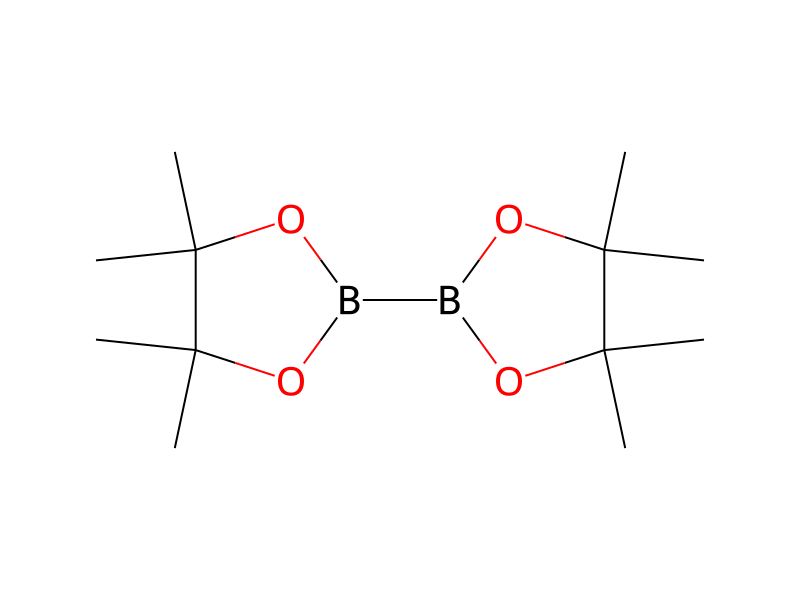
To a vial flushed with argon was added 7-bromo-3-methyl-[1,2,4]triazolo[4,3-a]pyridine (318 mg, 1.5 mmol), PdCl2(dppf).DCM (245 mg, 0.3 mmol), bis(pinacolato)diboron (508 mg, 2 mmol), and KOAc (442 mg, 4.5 mmol). Anhydrous dioxane (8 mL) was added, and the mixture was heated to 100° C. for 3 hours. After cooling to room temperature, the mixture was filtered over a plug of Celite, and concentrated to provide the crude product, which was used directly without further purification. LCMS-ESI+: calc'd for C7H9BN3O2: 178.1 (M+H+); Found: 178.1 (M+H+).
Workup
- customTo a vial flushed with argon
- temperatureAfter cooling to room temperature
- filtrationthe mixture was filtered over a plug of Celite
- concentrationconcentrated
Sources & evidence
- ORD record
- ord-cdcc7356122f4a9f8e454954eb3bd4eb
- Source dataset
- uspto-grants-2015_03
- Patent number
- US08987250B2
Reaction notes
Loading…