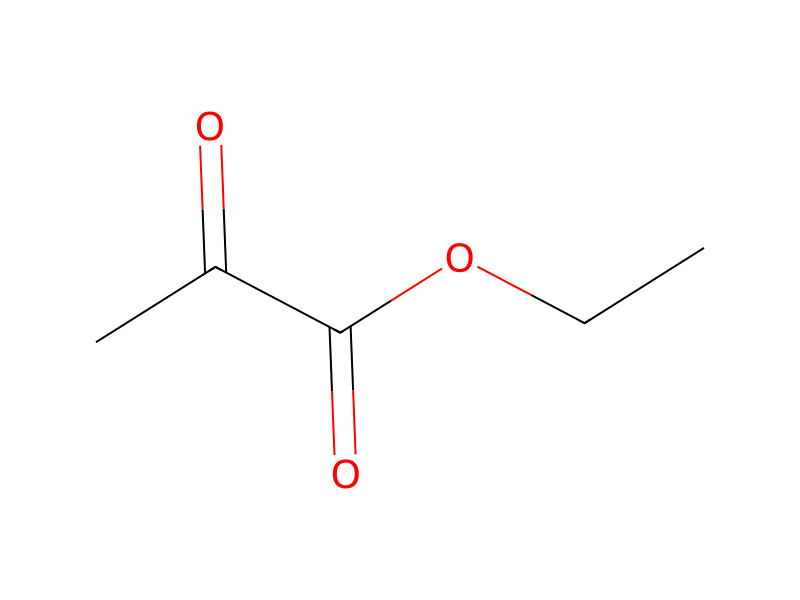
Ethyl pyruvate → HCID 13675760, compound
Reaction equation

[C:1]([O:6][CH2:7][CH3:8])(=[O:5])[C:2]([CH3:4])=O.Cl.[C:10]([NH:14][NH2:15])([CH3:13])([CH3:12])[CH3:11].C(N(CC)C(C)C)(C)C>C(O)C>[C:10]([NH:14]/[N:15]=[C:2](\[CH3:4])/[C:1]([O:6][CH2:7][CH3:8])=[O:5])([CH3:13])([CH3:12])[CH3:11]Participants
Reactant 3


Product 1

Reagents, catalysts & solvents 1

Procedure
To a solution of ethyl pyruvate (20.22 g, 174.1 mmol) in ethanol (150 mL) was added t-butyl hydrazine hydrochloride (21.7 g, 174 mmol) and N,N-diisopropylethyl amine (33.4 mL, 192 mmol). After stirring at reflux for 18 hours, the reaction was cooled and the volatiles were removed under reduced pressure. The resultant golden oil was taken up in 300 mL ethyl acetate and washed with 200 mL water and 300 mL saturated aqueous sodium bicarbonate. The organic layer was dried over sodium sulfate, filtered and concentrated to yield (E)-ethyl 2-(2-tert-butylhydrazono)propanoate (23.1 g) as a clear pale yellow oil. +APCI (M+H) 187.3; 1H NMR (400 MHz, CDCl3, δ): 5.51 (br. s., 1H), 4.25 (q, J=7.2 Hz, 2H), 1.89 (s, 3H), 1.32 (t, J=7.1 Hz, 3H), 1.28 (s, 9H).
Workup
- temperatureat reflux for 18 hours
- temperaturethe reaction was cooled
- customthe volatiles were removed under reduced pressure
- washwashed with 200 mL water and 300 mL saturated aqueous sodium bicarbonate
- dry with materialThe organic layer was dried over sodium sulfate
- filtrationfiltered
- concentrationconcentrated
Sources & evidence
- ORD record
- ord-e96d901d49e0422cb7b8ae5ee94ad5fd
- Source dataset
- uspto-grants-2015_03
- Patent number
- US08993586B2
Reaction notes
Loading…