Potassium Carbonate → 4-Bromo-1-but-3-ynyloxy-2-nitro-benzene
Reaction equation

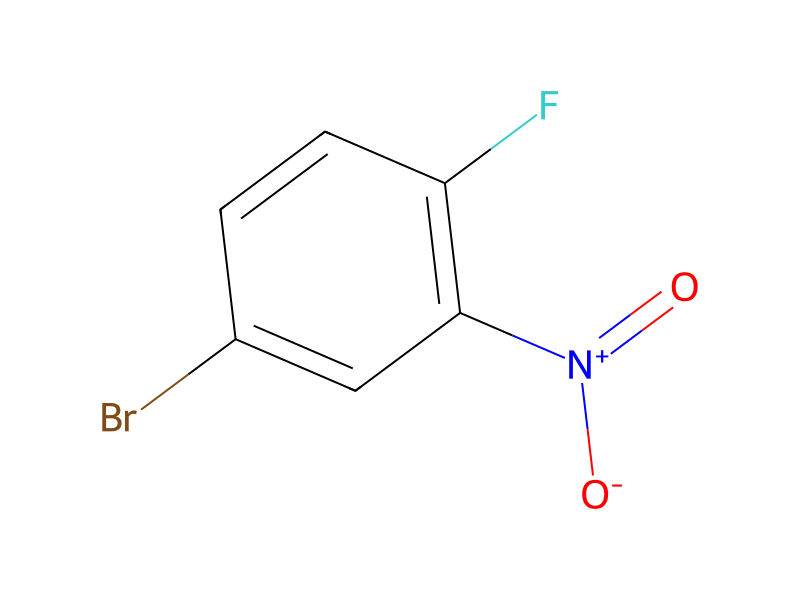
[Br:1][C:2]1[CH:7]=[CH:6][C:5](F)=[C:4]([N+:9]([O-:11])=[O:10])[CH:3]=1.[CH2:12]([OH:16])[CH2:13][C:14]#[CH:15].C(=O)([O-])[O-].[K+].[K+]>CN(C=O)C.O>[Br:1][C:2]1[CH:7]=[CH:6][C:5]([O:16][CH2:12][CH2:13][C:14]#[CH:15])=[C:4]([N+:9]([O-:11])=[O:10])[CH:3]=1Participants
6





Procedure
A mixture of 4-bromo-1-fluoro-2-nitrobenzene (20.0 g, 90 mmol), 3-butyn-1-ol (7.0 g, 99.8 mmol) and potassium carbonate (13.8 g, 99.8 mmol) in dry DMF (20 mL) was heated with 4 Å molecular sieves for 43 h. The mixture was cooled, diluted with water to approximately 500 mL and extracted three times with ethyl acetate. The combined organic extracts were washed with water and then brine, dried and concentrated in vacuo. The resultant residue was subjected to flash chromatography (SiO2, gradient 5 to 10% ethyl acetate in cyclohexane) to give 4-Bromo-1-but-3-ynyloxy-2-nitro-benzene as a yellow solid (17.35 g, 71%). NMR showed an impurity (19%) which was not removed at this stage. LCMS: RT=4.41 min, [M+Na]+=292/294.
Workup
- temperaturewas heated with 4 Å molecular sieves for 43 h
- temperatureThe mixture was cooled
- extractionextracted three times with ethyl acetate
- washThe combined organic extracts were washed with water
- dry with materialbrine, dried
- concentrationconcentrated in vacuo
Sources & evidence
- ORD record
- ord-9d0981d0a49e4cbbb9370baba2499fdd
- Source dataset
- uspto-grants-2012_08
- Patent number
- US08242104B2
Reaction notes
Loading…