Benzoyl Peroxide → 2-Benzyl-5-nitroisoindoline
Reaktionsgleichung

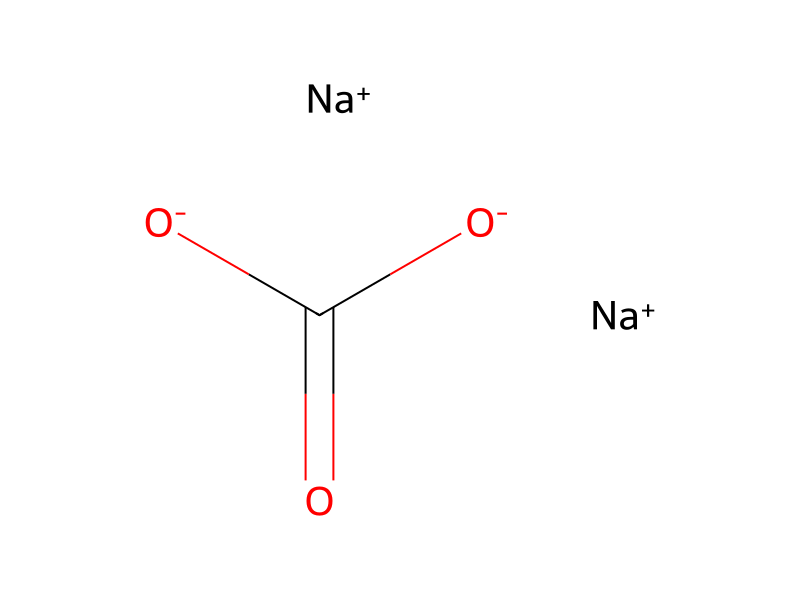
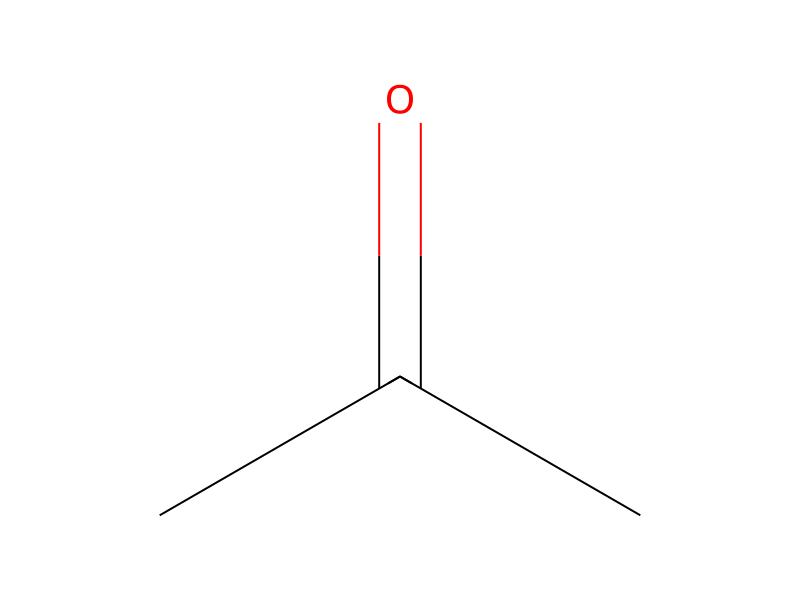
[N+:1]([C:4]1[CH:5]=[C:6]([CH3:11])[C:7]([CH3:10])=[CH:8][CH:9]=1)([O-:3])=[O:2].C1C(=O)N(Br)C(=O)C1.C(OOC(=O)C1C=CC=CC=1)(=O)C1C=CC=CC=1.C([O-])([O-])=O.[Na+].[Na+].[CH2:44]([NH2:51])[C:45]1[CH:50]=[CH:49][CH:48]=[CH:47][CH:46]=1>CC(C)=O.O.C(Cl)(Cl)(Cl)Cl>[CH2:44]([N:51]1[CH2:11][C:6]2[C:7](=[CH:8][CH:9]=[C:4]([N+:1]([O-:3])=[O:2])[CH:5]=2)[CH2:10]1)[C:45]1[CH:50]=[CH:49][CH:48]=[CH:47][CH:46]=1Komponenten
Edukt 5


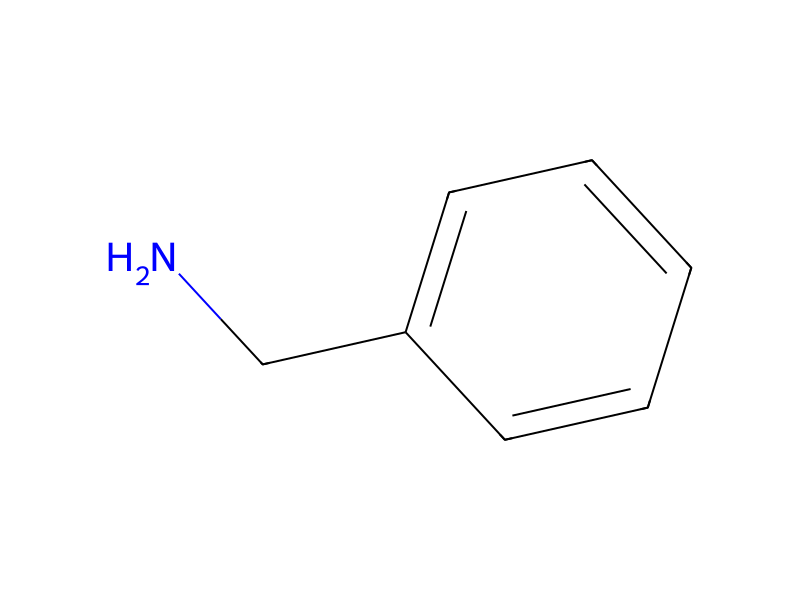

Produkt 1

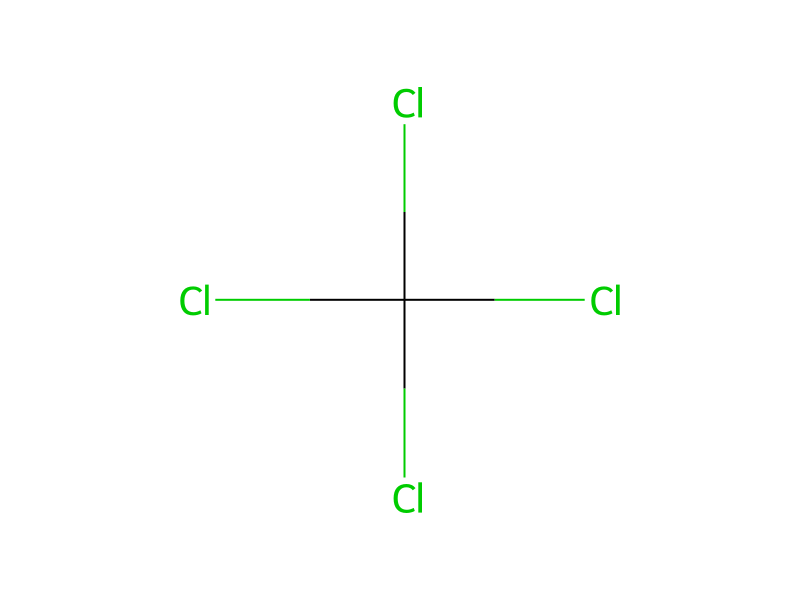
Reagenzien, Katalysatoren, Lösungsmittel 3
Versuchsvorschrift
Part A. A solution of 4-nitro-o-xylene (38.64 g, 255.9 mmol), NBS (91.1 g, 511.8 mmol), benzoyl peroxide (1.239 g, 5.118 mmol), and CCl4 (400 mL) was heated at reflux for 1 day, then at rt for 2 days. The solid was filtered off and washed with CCl4. The filtrate was evaporated to give the crude dibromo product (80 g). A portion of which (20 g) was dissolved in acetone (170 mL) and water (45 mL), then Na2CO3 (43.1 g, 407 mmol) was slowly added, followed by BnNH2 (7.05 mL, 64.6 mmol) in acetone (22 mL). After 10 h, the solution was concentrated to one-fourth its volume, the salt solid was filtered off, and the filtrate was evaporated. The residue was dissolved in EtOAc, washed with water and brine, dried over sodium sulfate, filtered, and evaporated. The residue was purified by column chromatography to provide the corresponding 2-benzyl-5-nitro-2,3-dihydro-1H-isoindole (5.41 g, 33% yield, over 2 steps): 1H NMR (300 MHz, CDCl3) δ 8.11 (d, 1H), 8.04 (s, 1H), 7.48–7.20 (m, 6H), 4.02 (s, 4H), 3.92 (s, 2H). Part B. To a solution of the isoindoline (5.40 g, 21.3 mmol) made above in EtOH (266 mL) under N2 was added 20% Pd(OH)2/C (3.00 g, 4.25 mmol). The reaction mixture was hydrogenated at 45 psi for 1 h. TLC analysis indicated that the nitro functionality was reduced and the Bn group was still intact. Therefore, concentrated HCl (1.6 mL, 19.1 mmol) was added to the reaction mixture and hydrogenation (50 psi) was continued overnight. The mixture was filtered through Celite®, washed with MeOH, and the filtrate was concentrated to one fourth of the volume. The precipitate was filtered off to provide the 5-aminoisoindoline.HCl (1.32 g, 36% yield): 1H NMR (500 MHz, CDCl3) δ 9.88 (s, br, 2H), 7.00 (d, 1H), 6.54 (m, 2H), 5.44 (s, br, 2H), 4.32 (s, 2H), 4.28 (s, 2H); ESI MS m/z 135 (MHCl+H)+. Part C. The 5-aminoisoindoline (700 mg, 4.11 mmol) made above was dissolved in 6 M HCl (4.6 mL) at rt, then cooled to 0° C. A solution of NaNO2 (340 mg, 4.93 mmol) in water (0.8 mL) was added dropwise, maintaining the reaction temperature below 5° C. After 40 min, AcOH (1.4 mL) was added to the mixture, followed by the dropwise addition of SnCl2 (1.79 g, 9.44 mmol) in concentrated HCl (2.7 mL) at 0° C. The mixture was warmed to 10° C. and stirred for 2 h, then a solution of 3-hydroxy-1-(4-iodophenyl)-4-(2,2,2-trifluoroacetyl)-5,6-dihydro-1H-pyridin-2-one (1.78 g, 4.31 mmol) in MeOH (16 mL) was added and the reaction mixture was heated at 50° C. for 16 h. Methyl alcohol was removed under vacuum and the solid was collected by filtration to give 1-(2,3-dihydro-1H-isoindol-5-yl)-6-methyl-3-trifluoromethyl-1,4,5,6-tetrahydro-pyrazolo[3,4-c]pyridin-7-one; compound with iodo-benzene as an AcOH salt (2.07 g, 86% yield): 1H NMR (500 MHz, DMSO-d6) δ 9.82 (s, br, 2H), 7.75 (d, 2H), 7.66–7.62 (m, 2H), 7.51 (d, 1H), 7.19 (d, 2H), 4.56 (m, 4H), 4.11 (t, 2H), 3.12 (t, 2H); ESI MS m/z 585 (M+H)+. Part D. The product from Part C (540 mg, 1.03 mmol) was added to a stirred solution of Et3N (143 mL, 1.03 mmol) and Boc2O (225 mg, 1.03 mmol) in THF (5.2 mL) at rt. After 2.5 h, the solvent was removed under vacuum and the residue was purified by column chromatography to provide the corresponding protected isoindoline 5-(6-methyl-7-oxo-3-trifluoromethyl-4,5,6,7-tetrahydro-pyrazolo[3,4-c]pyridin-1-yl)-1,3-dihydro-isoindole-2-carboxylic acid tert-butyl ester; compound with iodo-benzene (272 mg, 42% yield): 1H NMR (300 MHz, CDCl3) δ 7.69 (d, 2H), 7.45–7.26 (m, 3H), 7.06 (d, 2H), 4.68 (m, 4H), 4.13 (t, 2H), 3.17 (t, 2H), 1.51 (s, 9H); 19F NMR (282 MHz, CDCl3) δ−61.8. Part E. A mixture of the product from Part D (102 mg, 163 μmol), 2-hydroxy-pyridine (19 mg, 196 μmol), K2CO3 (25 mg, 180 μmol), 1,10-phenanthroline (3 mg, 18 mmol), CuI (4 mg, 20 μmol, and DMSO (0.3 mL) under argon atmosphere was heated at 110–120° C. for 24 h. The mixture was diluted with CH2Cl2, washed 1 M HCl (2×) and brine, dried over sodium sulfate, filtered, and evaporated under vacuum. The residue was purified by column chromatography to provide the corresponding biaryl lactam (17 mg), which was treated with TFA (21 mL) to provide, after purification by semi-preparative HPLC, the title compound 1-(2,3-dihydro-1H-isoindol-5-yl)-6-[4-(2-oxo-2H-pyridin-1-yl)phenyl]-3-trifluoromethyl-1,4,5,6-tetrahydropyrazolo[3,4-c]pyridin-7-one, trifluoroacetic acid salt (3.8 mg, 4% yield, 3 steps): 1H NMR (300 MHz, CDCl3) δ 9.77 (s, br, 2H), 7.63–7.34 (m, 8H), 7.10 (d, 1H), 6.69 (d, 1H), 6.45 (t, 1H), 4.21 (t, 2H), 4.07 (s, 2H), 3.20 (t, 2H), 1.31 (m, 2H); 19F NMR (282 MHz, CDCl3) δ−62.0, −76.2; ESI MS m/z 492 (M-CF3CO2H+ H)+.
Aufarbeitung
- temperatureat reflux for 1 day
- filtrationThe solid was filtered off
- washwashed with CCl4
- customThe filtrate was evaporated
- customto give the crude dibromo product (80 g)
- waitAfter 10 h
- concentrationthe solution was concentrated to one-fourth its volume
- filtrationthe salt solid was filtered off
- customthe filtrate was evaporated
- dissolutionThe residue was dissolved in EtOAc
- washwashed with water and brine
- dry with materialdried over sodium sulfate
- filtrationfiltered
- customevaporated
- customThe residue was purified by column chromatography
Quellen und Nachweise
- ORD-Eintrag
- ord-56a35c0372574976942e0cd9ec813d1b
- Quelldatensatz
- uspto-grants-2006_02
- Patentnummer
- US07005435B2
Notizen zur Reaktion
Wird geladen…