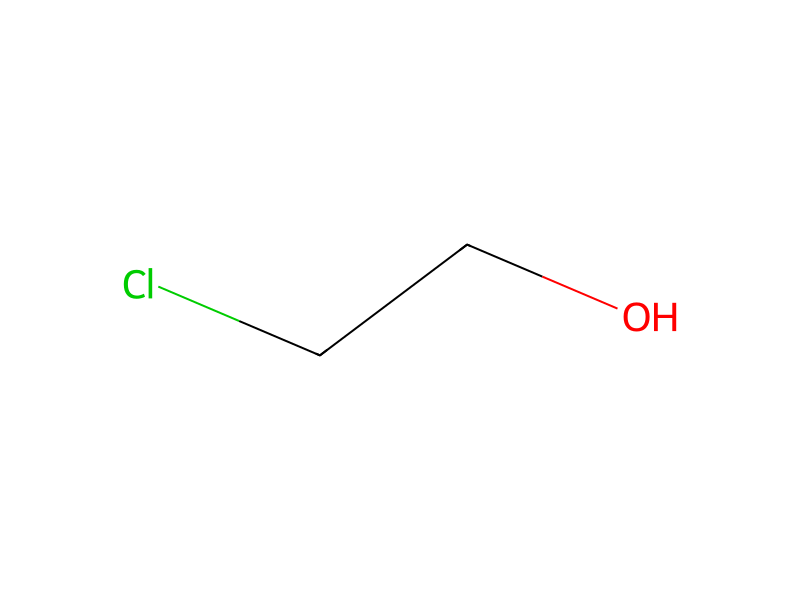
2-Chloroethanol → 2-(2-Naphthoxy)ethanol
Reaction equation

[CH:1]1[C:10]2[C:5](=[CH:6][CH:7]=[CH:8][CH:9]=2)[CH:4]=[CH:3][C:2]=1[OH:11].[OH-].[Na+].Cl[CH2:15][CH2:16][OH:17].C1(C)C=CC=CC=1>CS(C)=O>[CH:1]1[C:10]2[C:5](=[CH:6][CH:7]=[CH:8][CH:9]=2)[CH:4]=[CH:3][C:2]=1[O:11][CH2:15][CH2:16][OH:17]Participants
6
Reactant 4



Product 1

Reagents, catalysts & solvents 1

Procedure
The reaction set-up consisted of a three necked round bottom flask, equipped with a thermometer, condenser and a mechanical stirrer, and a dropping funnel. 2-Naphthol, 100 g (0.6936 moles), was dissolved in 60 mL of dimethyl sulfoxide. Sodium hydroxide, 27.7 g (0.6936 moles), was carefully added to the solution. Then 2-chloroethanol, 61.4 g (0.7629 moles), was slowly added, keeping the reaction temperature at 80.C. The reaction was followed by GC. After →→80% conversion was achieved, the reaction was worked-up by adding toluene and extracting the unreacted naphthol with 5% aqueous NaOH. The product was then recrystallized in ethanol or distilled under vacuum (70-80% yield).
Workup
- customequipped with a thermometer, condenser and a mechanical stirrer, and a dropping funnel
- extractionextracting the unreacted naphthol with 5% aqueous NaOH
- customThe product was then recrystallized in ethanol
- distillationdistilled under vacuum (70-80% yield)
Sources & evidence
- ORD record
- ord-823dcdfd8e994b759daa87ad960d6485
- Source dataset
- uspto-grants-1992_06
- Patent number
- US05118551
Reaction notes
Loading…