Potassium Carbonate → (E)-methyl 2-[2-(4-chloro-1,3,5-triazin-2-yloxy)phenyl]-3-methoxypropenoate
Reaction equation

[Cl:1][C:2]1[N:7]=[CH:6][N:5]=[C:4](Cl)[N:3]=1.C(=O)([O-])[O-].[K+].[K+].[OH:15][C:16]1[CH:21]=[CH:20][CH:19]=[CH:18][C:17]=1/[C:22](=[CH:27]\[O:28][CH3:29])/[C:23]([O:25][CH3:26])=[O:24].[F-].[Cs+].C1OCCOCCOCCOCCOCCOC1>C(#N)C.C(OCC)C>[Cl:1][C:2]1[N:7]=[CH:6][N:5]=[C:4]([O:15][C:16]2[CH:21]=[CH:20][CH:19]=[CH:18][C:17]=2/[C:22](=[CH:27]\[O:28][CH3:29])/[C:23]([O:25][CH3:26])=[O:24])[N:3]=1Participants
Reactant 5




Product 1

Reagents, catalysts & solvents 2


Procedure
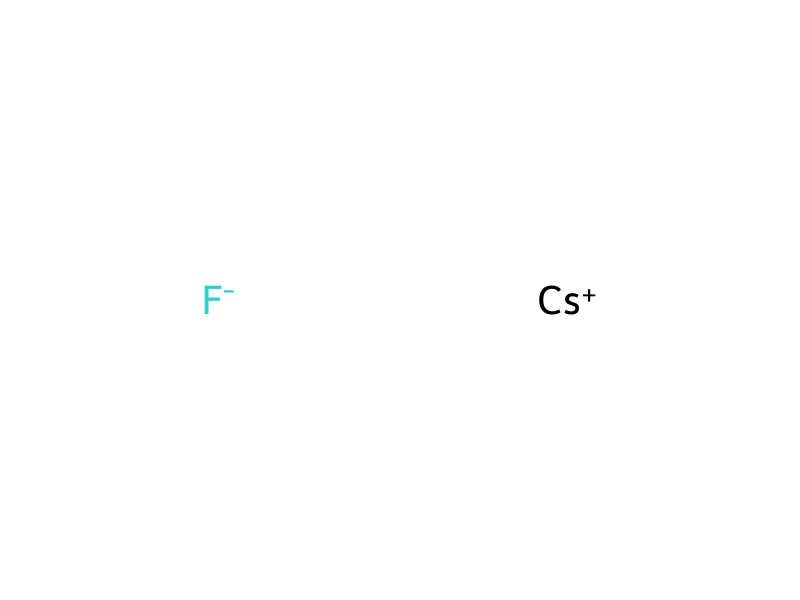
To a stirred solution of 2,6-dichloro-1,3,5-triazine (0.3g, 2 mmol; made according to R L N Harris, Synthesis, 1981, 907) and potassium carbonate (0.28g, 2 mmol) in dry acetonitrile (25 ml) at 0° C. under an atmosphere of nitrogen was added dropwise a solution of (E)-methyl 2-(2-hydroxyphenyl)-3-methoxypropenoate (0.42g, 2mmol) in dry acetonitrile (7 ml). Anhydrous caesium fluoride (0.30g, 2 mmol) and a catalytic amount of 18-crown-6 were added with stirring and the temperature was allowed to rise to room temperature. After stirring overnight, the reaction mixture was filtered and evaporated to leave a yellow/orange paste. Chromatography (eluent diethyl ether) afforded (E)-methyl 2-[2-(4-chloro-1,3,5-triazin-2-yloxy)phenyl]-3-methoxypropenoate (0.42white solid, m.p. 137°-140° C.; Infrared max. 1704, 1631 cm-1 ; 1H NMR (CDCl3) δ63.63(3H,s); 3.75(3H,s); 7.19-7.29(lH,m); 7.31-7.45(3H,m); 7.47(lH,s); 8.74(lH,s) ppm.
Workup
- customto rise to room temperature
- stirringAfter stirring overnight
- filtrationthe reaction mixture was filtered
- customevaporated
- customto leave a yellow/orange paste
Sources & evidence
- ORD record
- ord-bb307c223ab742b9a7097980c29e4446
- Source dataset
- uspto-grants-1992_06
- Patent number
- US05124329
Reaction notes
Loading…