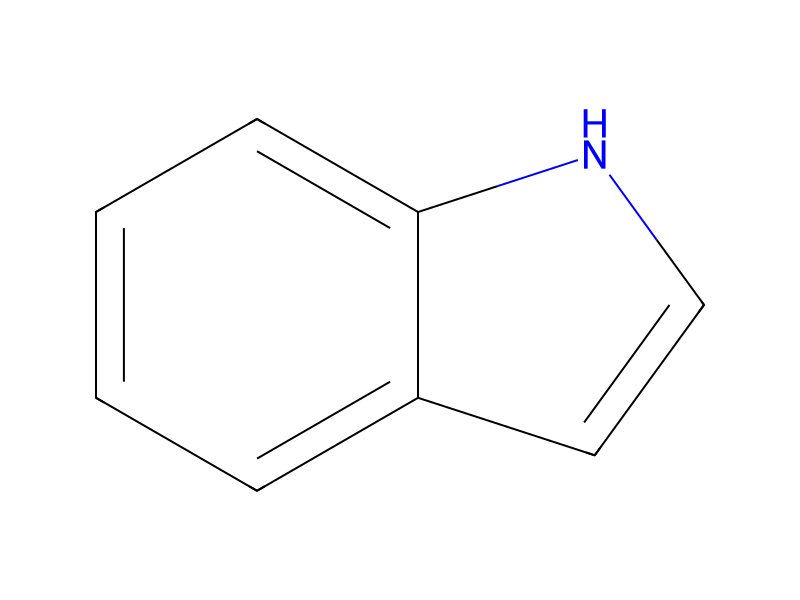
Indole → HCID 19892079, compound
Reaction equation

[Na].[NH:2]1[C:10]2[C:5](=[CH:6][CH:7]=[CH:8][CH:9]=2)[CH:4]=[CH:3]1.O=[C:12]1[CH2:17][CH2:16][CH:15]([C:18]([O:20]C)=[O:19])[CH2:14][CH2:13]1>CO>[NH:2]1[C:10]2[C:5](=[CH:6][CH:7]=[CH:8][CH:9]=2)[CH:4]=[C:3]1[C:12]1[CH2:17][CH2:16][CH:15]([C:18]([OH:20])=[O:19])[CH2:14][CH:13]=1Participants
Reactant 3


Product 1

Reagents, catalysts & solvents 1

Procedure
To 50 mL of methanol is added sodium (3.32 g, 144.3 mmol). After the metal has dissolved indole (2.89 g, 24.6 mmol) and methyl 4-oxocyclohexanecarboxylate (5.0 g, 32.0 mmol) are added. The mixture is heated to reflux for 3 hours. The methanol is removed under reduced pressure and the residue partitioned between water and methylene chloride. The organic layer is discarded. The aqueous layer is acidified to pH 5 and extracted with three portions of methylene chloride. The combined organics are dried over sodium sulfate and evaporated to give 4-indolyl-3-cyclohexenecarboxylic acid (1.71 g). The material is hydrogenated in methanol (75 mL) under 50 psi of hydrogen int he presence of 5% palladium on carbon (0.5 g). After filtration and removal of solvent, the product is obtained as a mixture of diastereomers.
Workup
- additionare added
- temperatureThe mixture is heated
- temperatureto reflux for 3 hours
- customThe methanol is removed under reduced pressure
- customthe residue partitioned between water and methylene chloride
- extractionextracted with three portions of methylene chloride
- dry with materialThe combined organics are dried over sodium sulfate
- customevaporated
Sources & evidence
- ORD record
- ord-09269720fd474d378005d8da444bf080
- Source dataset
- uspto-grants-1992_06
- Patent number
- US05124332
Reaction notes
Loading…