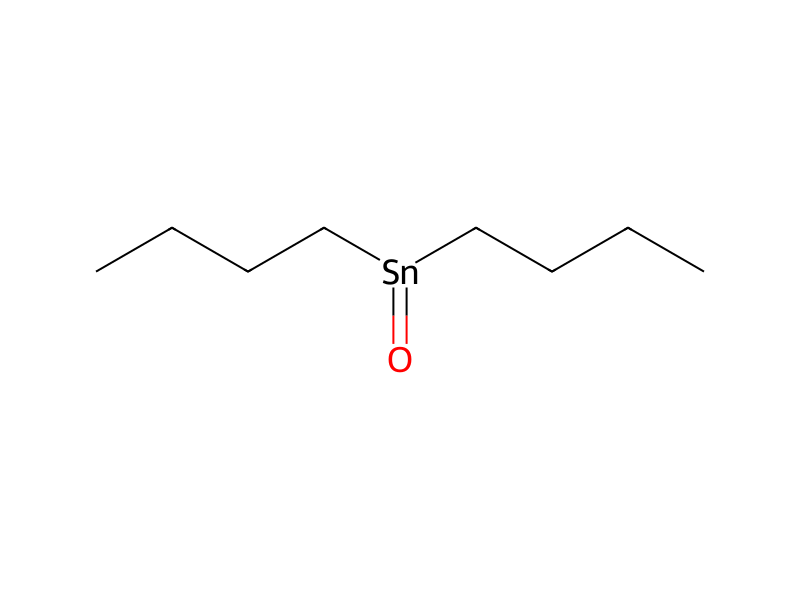
2-ethylhexanoic acid tin(II) salt → Dibutyltin oxide
Reaction equation

C1(C)C(S([O-])(=O)=[O:8])=CC=CC=1.C1(C)C(S([O-])(=O)=O)=CC=CC=1.[CH2:23]([Sn+2:27][CH2:28][CH2:29][CH2:30][CH3:31])[CH2:24][CH2:25][CH3:26].CCCCC(C([O-])=O)CC.CCCCC(C([O-])=O)CC.[Sn+2]>CN(C)C=O.O>[CH2:23]([Sn:27](=[O:8])[CH2:28][CH2:29][CH2:30][CH3:31])[CH2:24][CH2:25][CH3:26]Participants
5
Reactant 2


Product 1
Reagents, catalysts & solvents 2


Procedure
Employing the same formulation as in Example 1, dibutyltin bis-toluenesulfonate (DBTTS) was evaluated, using a solution of this catalyst in dimethylformamide. A portion of this catalyst solution was diluted with 10% water and aged at room temperature for three weeks. From the results reported in Table 2, it is seen that no apparent change in activity occurred in the aged sample. Addition of water to a stannous octoate solution, on the other hand, produces an immediate precipitate of dibutyltin oxide which is relatively inactive as a co-catalyst for urethane production.
Workup
- waitaged at room temperature for three weeks
Sources & evidence
- ORD record
- ord-19d8708fbafd45048a68de82fee2a3f0
- Source dataset
- uspto-grants-1981_08
- Patent number
- US04286073
Reaction notes
Loading…