2-Bromopyridine → 3-Methyl-1-pyridin-2-ylpiperazine hydrobromide
Reaction equation

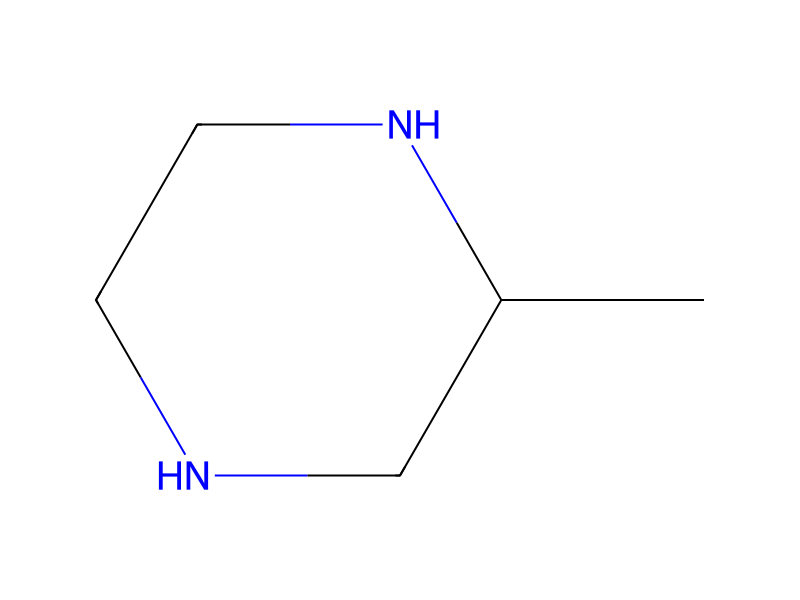
[CH3:1][CH:2]1[CH2:7][NH:6][CH2:5][CH2:4][NH:3]1.[Br:8][C:9]1[CH:14]=[CH:13][CH:12]=[CH:11][N:10]=1>>[BrH:8].[CH3:1][CH:2]1[NH:3][CH2:4][CH2:5][N:6]([C:9]2[CH:14]=[CH:13][CH:12]=[CH:11][N:10]=2)[CH2:7]1Participants
3


Conditions
- Temperature
- 120 °C
Procedure
2-Methylpiperazine (1.0 g, 0.01 mol, racemic mixture) and 2-bromopyridine (10 mL, 0.1 mol) were combined and heated at 120° C. for 16 hours. The reaction mixture was cooled to 23° C. and partitioned between ethyl acetate and water. The layers were separated, and the water layer was concentrated under reduced pressure. The residue was triturated with ethyl acetate, dichloromethane, and methanol to afford 460 mg (26% yield) of the title compound as an off-white solid. 1H NMR (300 MHz, DMSO-d6) δ 1.27 (d, J=6.6 Hz, 3H), 2.90 (dd, J=10.5, 14.1 Hz, 1H), 3.10 (m, 2H), 3.40 (m, 2H), 4.32 (m, 2H), 6.77 (dd, J=4.8, 6.9 Hz, 1H), 6.98 (d, J=8.1 Hz, 1H), 7.64 (m, 1H), 8.15 (m, 1H), 8.63 (bs, 1H), 8.92 (bs, 1H); MS (APCI) m/e 178 (M+H)+.
Workup
- temperatureThe reaction mixture was cooled to 23° C.
- custompartitioned between ethyl acetate and water
- customThe layers were separated
- concentrationthe water layer was concentrated under reduced pressure
- customThe residue was triturated with ethyl acetate, dichloromethane, and methanol
Sources & evidence
- ORD record
- ord-db4a887bda2d43559e8877bf506bdac2
- Source dataset
- uspto-grants-2008_04
- Patent number
- US07351828B2
Reaction notes
Loading…