p-Fluoronitrobenzene → 5-(4-Nitrophenoxy)-1H-isoindole-1,3(2H)-dione
Reaction equation

[H-].[Na+].[OH:3][C:4]1[CH:5]=[C:6]2[C:10](=[CH:11][CH:12]=1)[C:9](=[O:13])[NH:8][C:7]2=[O:14].F[C:16]1[CH:21]=[CH:20][C:19]([N+:22]([O-:24])=[O:23])=[CH:18][CH:17]=1>CN(C=O)C.O>[N+:22]([C:19]1[CH:20]=[CH:21][C:16]([O:3][C:4]2[CH:5]=[C:6]3[C:10](=[CH:11][CH:12]=2)[C:9](=[O:13])[NH:8][C:7]3=[O:14])=[CH:17][CH:18]=1)([O-:24])=[O:23]Participants
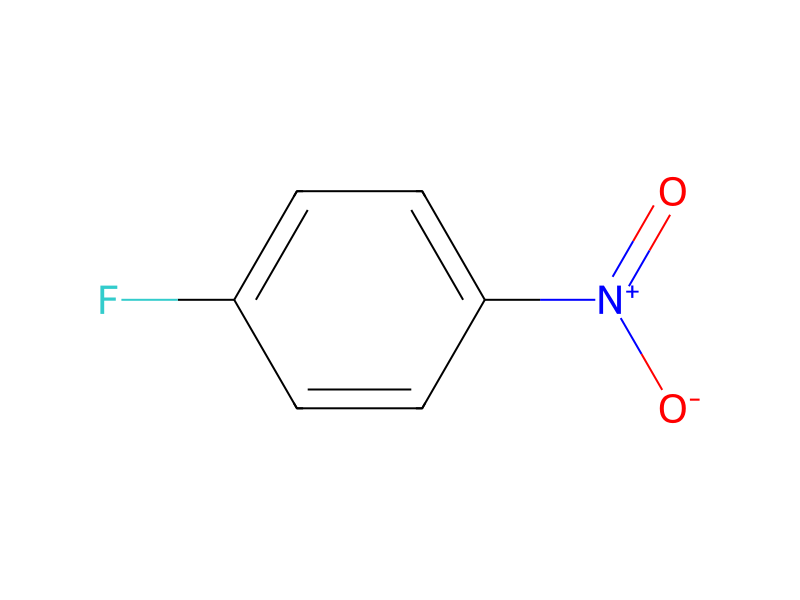





Conditions
- Temperature
- 70 °C
Procedure
To a stirring slurry of NaH (1.1 g, 44.9 mmol) in DMF (40 mL) at 0° C. was added a solution of 5-hydroxyisoindoline-1,3-dione (3.2 g, 19.6 mmol) in DMF (40 mL) dropwise. The bright yellow-green mixture was allowed to return to room temp. and was stirred for 1 h, then 1-fluoro-4-nitrobenzene (2.67 g, 18.7 mmol) was added via syringe in 3-4 portions. The resulting mixture was heated at 70° C. overnight, then cooled to room temp. and diluted slowly with water (150 mL), and extracted with EtOAc (2×100 mL). The combined organic layers were dried (MgSO4) and concentrated under reduced pressure to give 5-(4-nitrophenoxy)isoindoline-1,3-dione as a yellow solid (3.3 g, 62%): TLC (30% EtOAc/70% hexane) Rf 0.28; 1H NMR (DMSO-d6) δ 7.32 (d, J=12 Hz, 2H), 7.52-7.57 (m, 2H), 7.89 (d, J=7.8 Hz, 1H), 8.29 (d, J=9 Hz, 2H), 11.43 (br s, 1H); CI-MS m/z 285 ((M+H)+, 100%).
Workup
- customto return to room temp.
- temperaturecooled to room temp.
- extractionextracted with EtOAc (2×100 mL)
- dry with materialThe combined organic layers were dried (MgSO4)
- concentrationconcentrated under reduced pressure
Sources & evidence
- ORD record
- ord-9fca4fd2c7964318b0e88d824348ef65
- Source dataset
- uspto-grants-2008_04
- Patent number
- US07351834B1
Reaction notes
Loading…