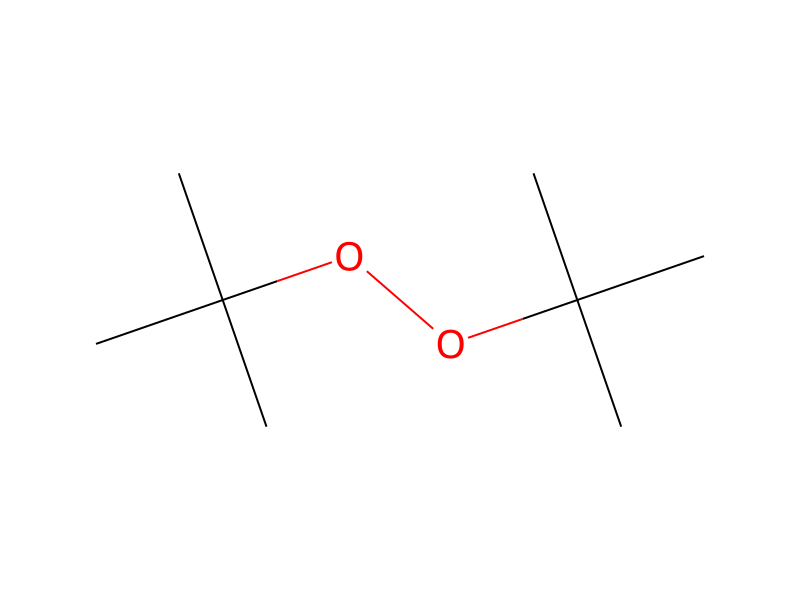
Dicumyl peroxide → Di-tert-butyl peroxide
Reaction equation

C(OOC(C1C=C(C=CC=1C(OOC(C)(C)C)=O)C(C1C=CC(C(OOC(C)(C)C)=O)=C(C(OOC(C)(C)C)=O)C=1)=O)=O)(C)(C)C.[C:47]([O:56][O:57][C:58]([C:61]1C=CC=CC=1)([CH3:60])[CH3:59])([C:50]1C=CC=CC=1)([CH3:49])[CH3:48]>>[CH3:48][C:47]([O:56][O:57][C:58]([CH3:61])([CH3:60])[CH3:59])([CH3:50])[CH3:49]Participants


Procedure
The initiator can be any known polymerization initiator which decomposes during the cure cycle. Suitable initiators include organic peroxide compounds, such as peroxy ketals (e.g., 1,1-bis(t-hexylperoxy)-3,3,5-trimethylcyclohexane, 1,1-bis(t-hexylperoxy)cyclohexane, 1,1-bis(t-butylperoxy)cyclododecane, n-butyl-4,4-bis(t-butylperoxy)valerate, 2,2-bis(4,4-di-t-butylperoxycyclohexyl)propane, 1,1-di(t-butylperoxy)-3,3,5-trimethylcyclohexane, 1,1-bis(t-butylperoxy)cyclohexane, 2,2-bis(t-butylperoxy)butane, 2,2-bis(t-butylperoxy)octane), dialkyl peroxide (e.g., dicumylperoxide (DCP), α,α-bis(t-butylperoxy)diisopropylbenzene (DTBP), 2,5-dimethyl-2,5-di(t-butylperoxy)hexane, di-t-butylperoxide, di-t-amylperoxide, t-butylcumylperoxide, di(2-methyl-1-phenyl-2-propyl)peroxide, t-butyl-2-methyl-1-phenyl-2-propylperoxide, 2,5-dimethyl-2,5-di(t-butylperoxy)hexyne-3, di(2-t-butyl-peroxyisopropyl)benzeneperoxide), diacyl peroxides (e.g., isobutyryl peroxide, 2,4-dichlorobenzoyl peroxide, 3,5,5-trimethylhexanoyl peroxide, m-toluoylbenzoyl peroxide, benzoylperoxide, m-toluoylperoxide, 2,5-dimethyl-2,5-di(benzoylperoxy)hexane, acetyl peroxide, propionylperoxide, octanoylperoxide, decanoylperoxide, lauroylperoxide, stearoylperoxide, succinic acid peroxide, t-butyl-peroxymaleic acid), peroxy esters (e.g., .alpha.,.alpha.-bis(neodecanoyl peroxy)diisopropylbenzene, cumyl peroxy neodecanoate, 1,1,3,3-tetramethylbutyl peroxyneodecanoate, 1-cyclohexyl-1-methylethyl peroxyneodecanoate, t-hexyl peroxyneodecanoate, t-butyl peroxyneodecanoate, t-hexyl peroxypivarate, t-butyl peroxypivarate, 1,1,3,3-tetramethylbutyl peroxy-2-ethylhexanoate, 2,5-dimethyl-2,5-bis(2-ethylhexanoyl peroxy)hexane, 1-cyclohexyl-1-methylethyl peroxy-2-ethylhexanoate, t-hexyl peroxy-2-ethylhexanoate, t-butyl peroxy-2-ethylhexanoate, t-hexyl peroxyisopropyl monocarbonate, t-butyl peroxymaleic acid, 2,5-dimethyl-2,5-bis(m-toluoyl peroxy)hexane, t-butyl peroxy-2-ethylhexyl monocarbonate, t-hexyl peroxy benzoate, 2,5-dimethyl-2,5-bis(benzoyl peroxy)hexane, t-butyl peroxy-m-toluoyl benzoate, bis(t-butyl peroxy)isophthalate, t-butyl-peroxyisopropylcarbonate, t-butylperoxyacetate, t-butylperoxyisobutyrate, t-butylperoxy-3,5,5-trimethylhexanoate, t-butylperoxylaurate, t-butylperoxybenzoate), ketone peroxides (e.g., methylcyclohexanone peroxide, methylacetoacetate peroxide, acetylacetone peroxide, methylethylketone peroxide, cyclohexanone peroxide), hydroperoxides (e.g., t-hexyl hydroperoxide, t-butylhydroperoxide, p-menthanehydroperoxide, 1,1,3,3-tetramethylbutylhydroperoxide, 2,5-dimethylhexane-2,5-dihydroperoxide, cumenehydroperoxide, diisopropylbenzenehydroperoxide), peroxydicarbonates (e.g., di-n-propyl peroxydicarbonate, diisopropyl peroxydicarbonate, bis(4-t-butylcyclohexyl) peroxydicarbonate, di-2-ethoxyethyl peroxydicarbonate, di-2-ethylhexyl peroxydicarbonate, di-2-methoxybutyl peroxydicarbonate, di(3-methyl-3-methoxybutyl) peroxydicarbonate), t-butyltrimethylsilyl proxide, 3,3′,4,4′-tetra(t-butyl peroxycarbonyl)benzophenone, and mixtures of two or more thereof. DCP is the most commonly used peroxide in golf ball manufacturing. DTBP can provide higher crosslinking efficiency, low odor and longer scorch time, among some properties. DCP can be blended with DTBP for use in golf balls. Other examples include, but are not limited to, VAROX® 231 XL and Varox® DCP-R, commercially available from Elf Atochem of Philadelphia, Pa., PERKODOX® BC and PERKODOX® 14, commercially available from Akzo Nobel of Chicago, Ill., and ELASTOCHEM® DCP-70, commercially available from Rhein Chemie of Trenton, N.J.
Workup
- customany known polymerization initiator which
Sources & evidence
- ORD record
- ord-e2205511d1cb42f3909f806784eb6387
- Source dataset
- uspto-grants-2008_04
- Patent number
- US07358308B2
Reaction notes
Loading…