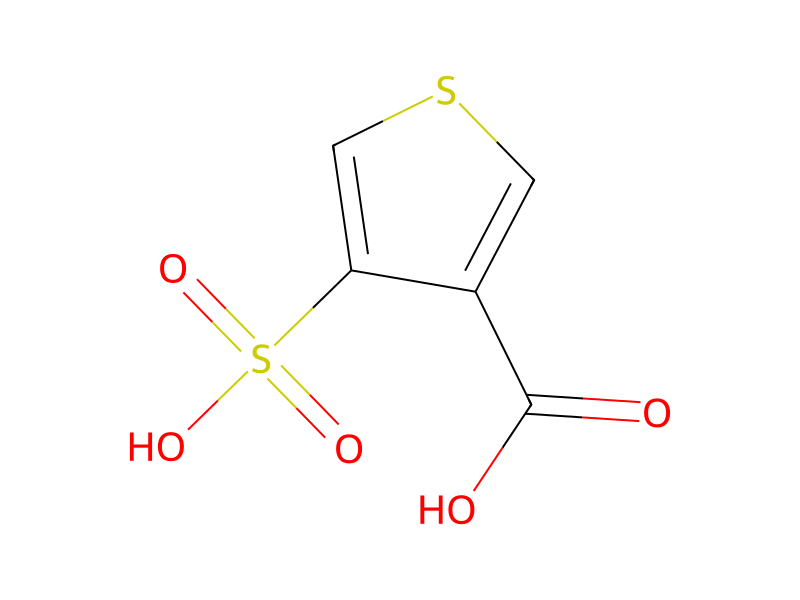
Sodium Hydroxide → 4-Sulfothiophene-3-carboxylic acid
Reaction equation

[OH-].[Na+].[S:3](=[O:6])([OH:5])[O-:4].[Na+].Cl[C:9]1[C:10]([C:14]([OH:16])=[O:15])=[CH:11][S:12][CH:13]=1>O.[Cu]Cl>[S:3]([C:9]1[C:10]([C:14]([OH:16])=[O:15])=[CH:11][S:12][CH:13]=1)([OH:5])(=[O:4])=[O:6]Participants





Conditions
- Temperature
- 143 °C
Procedure
In a glass autoclave, 8.6 g of 4-chlorothiophene-3-carboxylic acid are dissolved in 23 ml of water containing 2.1 g of sodium hydroxide, whereupon a solution of 5.6 g of sodium bisulphite in 16 ml of water is added and the solution made just alkaline with a 30% sodium hydroxide solution. The solution is treated with 0.43 g of copper (I) chloride and heated at 143° C. for 16 hours. After cooling, the red copper oxide is filtered off under suction. The filtrate is acidified with 7 ml of concentrated hydrochloric acid and the unreacted starting material precipitates out, the latter being removed by shaking out with ether. The acidic solution is treated with 12 g of potassium chloride while warming and, after cooling to 0° C., the potassium salt of 4-sulphothiophene-3-carboxylic acid separates as colourless crystals. The crystals are dissolved in 50 ml of water and the solution passed through an ion-exchange column which is charged with protons, after which the column is rinsed with water until the solution flowing out has a pH value of 5. The eluate is evaporated to dryness in vacuo. There is obtained 4-sulphothiophene-3-carboxylic acid as a crystalline residue of melting point 154° C. (recrystallisation from water).
Workup
- additionis added
- temperatureAfter cooling
- filtrationthe red copper oxide is filtered off under suction
- customprecipitates out
- customthe latter being removed
- additionThe acidic solution is treated with 12 g of potassium chloride
- temperaturewhile warming
- temperatureafter cooling to 0° C.
- dissolutionThe crystals are dissolved in 50 ml of water
- additionis charged with protons
- washafter which the column is rinsed with water until the solution
- customThe eluate is evaporated to dryness in vacuo
Sources & evidence
- ORD record
- ord-50955a95a1b84fe5bc49e568046a2eb8
- Source dataset
- uspto-grants-1980_10
- Patent number
- US04230873
Reaction notes
Loading…