Water → 3-(4-chlorophenyl)-5-(1H-pyrrol-1-yl)-1,2,4-thiadiazole
Reaction equation

Cl[C:2]1[S:6][N:5]=[C:4]([C:7]2[CH:12]=[CH:11][C:10]([Cl:13])=[CH:9][CH:8]=2)[N:3]=1.[NH:14]1[CH:18]=[CH:17][CH:16]=[CH:15]1.[H-].[Na+].O>CS(C)=O>[Cl:13][C:10]1[CH:11]=[CH:12][C:7]([C:4]2[N:3]=[C:2]([N:14]3[CH:18]=[CH:17][CH:16]=[CH:15]3)[S:6][N:5]=2)=[CH:8][CH:9]=1Participants

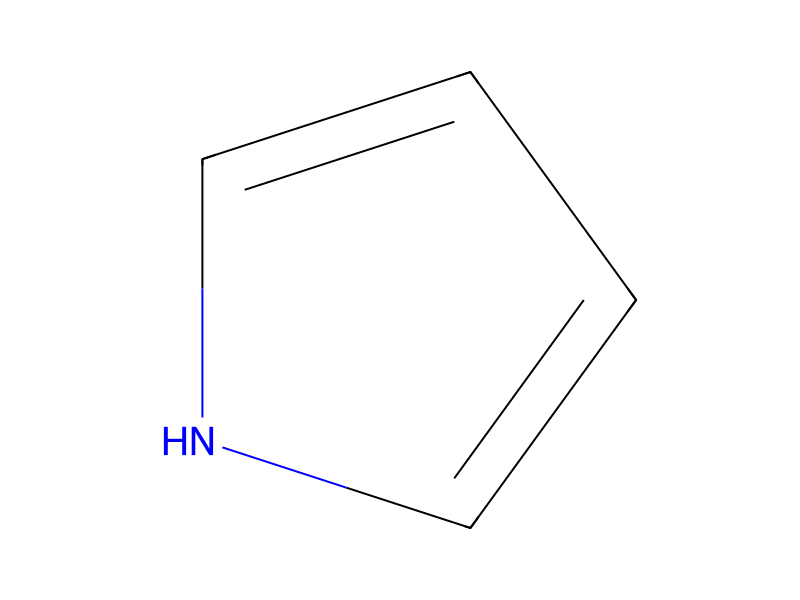




Conditions
- Temperature
- 80 °C
Procedure
The 5-chloro-1,2,4-thiadiazole compound (102 mg, 0.445 mmol) was dissolved in DMSO (2 mL) and pyrrol (300 mg, 2.22 mmol) added at room temperature. The mixture was heated for 18 h to 55° C. ext. temperature, however no conversion was found (sample tested by 1H-NMR). Sodium hydride (55% wetted with mineral oil, 20 mg, 0.467 mmol) was added and the mixture heated to 80° C. ext. temperature for 5 h. As the conversion was not complete (sample tested by 1H-NMR) the mixture was heated to 100° C. ext. temperature for 6 h. The reaction mixture was poured into water (10 mL) and crude product isolated by filtration. The purification by column chromatography (SiO2, 0-10% ethyl acetate inheptanes) afforded 3-(4-chlorophenyl)-5-(1H-pyrrol-1-yl)-1,2,4-thiadiazole (52 mg, 0.199 mmol, 45%), which was 98% pure (HPLC 254 nm). 1H-NMR spectra is in accordance with the chemical structure.
Workup
- temperatureThe mixture was heated for 18 h to 55° C. ext
- temperaturewas heated to 100° C. ext
- waittemperature for 6 h
- customisolated by filtration
- customThe purification by column chromatography (SiO2, 0-10% ethyl acetate inheptanes)
Sources & evidence
- ORD record
- ord-6028836f3b0647c694547bed887d7c31
- Source dataset
- uspto-grants-2011_09
- Patent number
- US08017555B2
Reaction notes
Loading…