Sodium Bicarbonate → (R)-1-(4-trifluoromethoxy-benzenesulfonyl)-piperazine-2-carboxylic acid 4-propyl-benzylamide
Reaction equation

FC(F)(F)OC1C=CC(CNC([C@H]2CNCCN2S(C2C=CC(OC(F)(F)F)=CC=2)(=O)=O)=O)=CC=1.O.ON1C2C=CC=CC=2N=N1.Cl.C(N=C=NCCCN(C)C)C.C(=O)([O-])O.[Na+].C(OC([N:71]1[CH2:76][CH2:75][N:74]([S:77]([C:80]2[CH:85]=[CH:84][C:83]([O:86][C:87]([F:90])([F:89])[F:88])=[CH:82][CH:81]=2)(=[O:79])=[O:78])[C@@H:73]([C:91](=[O:103])[NH:92][CH2:93][C:94]2[CH:99]=[CH:98][C:97]([CH2:100][CH2:101][CH3:102])=[CH:96][CH:95]=2)[CH2:72]1)=O)(C)(C)C.Cl.O1CCOCC1>CN(C)C=O.O1CCOCC1.O>[CH2:100]([C:97]1[CH:96]=[CH:95][C:94]([CH2:93][NH:92][C:91]([C@H:73]2[CH2:72][NH:71][CH2:76][CH2:75][N:74]2[S:77]([C:80]2[CH:85]=[CH:84][C:83]([O:86][C:87]([F:89])([F:90])[F:88])=[CH:82][CH:81]=2)(=[O:79])=[O:78])=[O:103])=[CH:99][CH:98]=1)[CH2:101][CH3:102]Participants
Reactant 6
 HCID 516892Sodium Bicarbonate
 HCID 27239391,3-Propanediamine, N'-(ethylcarbonimidoyl)-N,N-dimethyl-, monohydrochloride
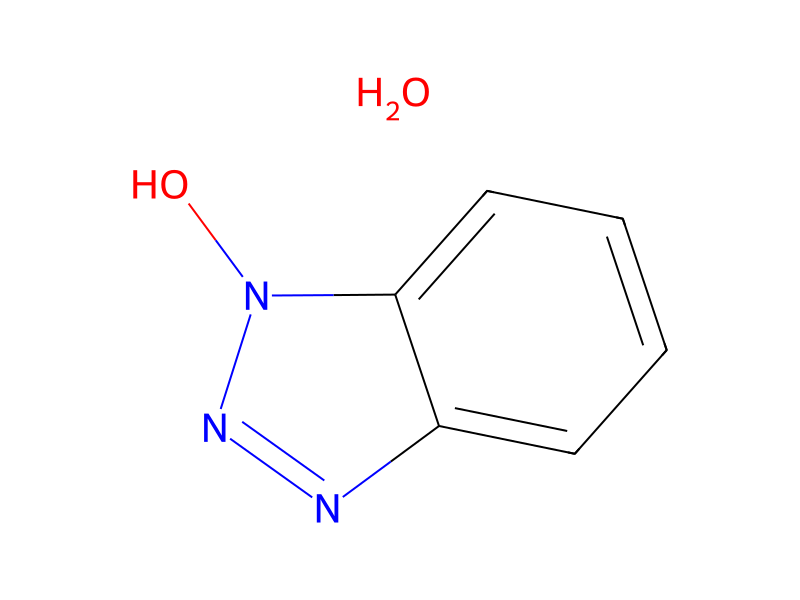 HCID 27960291-Hydroxybenzotriazole hydrate
 HCID 204431481,4-Dioxane hydrochloride2×
 HCID 59703800(R)-1-(4-trifluoromethoxy-benzenesulfonyl)-piperazine-2-carboxylic acid 4-trifluoromethoxy-benzylamide
 HCID 59703804(r)-3-(4-Propyl-benzylcarbamoyl)-4-(4-trifluoromethoxy-benzenesulfonyl)-piperazine-1-carboxylic acid tert-butyl ester
Product 1

Reagents, catalysts & solvents 3



Procedure
To a solution of the compound (6.65 g) obtained in Example 783, Step 2,4-propylbenzylamine (3.26 g) and 1-hydroxybenzotriazole hydrate (2.69 g) in N,N-dimethylformamide (33 ml) was added, with stirring under ice-cooling, 1-ethyl-3-(3-dimethylaminopropyl) carbodiimide hydrochloride (3.37 g). After stirring overnight at room temperature, saturated aqueous sodium hydrogen carbonate solution and water were added under ice-cooling, and the mixture was stirred at room temperature. The precipitated solid was collected by filtration, washed with water, and dried under reduced pressure to give a crude product (7.40 g). This was purified by silica gel column chromatography (ethyl acetate:n-hexane=1:2) to give a crude product containing (R)-3-(4-propyl-benzylcarbamoyl)-4-(4-trifluoromethoxy-benzenesulfonyl)-piperazine-1-carboxylic acid tert-butyl ester as a main component. The obtained crude product was dissolved in 1,4-dioxane (40 ml), 4N hydrogen chloride/1,4-dioxane solution (50 ml) was added at room temperature, and the mixture was stirred at room temperature for 2 hr. Further, 4N hydrogen chloride/1,4-dioxane solution (20 ml) was added, and the mixture was stirred at room temperature for 1 hr. The reaction mixture was concentrated under reduced pressure, and the residue was partitioned by adding saturated aqueous sodium hydrogen carbonate solution and ethyl acetate. The organic layer was washed with saturated brine, dried over anhydrous sodium carbonate, filtrated, and concentrated under reduced pressure to give a crude product (3.70 g) containing the title compound as a main component. The residue was crystallized from a mixed solvent of diisopropyl ether and n-hexane, and collected by filtration. The obtained crude crystals were suspended in diisopropyl ether, collected by filtration and dried to give the title compound (3.0 g).
Workup
- temperaturecooling
- stirringAfter stirring overnight at room temperature
- temperaturecooling
- stirringthe mixture was stirred at room temperature
- filtrationThe precipitated solid was collected by filtration
- washwashed with water
- customdried under reduced pressure
- customto give a crude product (7.40 g)
- customThis was purified by silica gel column chromatography (ethyl acetate:n-hexane=1:2)
- customto give a crude product
- customThe obtained crude product
- stirringthe mixture was stirred at room temperature for 2 hr
- stirringthe mixture was stirred at room temperature for 1 hr
- concentrationThe reaction mixture was concentrated under reduced pressure
- customthe residue was partitioned
- additionby adding saturated aqueous sodium hydrogen carbonate solution and ethyl acetate
- washThe organic layer was washed with saturated brine
- dry with materialdried over anhydrous sodium carbonate
- filtrationfiltrated
- concentrationconcentrated under reduced pressure
- customto give a crude product (3.70 g)
Sources & evidence
- ORD record
- ord-01a0c08a2ab7454e865a5675a3169418
- Source dataset
- uspto-grants-2011_09
- Patent number
- US08017612B2
Reaction notes
Loading…