1,2-Dimethoxyethane → 1-Bromo-4-phenylnaphthalene
Reaction equation

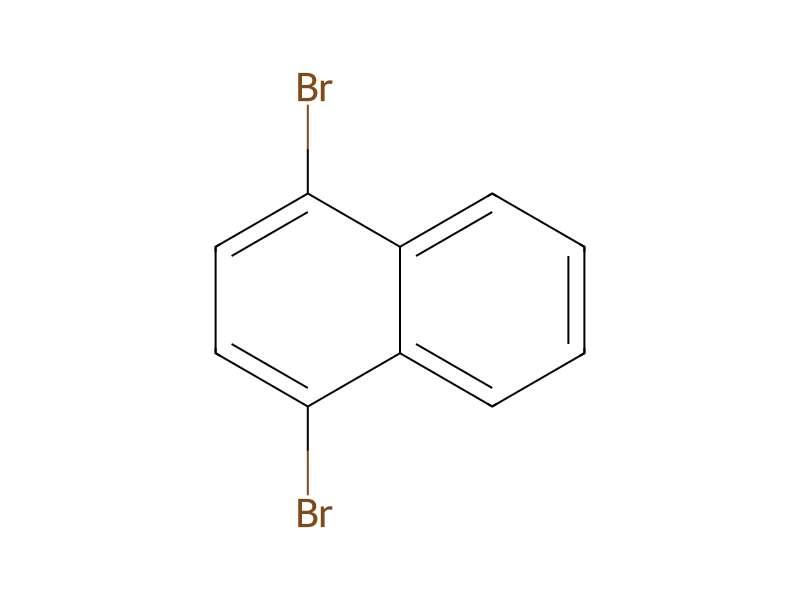
[C:1]1(B(O)O)[CH:6]=[CH:5][CH:4]=[CH:3][CH:2]=1.Br[C:11]1[C:20]2[C:15](=[CH:16][CH:17]=[CH:18][CH:19]=2)[C:14]([Br:21])=[CH:13][CH:12]=1.C(COC)OC.C(=O)([O-])[O-].[Na+].[Na+]>C1C=CC([P]([Pd]([P](C2C=CC=CC=2)(C2C=CC=CC=2)C2C=CC=CC=2)([P](C2C=CC=CC=2)(C2C=CC=CC=2)C2C=CC=CC=2)[P](C2C=CC=CC=2)(C2C=CC=CC=2)C2C=CC=CC=2)(C2C=CC=CC=2)C2C=CC=CC=2)=CC=1.O.C1(C)C=CC=CC=1>[Br:21][C:14]1[C:15]2[C:20](=[CH:19][CH:18]=[CH:17][CH:16]=2)[C:11]([C:1]2[CH:6]=[CH:5][CH:4]=[CH:3][CH:2]=2)=[CH:12][CH:13]=1Participants
8
Reactant 4



Product 1

Reagents, catalysts & solvents 3



Conditions
- Temperature
- 78 °C
Procedure
Under an argon gas atmosphere, 128.0 g (1.049 mol) of phenylboronic acid, 300.0 g (1.163 mol) of 1.4-dibromonaphthalene, 24.2 g (21.0 mmol) of tetrakis(triphenylphosphine)palladium(0), 4.3 L of dimethoxyethane and 1.60 L of 2M sodium carbonate solution were mixed, and stirred for 24 hours at 78 degrees C. The reaction mixture was further added with toluene and water, and then aqueous phase thereof was eliminated. After organic phase thereof was cleansed by water and dried with magnesium sulfate, toluene was distilled away under reduced pressure. By refining residue thereof by silica-gel column chromatography and by recrystallizing the residue by hexane, 122 g of 1-bromo-4-phenyl naphthalene was obtained with an yield of 41%.
Workup
- dry with materialdried with magnesium sulfate, toluene
- distillationwas distilled away under reduced pressure
- customby silica-gel column chromatography and by recrystallizing the residue by hexane
Sources & evidence
- ORD record
- ord-0c898c0cdae3494190d8a289e27c8731
- Source dataset
- uspto-grants-2011_09
- Patent number
- US08021574B2
Reaction notes
Loading…