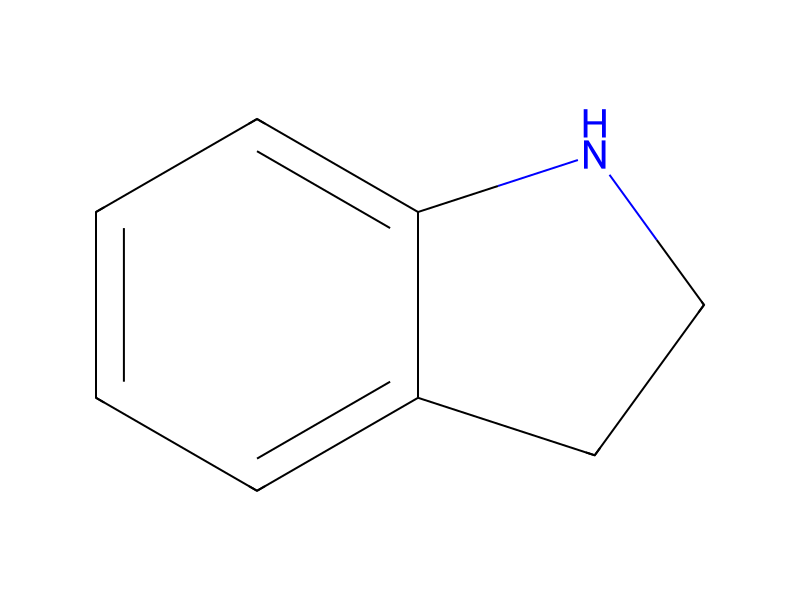
Indoline → HCID 12524226, compound
Reaction equation

FC(F)(F)S(OS(C(F)(F)F)(=O)=O)(=O)=O.CN(C)[C:18](=[O:21])[CH:19]=[CH2:20].[NH:23]1[C:31]2[C:26](=[CH:27][CH:28]=[CH:29][CH:30]=2)[CH2:25][CH2:24]1>ClC(Cl)C>[CH2:25]1[C:26]2=[C:31]3[C:30](=[CH:29][CH:28]=[CH:27]2)[C:18](=[O:21])[CH2:19][CH2:20][N:23]3[CH2:24]1Participants
Reactant 3


Product 1

Reagents, catalysts & solvents 1

Procedure
Add trifluoromethanesulfonic anhydride (10.5 mL, 63 mmol) in dichloroethane (30 mL) to N,N-dimethylacrylamide (6.4 mL, 63 mmol) in dichloroethane (100 mL) at 0° C. dropwise with vigorous stirring over 5 minutes. Add indoline (5.6 mL, 50 mmol) in dichloroethane (30 mL) dropwise over 5 minutes. Remove from cooling bath and heat at reflux for 3.5 hours. Cool to room temperature. Dilute with diethyl ether (600 mL). Wash with aqueous potassium carbonate (400 mL), dilute aqueous sodium bicarbonate (2×300 mL) and saturated aqueous sodium chloride (300 mL). Dry over sodium sulfate and concentrate under reduced pressure. Subject the residue to chromatography (pre-packed silica gel), eluting with 19:1 dichloromethane/ethyl acetate to provide the desired compound (2.65 g, 31%).
Workup
- customRemove
- temperaturefrom cooling bath
- temperatureheat
- temperatureat reflux for 3.5 hours
- additionDilute with diethyl ether (600 mL)
- washWash with aqueous potassium carbonate (400 mL), dilute aqueous sodium bicarbonate (2×300 mL) and saturated aqueous sodium chloride (300 mL)
- dry with materialDry over sodium sulfate
- concentrationconcentrate under reduced pressure
- washeluting with 19:1 dichloromethane/ethyl acetate
Sources & evidence
- ORD record
- ord-550b0a72785344b2be2bbfd795be069a
- Source dataset
- uspto-grants-2011_09
- Patent number
- US08022065B2
Reaction notes
Loading…