Ethylbenzene → 4-Hydroxypentan-2-one
Reaction equation

C=CC1C=CC=CC=1.C1(C#C)C=CC=CC=1.C(C1C=CC=CC=1)C.C1CCCCC=1.C=CCCCC.[C:37]([CH2:40][C:41](=[O:43])[CH3:42])(=[O:39])[CH3:38]>C(O)(C)C.CC(C)=O>[CH3:42]/[C:41](/[O-:43])=[CH:40]/[C:37]([CH3:38])=[O:39].[OH:43][CH:41]([CH3:42])[CH2:40][C:37](=[O:39])[CH3:38]Participants



Procedure
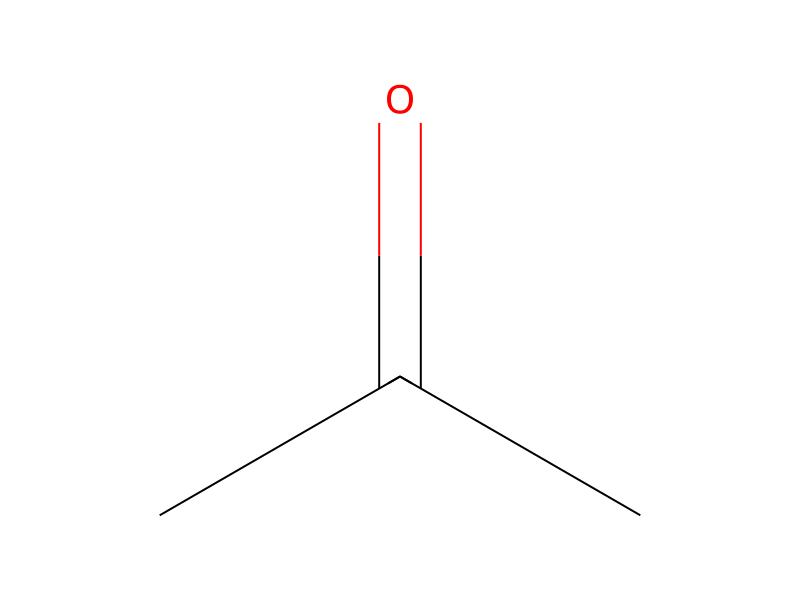
To study the scope of the catalytic activity of the SiO2@Pd-PAMAM microspheres, the catalytic hydrogenation reactions of substrates other than styrene were explored (Table 3). For instance, the SiO2@Pd-PAMAM core-shell microspheres catalyzed the hydrogenation of phenylacetylene to ethylbenzene. The hydrogenation of phenylacetylene was found to be slightly slower than that of styrene (Table 3, entry 4). This was, however, to be expected considering the fact that the hydrogenation of phenylacetylene to ethylbenzene goes through two hydrogenation steps, i.e., phenylacetylene to styrene and then styrene to ethylbenzene. The catalyst, nevertheless, still exhibited high catalytic activity and TOF even for such two-step hydrogenation reaction. The hydrogenation of another reactant, cyclohexene, took place with almost ˜100% conversion in 20 minutes in the presence of the SiO2@Pd-PAMAM core-shell microspheres under the same reaction condition (Table 3, entry 5). In addition, the SiO2@Pd-PAMAM core-shell microspheres catalyzed n-hexene with ˜100% conversion in 60 minutes (Table 3, entry 6). More interestingly, although ketones undergo hydrogenation rather relatively slowly (Deshmukh et al. (2008) Catal. Lett., 120:257-260), the SiO2@Pd-PAMAM core-shell microspheres catalyzed the hydrogenation of acetone and acetylacetone efficiently and with high TOF. The catalytic hydrogenation of acetone with SiO2@Pd-PAMAM core-shell microspheres gave a sole product, isopropanol, with ˜100% conversion in 2 hours at 50° C., whereas the catalytic hydrogenation acetylacetonate gave 4-hydroxypentan-2-one with 95% conversion in 2 hours (Table 3, entries 7 and 8).
Workup
- customThe catalyst, nevertheless, still exhibited high catalytic activity and TOF even for such two-step hydrogenation reaction
- customin 20 minutes
- customin 60 minutes
Sources & evidence
- ORD record
- ord-5d8d880ac3314ce881507fa5db2fb781
- Source dataset
- uspto-grants-2016_03
- Patent number
- US09283545B2
Reaction notes
Loading…