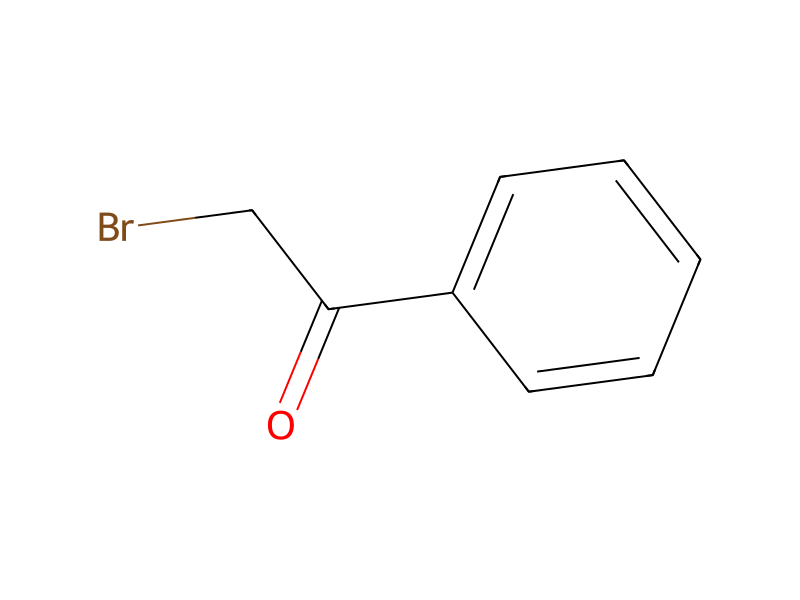
Phenacyl bromide → HCID 86725347, compound
Reaction equation

[F:1][C:2]([F:19])([F:18])[C:3]([N:5]1[CH2:11][CH2:10][C:9]2[CH:12]=[C:13]([OH:17])[C:14]([I:16])=[CH:15][C:8]=2[CH2:7][CH2:6]1)=[O:4].Br[CH2:21][C:22]([C:24]1[CH:29]=[CH:28][CH:27]=[CH:26][CH:25]=1)=[O:23].C(=O)([O-])[O-].[K+].[K+]>CC(C)=O>[F:19][C:2]([F:1])([F:18])[C:3]([N:5]1[CH2:6][CH2:7][C:8]2[CH:15]=[C:14]([I:16])[C:13]([O:17][CH2:21][C:22](=[O:23])[C:24]3[CH:29]=[CH:28][CH:27]=[CH:26][CH:25]=3)=[CH:12][C:9]=2[CH2:10][CH2:11]1)=[O:4]Participants
5
Reactant 3


Product 1

Reagents, catalysts & solvents 1

Procedure
Dry acetone (6 ml) was added to a flask containing the product from step (a) (0.528 g, 1.3 mmol). To this was added 2-Bromo-1-phenyl-ethanone (0.327 g, 1.6 mmol, 1.2 eq) and potassium carbonate (0.378 g, 2.7 mmol, 2.0 eq). The reaction mixture was allowed to stir for 16 hours at room temperature. The acetone was removed under vacuum and the solid was dissolved in dichloromethane, washed with 4N HCl, and brine. Purification by silica-gel chromatography (gradient elution: 0-100% EtOAc in hexanes) gave the sub-title compound as a white solid (552 mg). MS: ESI (positive): 504 (M+H).
Workup
- customThe acetone was removed under vacuum
- dissolutionthe solid was dissolved in dichloromethane
- washwashed with 4N HCl, and brine
- customPurification
- washby silica-gel chromatography (gradient elution: 0-100% EtOAc in hexanes)
Sources & evidence
- ORD record
- ord-b39f718ccaeb4a50b8541e495da9be38
- Source dataset
- uspto-grants-2016_03
- Patent number
- US09284277B2
Reaction notes
Loading…