Oxalyl chloride → 3-(Methyl(2-morpholinoethyl)carbamoyl)benzoyl chloride
Reaction equation
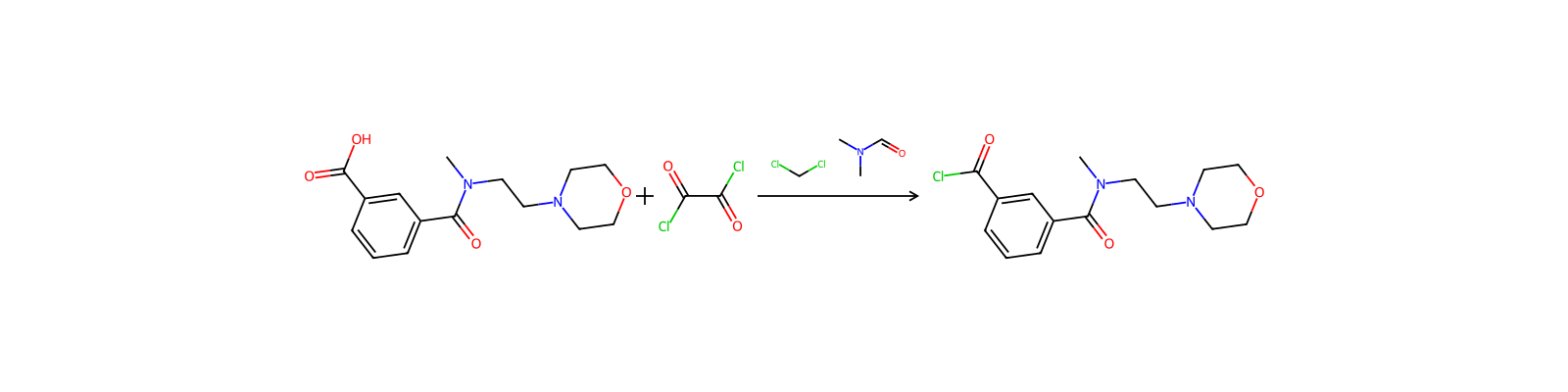
[CH3:1][N:2]([CH2:14][CH2:15][N:16]1[CH2:21][CH2:20][O:19][CH2:18][CH2:17]1)[C:3]([C:5]1[CH:6]=[C:7]([CH:11]=[CH:12][CH:13]=1)[C:8](O)=[O:9])=[O:4].C(Cl)(=O)C([Cl:25])=O>ClCCl.CN(C)C=O>[CH3:1][N:2]([CH2:14][CH2:15][N:16]1[CH2:21][CH2:20][O:19][CH2:18][CH2:17]1)[C:3]([C:5]1[CH:6]=[C:7]([CH:11]=[CH:12][CH:13]=1)[C:8]([Cl:25])=[O:9])=[O:4]Participants
5





Conditions
- Temperature
- 50 °C
Procedure
To 3-(methyl(2-morpholinoethyl)carbamoyl)benzoic acid (1.37 g, 4.69 mmol, 1.00 equiv) in dichloromethane (17 mL) was added 2 drops of N,N-dimethylformamide followed by the addition of oxalyl dichloride (3.63 g, 28.14 mmol, 6.00 equiv). The resulting solution was stirred for 1 h at 50° C. in an oil bath then concentrated under vacuum to afford 1.41 g (87%) of 3-(methyl(2-morpholinoethyl)carbamoyl)benzoyl chloride as a gray-yellow solid.
Workup
- concentrationthen concentrated under vacuum
Sources & evidence
- ORD record
- ord-28f686a2fff5475e934e54b7d39b721d
- Source dataset
- uspto-grants-2016_03
- Patent number
- US09289430B2
Reaction notes
Loading…