Isopropenyl acetate → HCID 13710978, compound
Reaction equation

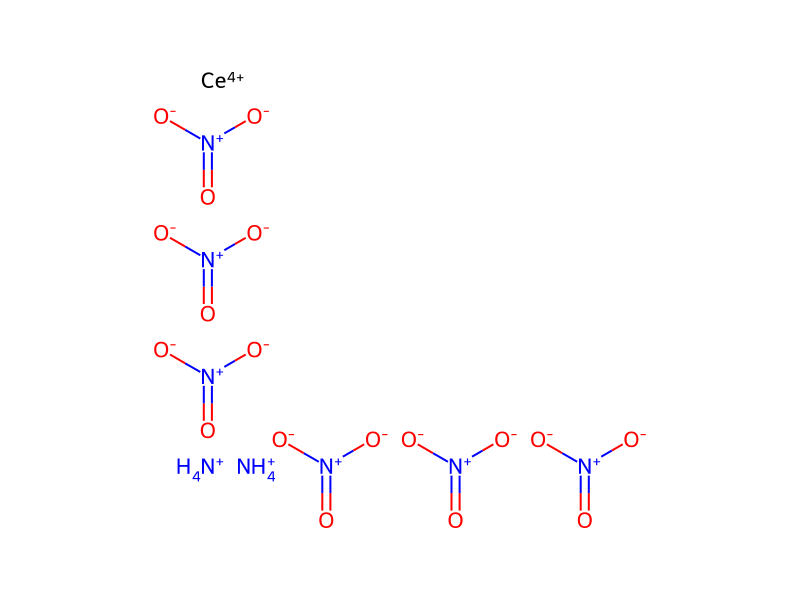
O=[N+]([O-])[O-].[O-][N+](=O)[O-].[O-][N+](=O)[O-].[O-][N+](=O)[O-].[O-][N+](=O)[O-].[O-][N+](=O)[O-].[Ce+4].[NH4+].[NH4+].[CH3:28][Si:29]([CH3:36])([CH3:35])/[CH:30]=[CH:31]/[C:32](=[O:34])[CH3:33].[C:37](OC(C)=C)(=[O:39])[CH3:38]>>[C:37]([O:34][C:32](/[CH:31]=[CH:30]/[Si:29]([CH3:36])([CH3:35])[CH3:28])=[CH2:33])(=[O:39])[CH3:38]Participants



Procedure
In a typical example, wherein R is acetyloxy and X is hydrogen, 3-butyne-2-ol (I) is reacted with butyl lithium and chlorotrimethylsilane and then with acid to give 4-(trimethylsilyl)-3-butyn-3-ol (II) which is hydrogenated in the presence of quinoline and benzene with palladium on barium sulfate as catalyst to give cis-4-(trimethylsilyl)-3-buten-2-ol (III). cis-4-(Trimethylsilyl)-3-buten-2-ol (III) is treated with Jones Reagent (a solution of chromic acid and sulfuric acid in water) at a temperature below 10° C. and the product is equilibrated with acid to give trans-4-(trimethylsilyl)-3-buten-2-one (IV). The preparation of this compound has been previously described [R. A. Felix, et. al. J. ORG. CHEM. 37, 2323 (1972), and H. G. Brook, CAN. J. CHEM. 51, 2024 (1973)]. trans-4-(Trimethylsilyl)-3-buten-2-one (IV) is reacted with isopropenyl acetate in the presence of acid to give trans-2-(acetyloxy)-4-(trimethylsilyl)-1,3-butadiene (V). trans-2-(Acetyloxy)-4-(trimethylsilyl)-1,3-butadiene (V) is reacted with quinizarinquinone to produce (±)- 3-(acetyloxy)-1,4,4aβ,12aβ-tetrahydro-1α-(trimethylsilyl)-5,6,11,12-naphthacenetetrone (VI). The reaction is typically carried out at a temperature of 45°-50° C. over a period of 96 hours. Chemical reduction or hydrogenation of (±)-3-(acetyloxy)-1,4,4aβ,12aβ-tetrahydro-1α-(trimethylsilyl)-5,6,11,12-naphthacenetetrone (VI) using palladium on barium sulfate as catalyst provides (±)-3-(acetyloxy)-1,4,4aβ,12aβ-tetrahydro-6,11-dihydroxy-1α-(trimethylsilyl)-5,12-naphthacenedione (VII) which is refluxed with methanol and hydrochloric acid to give (±)-1,2,3,4,4aβ,12aβ-hexahydro-6,11-dihydroxy-3,3-dimethoxy-1α-(trimethylsilyl)-5,12-naphthacenedione (VIII) which is then reacted with trifluoroacetic acid and water to yield (±)-3,4,4aβ,12aβ-tetrahydro-6,11-dihydroxy-1α-(trimethylsilyl)-2,5,12(1H)-naphthacenetrione (IX). (±)-3,4,4aβ,12aβ-tetrahydro-6,11-dihydroxy-1α-(trimethylsilyl)-2,5,12(1H)-naphthacenetrione (IX) is converted to (±)-3-ethynyl-1,2,3,4,4aβ,12aβ-hexahydro-3β,6,11-trihydroxy-1α-(trimethylsilyl)-5,12-naphthacenedione (X) via a Grignard reaction. Compound X is stirred with isopropenyl acetate and acid for 20 hours at room temperature to give (±)-3β-(acetyloxy)-3-ethynyl-1,2,3,4,4aβ,12aβ-hexahydro-6,11-dihydroxy-1α-(trimethylsilyl)-5,12-naphthacenedione (XII) which is then oxidized with lead tetraacetate to provide (±)-3β-(acetyloxy)-3-ethynyl-1,2,3,4,4aβ,12aβ-hexahydro-1α-(trimethylsilyl)-5,6,11,12-naphthacenetetrone (XIII). Alternately, compound X is oxidized with lead tetraacetate to yield (±)-3-ethynyl-1,2,3,4,4aβ,12aβ-hexahydro-3β-hydroxy-1α-(trimethylsilyl)-5,6,11,12-naphthacenetetrone (XI) which is then heated with isopropenylacetate and acid to provide XIII. Heating XIII with potassium acetate and acetic acid yields trans-(±)-9-(acetyloxy)-9-ethynyl-7,8,9,10-tetrahydro-6,11-dihydroxy-1-(trimethylsilyl)-5,12-naphthacenedione (XIV) which is heated with isopropenyl acetate and acid to give trans-(±)-9,11-bis(acetyloxy)-9-ethynyl-7,8,9,10-tetrahydro-6-hydroxy-7-(trimethylsilyl)-5,12-naphthacenedione (XV). When XV is allowed to react with lead tetraacetate the trimethylsilyl group is replaced by an acetyloxy group to give cis-(±)-7,9,11-tris(acetyloxy)-9-ethynyl-7,8,9,10-tetrahydro-6-hydroxy-5,12-naphthacenedione (XVI) which when refluxed with mercuric chloride, aniline and water affords cis-(±)-9-acetyl-7,9,11-tris(acetyloxy)-7,8,9,10-tetrahydro-6-hydroxy-5,12-naphthacenedione (XVII). Hydrolysis of the acetyloxy groups by reacting cis-(±)-9-acetyl-7,9,11-tris(acetyloxy)-7,8,9,10-tetrahydro-6-hydroxy-5,12-naphthacenedione (XVII) with methanol and hydrochloric acid gives (±)-4-demethoxydaunomycinone (XVIII).
Workup
- customThe preparation of this compound
Sources & evidence
- ORD record
- ord-7ba476b2d7604252994f1e1632eb9798
- Source dataset
- uspto-grants-1979_07
- Patent number
- US04161480
Reaction notes
Loading…