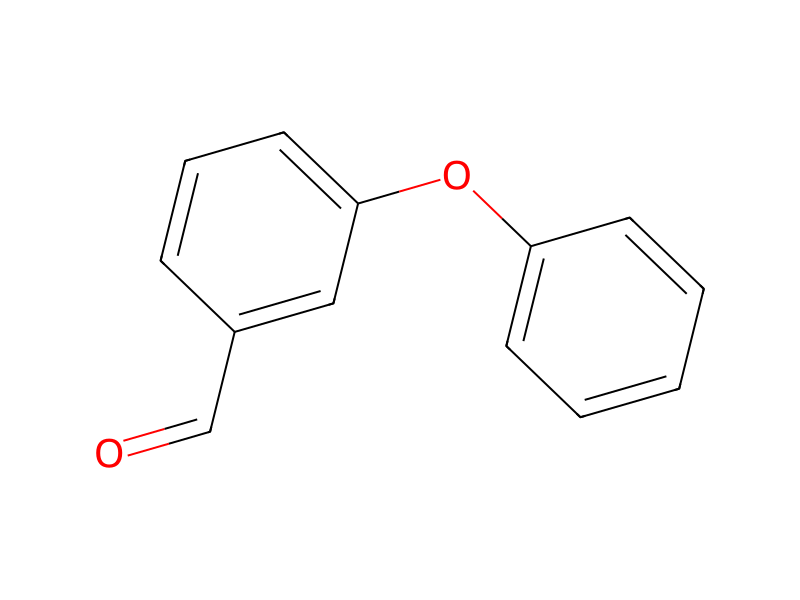
Hydrochloric Acid → 3-Phenoxybenzaldehyde
Reaction equation

Cl.[O:2]([C:9]1[CH:10]=[C:11]([CH:14]=[CH:15][CH:16]=1)[C:12]#N)[C:3]1[CH:8]=[CH:7][CH:6]=[CH:5][CH:4]=1.[OH2:17]>CCOCC>[O:2]([C:9]1[CH:10]=[C:11]([CH:14]=[CH:15][CH:16]=1)[CH:12]=[O:17])[C:3]1[CH:8]=[CH:7][CH:6]=[CH:5][CH:4]=1Participants
5
Reactant 3



Product 1
Reagents, catalysts & solvents 1

Procedure
Hydrogen chloride was introduced until saturation into a solution of 37.9 g of anhydrous stannous chloride (0.2 mole) in 200 ml of anhydrous ether. To the resulting solution, was added 19.5 g of 3-phenoxybenzonitrile (0.1 mole) and the mixture was stirred for 10 hours at room temperature. After addition of 200 ml of water and thorough stirring, the insoluble matter was removed by filtration. The filtrate was separated and the ether layer was further washed three times with 50 ml of water. After removal of the ether by distillation, the residue was distilled to obtain 8.5 g of crude 3-phenoxybenzaldehyde boiling at 100° to 115° C./0.45 mmHg which contained 71.4% of 3-phenoxybenzaldehyde.
Workup
- customthe insoluble matter was removed by filtration
- customThe filtrate was separated
- washthe ether layer was further washed three times with 50 ml of water
- customAfter removal of the ether
- distillationby distillation
- distillationthe residue was distilled
Sources & evidence
- ORD record
- ord-61af36005c8d4be0888ee0b379858aff
- Source dataset
- uspto-grants-1979_07
- Patent number
- US04162269
Reaction notes
Loading…