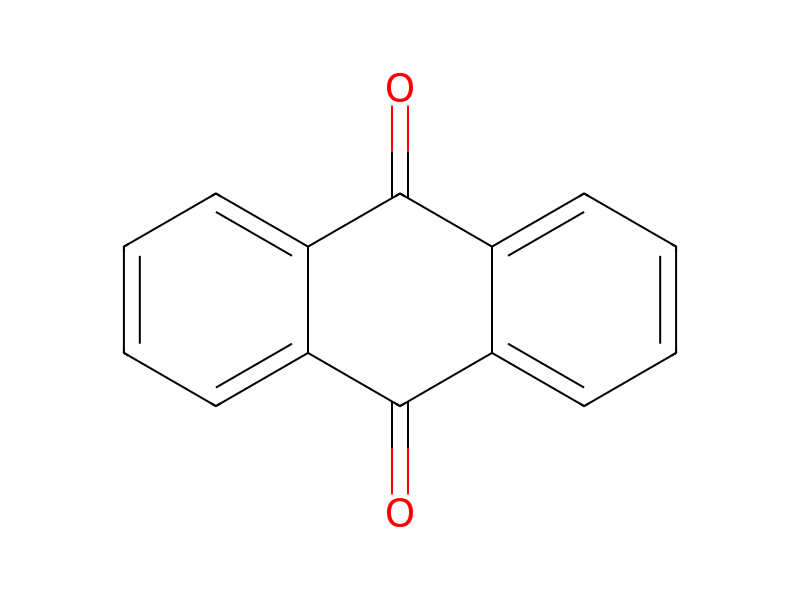
Anthraquinone → 1-Chloroanthraquinone
Reaction equation

[Cl:1]Cl.[CH:3]1[C:16]2[C:15](=[O:17])[C:14]3[C:9](=[CH:10][CH:11]=[CH:12][CH:13]=3)[C:8](=[O:18])[C:7]=2[CH:6]=[CH:5][CH:4]=1>>[Cl:1][C:10]1[C:9]2[C:8](=[O:18])[C:7]3[C:16](=[CH:3][CH:4]=[CH:5][CH:6]=3)[C:15](=[O:17])[C:14]=2[CH:13]=[CH:12][CH:11]=1Participants
3


Procedure
1,400 g of a 93% pure 1-chloroanthraquinone, produced from anthraquinone-1-sulphonic acid by exchanging the sulpho group by chlorine according to Fischer (Ullmann's Encyklopaedie der technischen Chemie (Ullmann's Encyclopaedia of Industrial Chemistry), 4th Edition, Volume 7, Example 1, page 589 (1973)) and contaminated with 0.5% of anthraquinone, 2.0% of 1,6- and 1,7-dichloroanthraquinone, 2.5% of 1,5- and 1,8-dichloroanthraquinone and 2.0% of other compounds, are employed in the flask of the test installation (according to Example 1). At an absolute pressure at the top of 20 mm Hg and a reflux ratio R/T= 4/1, highly pure 1-chloroanthraquinone (>99% pure) is obtained:
Sources & evidence
- ORD record
- ord-506325eabb274da2a3708d81b8581ec5
- Source dataset
- uspto-grants-1979_07
- Patent number
- US04162946
Reaction notes
Loading…