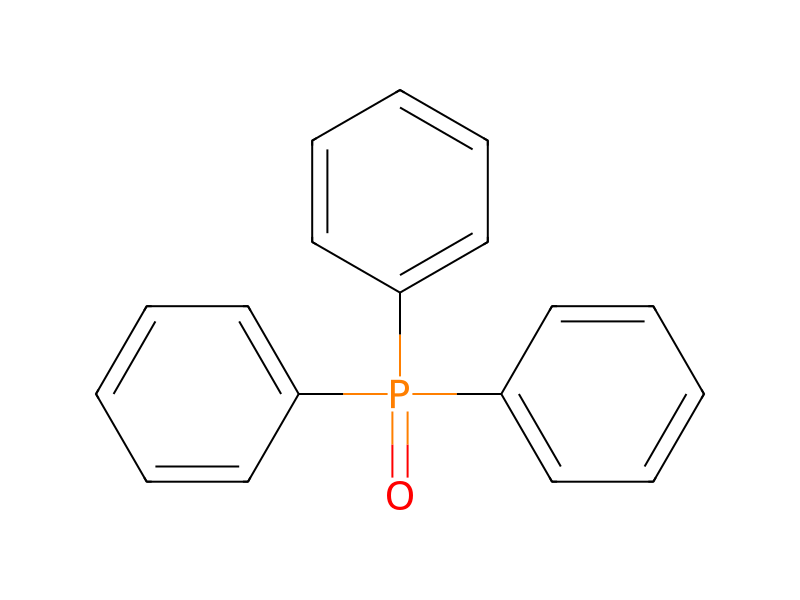
Triphenylphosphine → Triphenylphosphine Oxide
Reaction equation

FC1C=C(C(C)C(=O)C[OH:11])C=CC=1C1C=CC=CC=1.[C:20]1([P:26]([C:33]2[CH:38]=[CH:37][CH:36]=[CH:35][CH:34]=2)[C:27]2[CH:32]=[CH:31][CH:30]=[CH:29][CH:28]=2)[CH:25]=[CH:24][CH:23]=[CH:22][CH:21]=1>C(Cl)(Cl)(Cl)Cl>[C:33]1([P:26](=[O:11])([C:20]2[CH:21]=[CH:22][CH:23]=[CH:24][CH:25]=2)[C:27]2[CH:32]=[CH:31][CH:30]=[CH:29][CH:28]=2)[CH:34]=[CH:35][CH:36]=[CH:37][CH:38]=1Participants
4
Reactant 2


Product 1
Reagents, catalysts & solvents 1

Procedure
To 3-(2-fluoro-4-biphenylyl)-2-oxo-1-butanol (2.00 g, 7.74 mmol) in carbon tetrachloride (5 ml) was added triphenylphosphine (2.15 g, 8.20 mmol) at room temperature. After the addition, the mixture was stirred over night at room temperature, then concentrated to give triphenylphosphine oxide as precipitates. After filtration of the precipitates, the filtrates were evaporated under reduced pressure to a residue, which was chromatographed to afford 1-chloro-3-(2-fluoro-4-biphenylyl)-2-butanone (1.01 g, 47% yield) as crystalline materials: mp 57°-59° C.; NMR(CDCl3)δ 1.48(d, 3H), 4.07(m, 3H), 6.93-7.63(m, 8H); IR(neat) 1740, 1620, 1480, 1420, 1270 cm-1.
Workup
- additionAfter the addition
- concentrationconcentrated
Sources & evidence
- ORD record
- ord-29d860e3f30e4306a7c057bdcda34744
- Source dataset
- uspto-grants-1991_11
- Patent number
- US05066666
Reaction notes
Loading…