Hydrochloric Acid → 2-Naphthalenemethanethiol
Reaction equation

N[C:2](N)=[S:3].BrC[C:7]1[CH:16]=[CH:15][C:14]2[C:9](=[CH:10][CH:11]=[CH:12][CH:13]=2)[CH:8]=1.[OH-].[K+].Cl>C(O)C.O>[SH:3][CH2:2][C:7]1[CH:16]=[CH:15][C:14]2[C:9](=[CH:10][CH:11]=[CH:12][CH:13]=2)[CH:8]=1Participants
Reactant 4


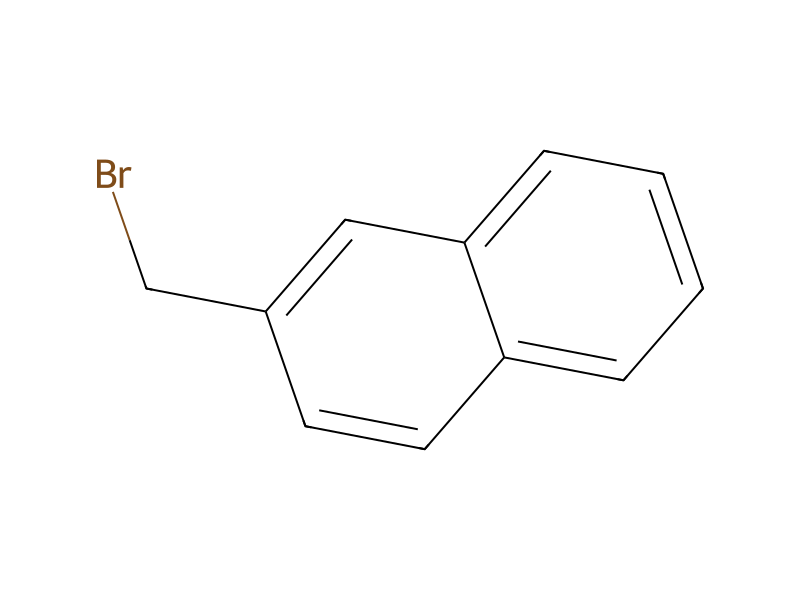

Product 1

Reagents, catalysts & solvents 2


Conditions
- Temperature
- 25 °C
Procedure
Utilizing the procedure of G. G. Urquhart, J. W. Gates and R. Conner, Org. Syn. Coll. Vol. 3, p. 363, thiourea (6.89 g, 90.5 mmol) was added to a solution of 2-(bromomethyl)naphthalene (20.6 g, 90.5 mmol) in anhydrous ethanol (100 mL) and then heated at reflux. After 17 h, the reaction solution was concentrated to an oil. The oil was dissolved in a solution of potassium hydroxide (11.2 g, 199 mmol) in water (100 mL) and heated at reflux for 2 h. The solution was then cooled to 25° C. and treated with aqueous hydrochloric acid (2.0N). The resulting aqueous mixture was extracted with ethyl acetate (3×). The combined ethyl acetate extracts were dried over magnesium sulfate, filtered and evaporated to give yellow crystals (14.5 g, 91.9% yield).
Workup
- temperatureheated
- temperatureat reflux
- concentrationthe reaction solution was concentrated to an oil
- temperatureheated
- temperatureat reflux for 2 h
- extractionThe resulting aqueous mixture was extracted with ethyl acetate (3×)
- dry with materialThe combined ethyl acetate extracts were dried over magnesium sulfate
- filtrationfiltered
- customevaporated
Sources & evidence
- ORD record
- ord-1474413af80e4768b9490a2ac5b01b12
- Source dataset
- uspto-grants-1991_11
- Patent number
- US05068342
Reaction notes
Loading…