Sulfuric Acid → Quinacridone
Reaction equation

[CH2:1]1[C:6]2[NH:7][C:8]3[C:13]([C:14](=[O:15])[C:5]=2[CH2:4][C:3]2[NH:16][C:17]4[C:22]([C:23](=[O:24])[C:2]1=2)=[CH:21][CH:20]=[CH:19][CH:18]=4)=[CH:12][CH:11]=[CH:10][CH:9]=3.[OH-].[Na+].S(=O)(=O)(O)O.[N+](C1C=C(S([O-])(=O)=O)C=CC=1)([O-])=O.[Na+]>CO>[CH:20]1[CH:21]=[C:22]2[C:23]([C:2]3[C:3]([NH:16][C:17]2=[CH:18][CH:19]=1)=[CH:4][C:5]1[C:14]([C:13]2[C:8]([NH:7][C:6]=1[CH:1]=3)=[CH:9][CH:10]=[CH:11][CH:12]=2)=[O:15])=[O:24]Participants
Reactant 4




Product 1
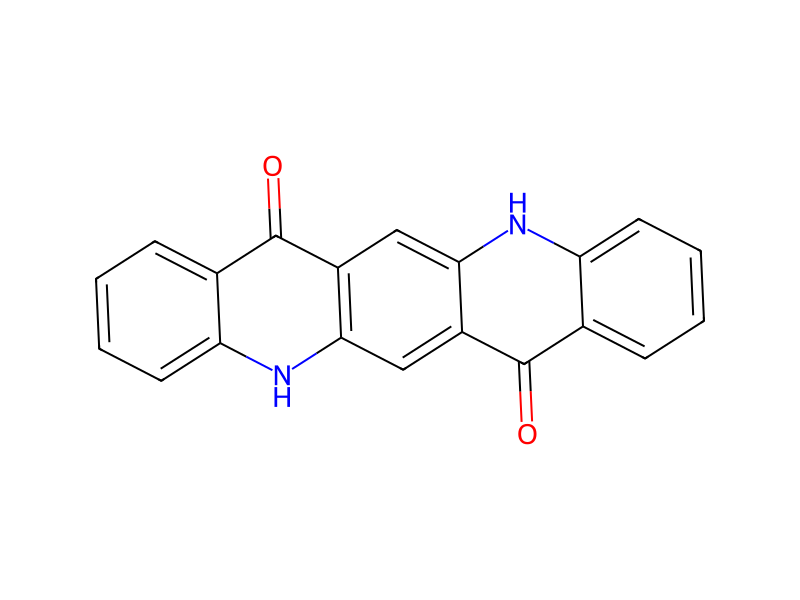
Reagents, catalysts & solvents 1

Procedure
A stainless steel flask having a refluxing device was charged with 10 parts of the 6,13-dihydroquinacridone obtained in Example 1 and 80 parts of methanol, and the mixture was stirred. 12 Parts of a 50% NaOH aqueous solution was added, and the mixture was stirred at 40° C. for 30 minutes to form a salt. 26 Parts of 10% sulfuric acid was added to hydrolyze the salt, and the resultant solution was refluxed for 1 hour. Then, 10 parts of sodium m-nitrobenzenesulfonate was added, and immediately thereafter, 3 parts of a 50% NaOH aqueous solution was added. Then, the mixture was refluxed for 4 hours to give 9.8 parts (98.8% of a theoretical value) of a nonsubstituted quinacridone as a pigment having a uniform particle diameter. The so-obtained quinacridone had a specific surface area of 25.1 m2 /g.
Workup
- customA stainless steel flask having
- stirringthe mixture was stirred at 40° C. for 30 minutes
- customto form a salt
- temperatureThen, the mixture was refluxed for 4 hours
Sources & evidence
- ORD record
- ord-3920c5e846a04297b75c2c75c822ecfe
- Source dataset
- uspto-grants-1997_03
- Patent number
- US05610306
Reaction notes
Loading…