Hydrogen Peroxide → Quinacridone
Reaction equation

[CH2:1]1[C:6]2[NH:7][C:8]3[C:13]([C:14](=[O:15])[C:5]=2[CH2:4][C:3]2[NH:16][C:17]4[C:22]([C:23](=[O:24])[C:2]1=2)=[CH:21][CH:20]=[CH:19][CH:18]=4)=[CH:12][CH:11]=[CH:10][CH:9]=3.[OH-].[Na+].C1C(S(O)(=O)=O)=CC2C(C3C=C(S(O)(=O)=O)C=CC=3C(=O)C=2C=1)=O.OO>O.CO>[CH:20]1[CH:21]=[C:22]2[C:23]([C:2]3[C:3]([NH:16][C:17]2=[CH:18][CH:19]=1)=[CH:4][C:5]1[C:14]([C:13]2[C:8]([NH:7][C:6]=1[CH:1]=3)=[CH:9][CH:10]=[CH:11][CH:12]=2)=[O:15])=[O:24]Participants




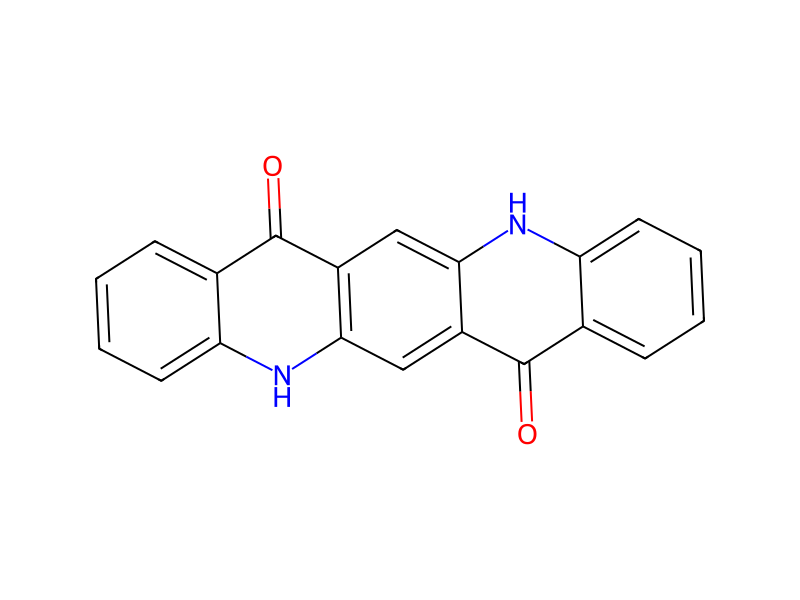


Conditions
- Temperature
- 23.5 °C
Procedure
A one-liter flask equipped with a thermometer, stirrer and condenser is charged with 50 g 6,13-dihydroquinacridone, 180 ml methanol, 1 g polyvinyl pyrrolidone powder (Luviskol® K-30/BASF) are stirred at 20 to 27° C. for 10 minutes. 73 g 50% aqueous sodium hydroxide are added. The mixture is stirred under a slow flow of nitrogen at 50-53° C. for 50 minutes then heated to reflux. 1.2 g 2,7-anthraquinone disulfonic acid is added as catalyst. 76 g of an aqueous 18.9% hydrogen peroxide solution is added into the reaction mixture with a peristaltic pump at a pumping rate of 0.4 ml/minute. The resulting pigment suspension is further stirred for 10 minutes at reflux then diluted with 100 ml cold water and filtered. The presscake is washed with hot water then dried, yielding a bronze colored large particle size beta quinacridone.
Workup
- customA one-liter flask equipped with a thermometer, stirrer and condenser
- stirringThe mixture is stirred under a slow flow of nitrogen at 50-53° C. for 50 minutes
- temperaturethen heated to reflux
- stirringThe resulting pigment suspension is further stirred for 10 minutes
- temperatureat reflux
- filtrationfiltered
- washThe presscake is washed with hot water
- customthen dried
Sources & evidence
- ORD record
- ord-903ace8a0d934ab6beb25a8b31185d7a
- Source dataset
- uspto-grants-2005_03
- Patent number
- US06864371B2
Reaction notes
Loading…