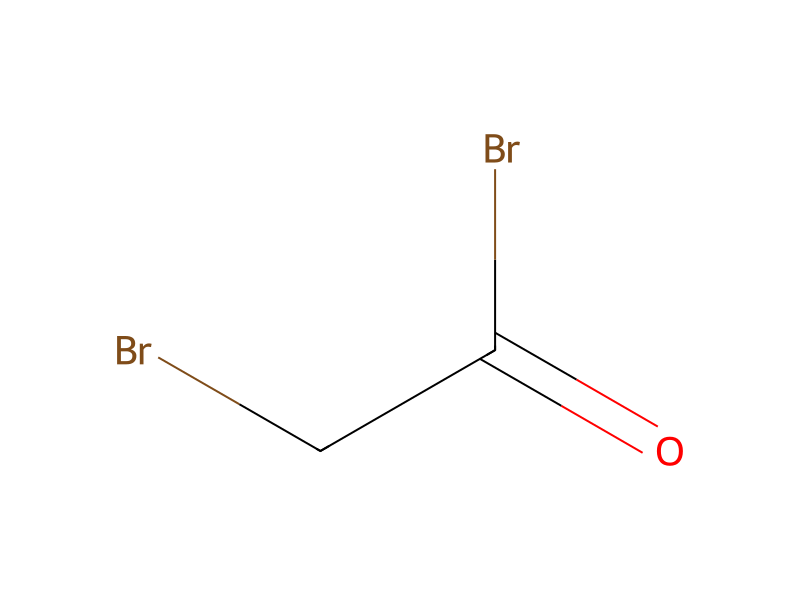
Bromoacetyl bromide → HCID 13944533, compound
Reaction equation

[CH2:1]([CH:8]1[CH2:12][O:11][C:10](=[O:13])[NH:9]1)[C:2]1[CH:7]=[CH:6][CH:5]=[CH:4][CH:3]=1.C([Li])CCC.[Br:19][CH2:20][C:21](Br)=[O:22]>C1COCC1>[CH2:1]([CH:8]1[CH2:12][O:11][C:10](=[O:13])[N:9]1[C:21](=[O:22])[CH2:20][Br:19])[C:2]1[CH:3]=[CH:4][CH:5]=[CH:6][CH:7]=1Participants
Reactant 3


Product 1

Reagents, catalysts & solvents 1

Conditions
- Temperature
- -78 °C
Procedure
A solution of 4-benzyl-2-oxazolidinone in dry THF (300 ml) was stirred at −78° C. under nitrogen during the dropwise addition of 1.6 M n-butyl lithium in hexanes, (60 ml, 97 mmol) followed by bromo-acetyl bromide. The pale yellow solution was stirred for a further 10 minutes at −78° C. and allowed to warm to room temperature over 30 minutes. The reaction was then quenched by the addition of saturated aqueous ammonium chloride solution. After dilution with ethyl acetate and brine, the two layers were separated and the aqueous layer was extracted with ethyl acetate. The combined organic layers were washed with brine, dried (anhydrous magnesium sulfate) and concentrated in vacuo to give 4-benzyl-3-(2-bromo-acetyl)-oxazolidin-2-one (26.2 g) which was used in the next step without further purification.
Workup
- temperatureto warm to room temperature over 30 minutes
- customThe reaction was then quenched by the addition of saturated aqueous ammonium chloride solution
- customAfter dilution with ethyl acetate and brine, the two layers were separated
- extractionthe aqueous layer was extracted with ethyl acetate
- washThe combined organic layers were washed with brine
- dry with materialdried (anhydrous magnesium sulfate)
- concentrationconcentrated in vacuo
Sources & evidence
- ORD record
- ord-ad2bb0613c444ab3b73792f2aed2293e
- Source dataset
- uspto-grants-2003_10
- Patent number
- US06632826B1
Reaction notes
Loading…