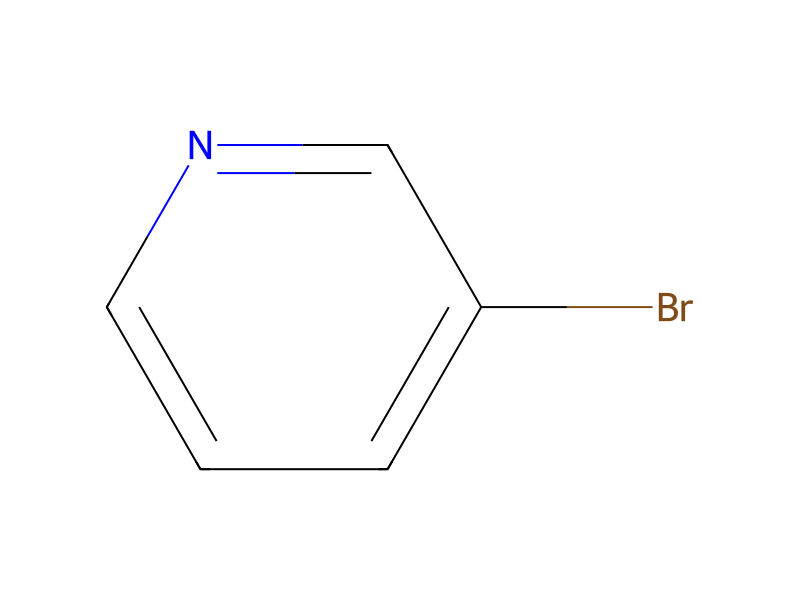
3-Bromopyridine → HCID 13694122, compound
Reaction equation

[OH-].[Na+].CC1(C)C(C)(C)OB([C:11]2[CH:19]=[CH:18][CH:17]=[C:16]3[C:12]=2[CH:13]=[CH:14][NH:15]3)O1.Br[C:22]1[CH:23]=[N:24][CH:25]=[CH:26][CH:27]=1>[Pd].C1COCC1>[N:24]1[CH:25]=[CH:26][CH:27]=[C:22]([C:11]2[CH:19]=[CH:18][CH:17]=[C:16]3[C:12]=2[CH:13]=[CH:14][NH:15]3)[CH:23]=1Participants
6





Conditions
- Temperature
- 70 °C
Procedure
Palladium catalyst Pd(PPh3)4 (284 mg, 0.25 mmol) and freshly prepared aqueous sodium hydroxide (984 mg in 9 mL of water) were added to a mixture of 4-(4,4,5,5-tetramethyl-[1,3,2]dioxaborolan-2-yl)-1H-indole (2 g, 8.2 mmol) and 3-bromopyridine (0.8 mL, 8.3 mmol) in THF (28 mL). The system was degassed and then purged three times with nitrogen. The mixture was stirred under nitrogen at 70° C. in an oil bath for 6 hours. It was then cooled to room temperature and 400 ml ethyl acetate was added. The organic layer was isolated, washed with brine, dried over anhydrous Na2SO4 and concentrated. The residue was column chromatographed to give 1 g (62%) of 4-pyridin-3-yl-1H-indole as a white solid.
Workup
- customThe system was degassed
- custompurged three times with nitrogen
- temperatureIt was then cooled to room temperature
- addition400 ml ethyl acetate was added
- customThe organic layer was isolated
- washwashed with brine
- dry with materialdried over anhydrous Na2SO4
- concentrationconcentrated
- customchromatographed
Sources & evidence
- ORD record
- ord-70aaf6cb1de04fe0b6019ab2d5ccef03
- Source dataset
- uspto-grants-2003_10
- Patent number
- US06635640B2
Reaction notes
Loading…