1,2-Dimethoxyethane → Ethyl 5-(3,4-dichlorophenyl)-3-methyl-pentadienoate
Reaction equation

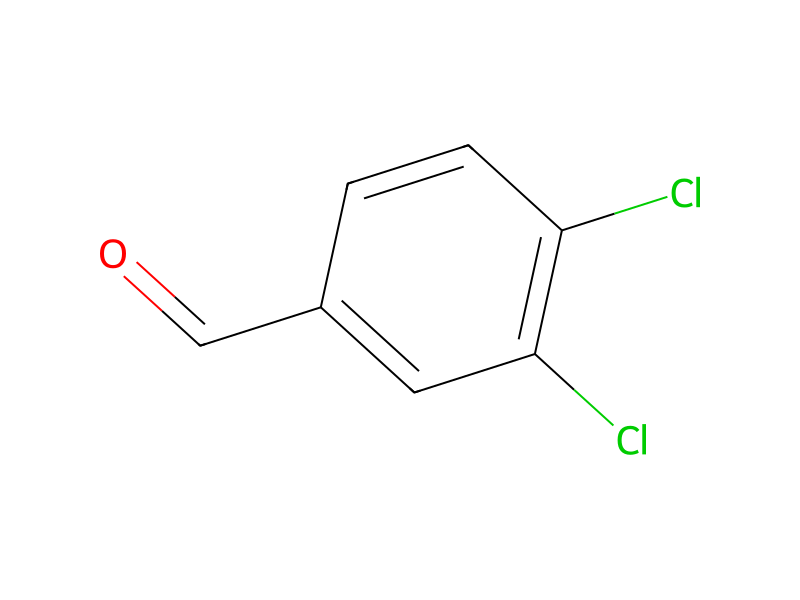
[H-].[Na+].C([C:5]([CH2:18][CH3:19])(P(O)(O)=O)/[C:6](/[CH3:13])=[C:7](\CC)/[C:8]([O-:10])=[O:9])C.[Cl:20][C:21]1[CH:22]=C([CH:26]=[CH:27][C:28]=1[Cl:29])C=O.[CH2:30]([CH2:33]OC)OC>>[Cl:20][C:21]1[CH:22]=[C:19]([CH:18]=[CH:5][C:6]([CH3:13])=[CH:7][C:8]([O:10][CH2:30][CH3:33])=[O:9])[CH:26]=[CH:27][C:28]=1[Cl:29]Participants




Procedure
A suspension of sodium hydride (0.40 g. 10.0 mmol) in anhydrous dimethoxyethane (5 mL) is cooled in a room temperature water bath. While stirring vigorously, triethyl-3-methyl-4-phosphonocrotonate (2.64 g, 10 mmol), is added dropwise over 10 minutes. After gas evolution has stopped, (˜5 minutes) the reaction mixture is treated with a solution of 3,4-dichlorobenzaldehyde (1.75 g, 10 mmol) in anhydrous dimethoxyethane (5 mL). The resulting brown solution is then heated to reflux. After three hours, the mixture is cooled and quenched with saturated aqueous brine. The aqueous layer is extracted several times with EtOAc, and the combined organic layers are dried (sodium sulfate) and concentrated in vacuo. The resulting brown oil is chromatographed on silica gel eluting with 7% EtOAc: 93% hexane to give 1.146 g of a brown oil, which is a 1:1 mixture of alkene isomers at C-2.
Workup
- temperatureThe resulting brown solution is then heated to reflux
- temperaturethe mixture is cooled
- customquenched with saturated aqueous brine
- extractionThe aqueous layer is extracted several times with EtOAc
- dry with materialthe combined organic layers are dried (sodium sulfate)
- concentrationconcentrated in vacuo
- customThe resulting brown oil is chromatographed on silica gel eluting with 7% EtOAc
Sources & evidence
- ORD record
- ord-723dda25385b496794f82a5e7dfb98b2
- Source dataset
- uspto-grants-2002_10
- Patent number
- US06458806B1
Reaction notes
Loading…