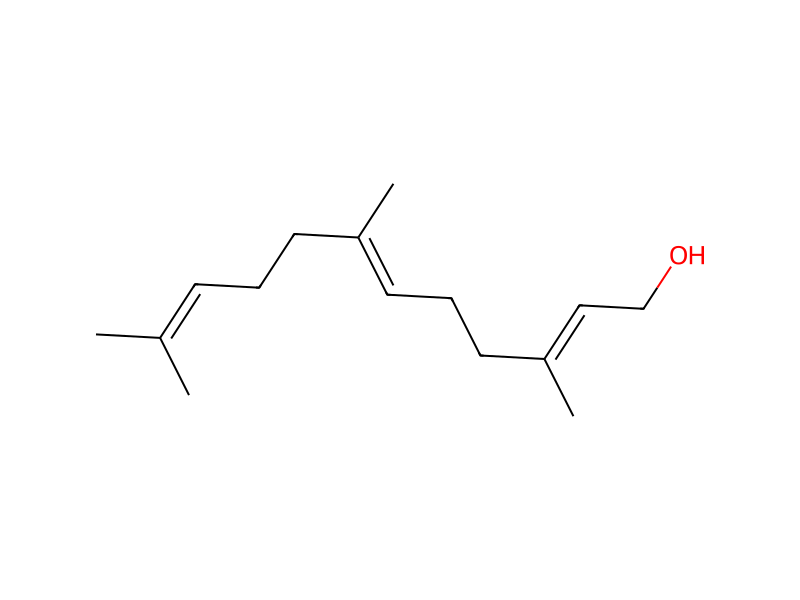
a Farnesol → (2E,6E)-3,7,11-trimethyldodeca-2,6,10-trienal
Reaction equation

[OH:1][CH2:2][CH:3]=[C:4]([CH2:6][CH2:7][CH:8]=[C:9]([CH2:11][CH2:12][CH:13]=[C:14]([CH3:16])[CH3:15])[CH3:10])[CH3:5].C(OCC)(=O)C>CS(C)=O>[CH3:15][C:14]([CH3:16])=[CH:13][CH2:12][CH2:11]/[C:9](/[CH3:10])=[CH:8]/[CH2:7][CH2:6]/[C:4](/[CH3:5])=[CH:3]/[CH:2]=[O:1]Participants
Reactant 2

Product 1

Reagents, catalysts & solvents 1

Procedure
5 g of the composition prepared in Example 7 are introduced in small fractions over a period of 15 minutes into a solution of 1.6 g of farnesol in 40 ml of dimethyl sulfoxide while maintaining the temperature at from 20° C. to 25° C. After 2 hours under agitation, the solution is poured into 100 ml of hexanes (petrol G) and the precipitate is separated off and washed with water and then with petrol G. The organic phases are concentrated under vacuum and the residue obtained is purified by chromatography over 25 g of R60 Merck® silica in order to separate the remaining stabilizing agent from the farnesal obtained; the eluent is petrol G and then its mixture with ethyl acetate (9/1-v/v). The pure farnesal is isolated with a yield of 85%.
Workup
- custom5 g of the composition prepared in Example 7
- temperaturewhile maintaining the temperature at from 20° C. to 25° C
- customthe precipitate is separated off
- washwashed with water
- concentrationThe organic phases are concentrated under vacuum
- customthe residue obtained
- customis purified by chromatography over 25 g of R60 Merck® silica in order
- customto separate the
- customobtained
Sources & evidence
- ORD record
- ord-807e24629de14dd5b5fe471da5e911d5
- Source dataset
- uspto-grants-2002_10
- Patent number
- US06462227B2
Reaction notes
Loading…