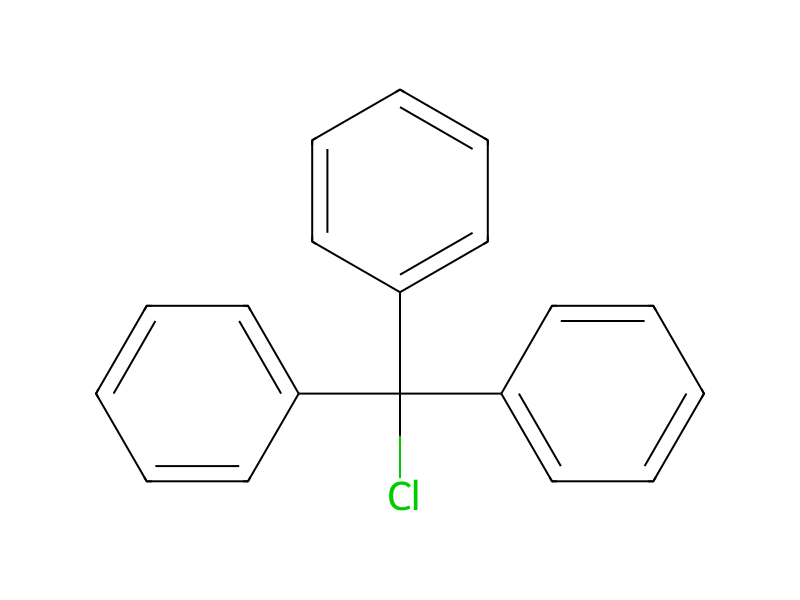
Trityl chloride → Ethyl 1-tritylpyrazole-4-carboxylate
Reaction equation

CC(C)([O-])C.[K+].[C:7](Cl)([C:20]1[CH:25]=[CH:24][CH:23]=[CH:22][CH:21]=1)([C:14]1[CH:19]=[CH:18][CH:17]=[CH:16][CH:15]=1)[C:8]1[CH:13]=[CH:12][CH:11]=[CH:10][CH:9]=1.[CH2:27]([O:29][C:30]([C:32]1[CH:33]=[N:34][NH:35][CH:36]=1)=[O:31])[CH3:28].O.C(OCC)(=O)C>CN(C=O)C>[CH2:27]([O:29][C:30]([C:32]1[CH:33]=[N:34][N:35]([C:7]([C:20]2[CH:25]=[CH:24][CH:23]=[CH:22][CH:21]=2)([C:14]2[CH:19]=[CH:18][CH:17]=[CH:16][CH:15]=2)[C:8]2[CH:13]=[CH:12][CH:11]=[CH:10][CH:9]=2)[CH:36]=1)=[O:31])[CH3:28]Participants
6





Procedure
Under N2 atmosphere, potassium tert-butoxide (9.60 g, 85.5 m mol) and trityl chloride (21.9 g, 78.5 m mol) were added successively to a solution of 4-(ethoxycarbonyl)pyrazole (10.0 g, 71.3 m mol) in DMF (100 ml) at 0° C. After stirred for 1 hour, the mixture was poured into water/ethyl acetate. The aqueous layer was separated, and the organic layer was washed with water, brine and dried over magnesium sulfate. After evaporation of the solvent, the resulting precipitate was recrystallized from ethyl acetate to afford 4-ethoxycarbonyl-1-(trityl)pyrazole (21.7 g).
Workup
- customThe aqueous layer was separated
- washthe organic layer was washed with water, brine
- dry with materialdried over magnesium sulfate
- customAfter evaporation of the solvent
- customthe resulting precipitate was recrystallized from ethyl acetate
Sources & evidence
- ORD record
- ord-4f0cfd2035d048d49bcc4289b5b6845b
- Source dataset
- uspto-grants-2002_10
- Patent number
- US06468995B1
Reaction notes
Loading…