HomeMCPSkillsWorkbenchOpenChem
HomeWorkbenchNotificationsMe
llms.txt · skill.md · MCP GuidePrivacy Policy · Terms of Service · Supportv1.8.5
  1. Home
  2. /Compound

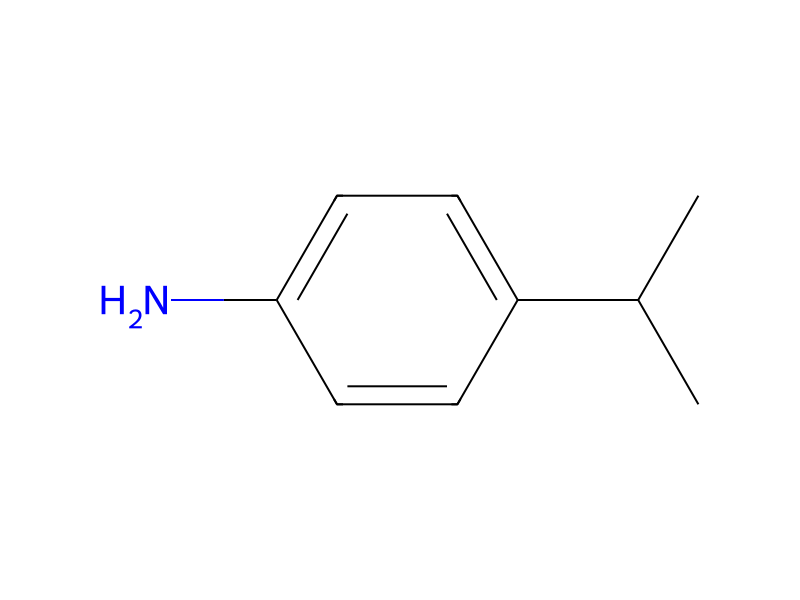
4-Isopropylaniline

HCID 7464
New reaction
Print
Basic informationOverviewNames & identifiersPropertiesSafety & regulationChemistry & industryRelated reactionsCompound notes
Substructure searchFind similar structures

Basic information

CAS
99-88-7
Standard SMILES
CC(C)c1ccc(N)cc1
InChIKey
LRTFPLFDLJYEKT-UHFFFAOYSA-N
Molecular formula
C9H13N
Average molar mass
135.21 g/mol
Monoisotopic mass
135.10479942

Overview

Para-isopropylaniline is a substituted aniline carrying an isopropyl group at position 4. It is a metabolite of isoproturon. It has a role as a bacterial xenobiotic metabolite and a marine xenobiotic metabolite.

Names & identifiers

Preferred name
4-Isopropylaniline
IUPAC
4-propan-2-ylaniline
English name
4-Isopropylaniline
Molecular formula
C9H13N
Molecular weight
135.21

Names & synonyms

4-ISOPROPYLANILINE99-88-7Cumidine4-Aminocumenep-Isopropylanilinep-Cumidine4-Amino-1-isopropylbenzenePARA-ISOPROPYLANILINE4-propan-2-ylaniline4-(1-methylethyl)anilinebeta-(4-Aminophenyl)propane0D54T7V7XL
Show more names
4-Isopropyl-phenylaminecumidinCUMIDENE4-Cumidine4-AMINOCUMOLP-AMINOCUMENE
NSC-7198CHEBI:43405DTXSID20243932RefChem:579535DTXCID50166423202-797-2682-629-64-(Propan-2-Yl)Aniline

Database identifiers

CAS
99-88-7
PubChem CID
7464
DTXSID
DTXSID20243932
ChEBI
CHEBI:43405
UNII
0D54T7V7XL
EC Number
202-797-2、682-629-6
Nikkaji
J11.624F

Properties

Computed structural properties

XLogP
2.2
Topological polar surface area
26 Ų
Hydrogen bond donors
1
Hydrogen bond acceptors
1
Rotatable bonds
1
Heavy atoms
10
Formal charge
0
Complexity
90.9

Experimental & physicochemical properties

Chemical ClassesNitrogen Compounds -> Amines, Aromatic
DrugsPharmaceuticals -> Listed in ZINC15
SpringerMaterials Properties13C nuclear magnetic resonance spectrum
Pesticides · 2 items

Pesticide -> transformation product

Pesticides -> Herbicides -> Urea herbicides -> Phenylurea herbicides -> Transformation products

LogP2.31
Physical DescriptionLiquid; [Merck Index] Clear dark red liquid; [Sigma-Aldrich MSDS]

Physicochemical properties

Melting point
-63 °C · -63 °C
Boiling point
224 °C · 224 °C
Density
0.95 · 0.95
vapor pressure
10 Pa · 10Pa at 20℃
refractive index

Safety & regulation

Safety information is for reference only and does not replace the supplier’s Safety Data Sheet (SDS), applicable regulations, or professional assessment.

GHS classification

GHS Classification · 6 items

Warning

H302 (16.7%): Harmful if swallowed [Warning Acute toxicity, oral]

P261, P264, P264+P265, P270, P271, P280, P301+P317, P302+P352, P304+P340, P305+P351+P338, P317, P319, P321, P330, P332+P317, P337+P317, P362+P364, P403+P233, P405, and P501 (click each P-code to see the statement)

Aggregated GHS information provided per 48 reports by companies from 8 notifications to the ECHA C&L Inventory. Each notification may be associated with multiple companies.

Warning

H315 (100%): Causes skin irritation [Warning Skin corrosion/irritation]

Hazard information

Regulatory Information · 2 items

REACH registered substance: 4-isopropylaniline (EC: 202-797-2)

Benzenamine, 4-(1-methylethyl)-: Does not have an individual approval but may be used under an appropriate group standard

Hazards Summary · 1 item

Hematological changes (including increased methemoglobin), increased spleen and liver weights, and histopathological changes of the bone marrow, spleen, and liver observed in oral repeated dose/reproductive/developmental study of rats with NOEL for parental animals of 6 mg/kg/day; This study also demonstrated decreased pup body weights and viability on day 4 of lactation but no evidence of reproductive toxicity; [JECDB] May induce methemoglobinemia; [IUCLID] Causes burns; Toxic by ingestion, inhalation, and skin absorption; [ECHA REACH Registrations] A skin and strong eye irritant; May induce methemoglobinemia; [Sigma-Aldrich MSDS]

Hazard Classes and Categories · 3 items

Acute Tox. 4 (16.7%)

Skin Irrit. 2 (100%)

Flammable liquids - Category 4

Toxicology

Chemistry & industry

Uses & manufacturing

UsesUsed in the determination of tungsten; [Merck Index] Used in chemical synthesis; [IUCLID] Used to make fine and large scale chemicals; [ECHA REACH Registrations]
Use ClassificationPesticides -> Herbicides -> Urea herbicides -> Phenylurea herbicides -> Transformation products

Applications

Uses4-Isopropylaniline was used in the hydroamination of phenylacetylene.

General Description4-isopropylaniline is a metabolite of phenylurea herbicide isoproturon.

Upstream & downstream products

Upstream raw materials

1-Isopropyl-4-nitrobenzene4-chlorocumene1-(4-Isopropylphenyl)hydrazine3-IsopropylanilineAniline2-Isopropylaniline4-IodoanilinePropaneIsopropylmagnesium bromideCumene

Downstream products

IsoproturonPhenol4-Isopropylphenyl isocyanate

Related reactions

245 records
New reaction record
HRID 33769As reactant
HRID 33772As reactant
HRID 33773As reactant
HRID 33774As reactant
HRID 54464As reactant
HRID 58562As reactant
HRID 71510As reactant
HRID 71515As reactant
PreviousPage 1 of 31

Compound notes

On this pageBasic informationOverviewNames & identifiersPropertiesSafety & regulationChemistry & industryRelated reactionsCompound notes
1.54 · 1.54
Flash point
116 °C · 116 °C
storage temp.
Keep in dark place,Inert atmosphere,Room temperature
solubility
2 O: · H2O: insoluble
pka
5.01 · 5.01±0.10(Predicted)
form
clear liquid
color
Colorless to Brown
PH
7 · 7 (2.2g/l, H2O, 20℃)
Water Solubility
insoluble
Sensitive
Light Sensitive
Merck
14 · 14,2620
BRN
1930544 · 1930544
InChI
1S/C9H13N/c1-7(2)8-3-5-9(10)6-4-8/h3-7H,10H2,1-2H3
InChIKey
LRTFPLFDLJYEKT-UHFFFAOYSA-N
SMILES
CC(C)c1ccc(N)cc1
LogP
2.49 · 2.49
CAS DataBase Reference
99 · 99-88-7(CAS DataBase Reference)
FDA UNII
0 D54T7V7XL · 0D54T7V7XL
NIST Chemistry Reference
4 · 4-Isopropylaniline(99-88-7)
Comptox DTXSID
20243932 · DTXSID20243932
UNSPSC Code
12352100 · 12352100
NACRES
22 · NA.22
Symbol(GHS)
7 · GHS07
Signal word
Warning
Hazard statements
315 · H315-H319-H335
Precautionary statements
261 · P261-P264-P271-P280-P302+P352-P305+P351+P338
target organs
Respiratory system
PPE
Eyeshields, Gloves, type ABEK (EN14387) respirator filter
Hazard Codes
Xi,Xn
Risk Statements
36 · 36/37/38-20/21/22
Safety Statements
26 · 26-36-36/37
RIDADR
1993 · UN 1993 / PGIII
WGK Germany
2 · 2
Hazard Note
Irritant
HS Code
29214980 · 29214980
Storage Class
10 · 10 - Combustible liquids
Hazard Classifications
2 Skin · Eye Irrit. 2Skin Irrit. 2STOT SE 3
REACH Registrations
Active
Adverse EffectsMethemoglobinemia - The presence of increased methemoglobin in the blood; the compound is classified as secondary toxic effect

Safety data

PPE
Eyeshields, Gloves, type ABEK (EN14387) respirator filter
wgk
2
ridadr
UN 1993 / PGIII
hs_code
29214980
risk_code
36/37/38-20/21/22
Signal word
Warning
Symbol(GHS)
GHS07
hazard_code
Xi,Xn
hazard_note
Irritant
safety_code
26-36-36/37
Storage Class
10 - Combustible liquids
target organs
Respiratory system
Hazard statements
H315-H319-H335
REACH Registrations
Active
Hazard Classifications
Eye Irrit. 2Skin Irrit. 2STOT SE 3
Precautionary statements
P261-P264-P271-P280-P302+P352-P305+P351+P338
1,3-Dibromo-5-isopropylbenzene
1,1-Dimethylurea
N,N-Dimethylcarbamic acid
tert-Butyl 4-(4-isopropylanilino)tetrahydro-1(2H)-pyridinecarboxylate

Additional notes

DefinitionChEBI: A substituted aniline carrying an isopropyl group at position 4. It is a metabolite of isoproturon.