

Grundinformationen
- Standard-SMILES
Cc1ncc(CO)c(CO)c1O- InChIKey
LXNHXLLTXMVWPM-UHFFFAOYSA-N- Summenformel
- C8H11NO3
- Durchschnittliche Molmasse
- 169,18 g/mol
- Monoisotopische Masse
- 169,07389321
Überblick
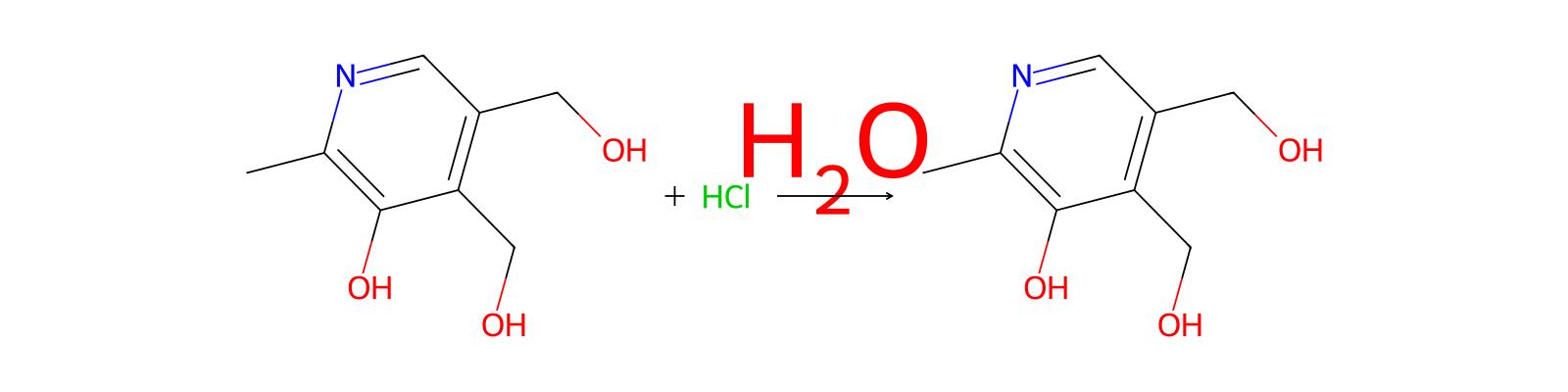
Pyridoxine is a hydroxymethylpyridine with hydroxymethyl groups at positions 4 and 5, a hydroxy group at position 3 and a methyl group at position 2. The 4-methanol form of vitamin B6, it is converted intoto pyridoxal phosphate which is a coenzyme for synthesis of amino acids, neurotransmitters, sphingolipids and aminolevulinic acid. It has a role as a cofactor, a mouse metabolite, a Saccharomyces cerevisiae metabolite, an Escherichia coli metabolite and a human metabolite. It is a member of methylpyridines, a vitamin B6, a monohydroxypyridine and a hydroxymethylpyridine.
Namen und Bezeichner
- Bevorzugter Name
- Pyridoxine
- IUPAC
- 4,5-bis(hydroxymethyl)-2-methylpyridin-3-ol
- Lokaler Name
- Pyridoxin
- Englischer Name
- Pyridoxine
- Summenformel
- C8H11NO3
- Molmasse
- 169.18
Namen und Synonyme
pyridoxine65-23-6PyridoxolPyridoxin3-hydroxy-4,5-bis(hydroxymethyl)-2-methylpyridineAdermineGravidoxHydoxinPyridoxolum4,5-bis(hydroxymethyl)-2-methylpyridin-3-ol3,4-Pyridinedimethanol, 5-hydroxy-6-methyl-5-Hydroxy-6-methyl-3,4-pyridinedimethanol
Weitere Namen anzeigen
PYRIDOXINE HCLPyridoxine (Vitamin B6)(5-hydroxy-6-Methylpyridine-3,4-diyl)diMethanolPYRIDOXIN HYDROCHLORIDE5-HYDROXY-6-METHYL-3,4-PYRIDINEDIMETHANOL HYDROCHLORIDEB6-HCLPridoxineADEMINE HCL
PiridoxinaPyridoxinumPiridossina3-Hydroxy-4,5-dimethylol-alpha-picolineHexabione2-Methyl-3-hydroxy-4,5-bis(hydroxymethyl)pyridine2-Methyl-3-hydroxy-4,5-di(hydroxymethyl)pyridineVitamin V6
Datenbank-Bezeichner
- CAS
65-23-6- PubChem CID
- 1054
- DTXSID
DTXSID4023541- ChEMBL
CHEMBL1364- ChEBI
CHEBI:16709- UNII
- KV2JZ1BI6Z
- EC Number
- 200-603-0
- Nikkaji
- J2.095.349G、J2.356F
Eigenschaften
Berechnete Struktureigenschaften
- XLogP
- -0,8
- Polarare Oberfläche (TPSA)
- 73,6 Ų
- H-Brücken-Donoren
- 3
- H-Brücken-Akzeptoren
- 4
- Frei drehbare Bindungen
- 2
- Schwere Atome
- 12
- Formalladung
- 0
- Komplexität
- 142
Experimentelle und physikochemische Eigenschaften
Chemical ClassesBiological Agents -> Vitamins and Derivatives
Drugs
Pharmaceuticals -> Listed in ZINC15
Pharmaceuticals
CosmeticsHair conditioning; Antistatic; Skin conditioning
LogP-0.77
Food AdditivesUse unspecified -> FDA Substance added to food
Solubility79 mg/mL
Human Drugs
Breast Feeding; Lactation; Milk, Human; Vitamins
FDA approved drugs -> Active ingredient
FDA approved drugs -> Active ingredient
FDA approved drugs -> Active ingredient
Vitamins and minerals
Melting Point
159-162 °C
159 - 162 °C
Vapor Pressure0.00000028 [mmHg]
Physical Description
Dry Powder
White powder; [Alfa Aesar MSDS]
Solid
Ionization Efficiency
Positive
3.28
2.7
Agilent XCT
Electrospray ionization
formic acid (5.3nM)
Collision Cross Section
133.7 Ų [M+H]+ [CCS Type: DT; Buffer gas: N2; Ionization: APCI+; Dataset: TOXCAST; Source Identifier: DTXSID1040792]
134.4 Ų [M+H]+ [CCS Type: DT; Method: single field calibrated with ESI Low Concentration Tuning Mix (Agilent)]
132.3 Ų [M+H]+ [CCS Type: TW; Method: calibrated with polyalanine and drug standards]
134.6 Ų [M+H]+ [CCS Type: DT; Method: single field calibrated with Agilent tune mix (Agilent)]
126.18 Ų [M+H-H2O]+ [CCS Type: TW; Method: calibrated with polyalanine and drug standards]
135.69 Ų [M+H]+ [CCS Type: DT; Method: stepped-field]
Physikochemische Eigenschaften
- Schmelzpunkt
- 214 · 214-215 °C(lit.)
- Siedepunkt
- 298.46 °C · 298.46°C (rough estimate)
- Dichte
- 1.2435 · 1.2435 (rough estimate)
- Brechungsindex
- 1.51 · 1.5100 (estimate)
- storage temp.
- 2 · Inert atmosphere,2-8°C
- Löslichkeit
- 2 O: · H2O: 0.1 g/mL at 20 °C, clear, colorless
- pka
- 5 · pKa 5.00(H2O t = 25.0 I = 0.15 (mixed)) (Uncertain)
- Aggregatzustand
- Solid
- Farbe
- White to Off-White
- Geruch (Odor)
- Odorless
- BCS Class
- 1 · 1,3
- Stabilität
- Stable. Incompatible with strong oxidizing agents.
- Kosmetik-Inhaltsstoffe Funktionen
- HAIR CONDITIONINGANTISTATICSKIN CONDITIONING
- InChI
- 1S/C8H11NO3/c1-5-8(12)7(4-11)6(3-10)2-9-5/h2,10-12H,3-4H2,1H3
- InChIKey
- LXNHXLLTXMVWPM-UHFFFAOYSA-N
- SMILES
- Cc1ncc(CO)c(CO)c1O
- LogP
- -0.77 · -0.770
- CAS Datenbank
- 65 · 65-23-6(CAS DataBase Reference)
- NIST chemische Informationen
- 2 · 2-Methyl-3-hydroxy-4,5-dihydroxymethylpyridine(65-23-6)
- EPA chemische Informationen
- 3 · 3,4-Pyridinedimethanol, 5-hydroxy-6-methyl- (65-23-6)
Sicherheit und Regulatorisches
GHS-Klassifizierung
GHS Classification
This chemical does not meet GHS hazard criteria for 3.8% (2 of 52) of reports.
Warning
H315 (96.2%): Causes skin irritation [Warning Skin corrosion/irritation]
P261, P264, P264+P265, P271, P280, P302+P352, P304+P340, P305+P351+P338, P319, P321, P332+P317, P337+P317, P362+P364, P403+P233, P405, and P501 (click each P-code to see the statement)
Aggregated GHS information provided per 52 reports by companies from 8 notifications to the ECHA C&L Inventory. Each notification may be associated with multiple companies.
Gefahrenhinweise
Regulatory Information
Chemical: 3,4-Pyridinedimethanol, 5-hydroxy-6-methyl-
3,4-Pyridinedimethanol, 5-hydroxy-6-methyl- is listed on the EPA's Chemical Data Reporting (CDR) system. Manufacturers and importers of 3,4-Pyridinedimethanol, 5-hydroxy-6-methyl- are required to report information about their production and use of this chemical to the EPA under the Toxic Substances Control Act (TSCA). (40 eCFR Part 711)
Status: Active Update: 28-05-2018 https://echa.europa.eu/registration-dossier/-/registered-dossier/25773
Pyridoxine: Does not have an individual approval but may be used under an appropriate group standard
Other Safety InformationEvaluation - Chemicals that are unlikely to require further regulation to manage risks to environment
Hazards Summary
Has been tested in humans to relieve nausea and vomiting during pregnancy; Chronic ingestion of gram quantities can cause ataxia and sensory neuropathy; Has demonstrated testicular toxicity in rats; [REPROTOX] An irritant; May have cumulative adverse effects; [Alfa Aesar MSDS] See Pyridoxine hydrochloride.
Hazard Classes and CategoriesSkin Irrit. 2 (96.2%)
Toxikologische Informationen
TreatmentAdminister charcoal as a slurry. (T273)
Exposure RoutesOral; parenteral (intramuscular).
The B vitamins are readily absorbed from the gastrointestinal tract, except in malabsorption syndromes. Pyridoxine is absorbed mainly in the jejunum.
Toxicity Summary
Vitamin B6 is the collective term for a group of three related compounds, pyridoxine (PN), pyridoxal (PL) and pyridoxamine (PM), and their phosphorylated derivatives, pyridoxine 5'-phosphate (PNP), pyridoxal 5'-phosphate (PLP) and pyridoxamine 5'-phosphate (PMP). Although all six of these compounds should technically be referred to as vitamin B6, the term vitamin B6 is commonly used interchangeably with just one of them, pyridoxine. Vitamin B6, principally in its biologically active coenzyme form pyridoxal 5'-phosphate, is involved in a wide range of biochemical reactions, including the metabolism of amino acids and glycogen, the synthesis of nucleic acids, hemogloblin, sphingomyelin and other sphingolipids, and the synthesis of the neurotransmitters serotonin, dopamine, norepinephrine and gamma-aminobutyric acid (GABA).
Signs and SymptomsToxic effects include convulsions, dyspnea, hypermotility, diarrhea, ataxia and muscle weakness.
Carcinogen ClassificationNo indication of carcinogenicity to humans (not listed by IARC).
Drug Induced Liver Injury
Drug-Induced Liver Injury Severity and Toxicity (DILIst)
pyridoxine
DILI Negative
Intravenous
DOI:10.1016/j.drudis.2019.09.022
Effects During Pregnancy and Lactation◉ Summary of Use during Lactation
Toxicity DataLD50: 4 gm/kg (oral, rat)
Sicherheitsdaten
- F
- 8-10
- wgk
- 3
- tsca
- TSCA listed
- hs_code
- 29362500
- RTECS-Nr.
- UV1350000
- risk_code
- 36/37/38
- hazard_code
- Xi
- safety_code
- 26-36
- Speicherklasse
- 11 - Combustible Solids
Chemie und Industrie
Pharmakologische Informationen
ATC Code
A11HA02
A - Alimentary tract and metabolism
QA - Alimentary tract and metabolism
A11HA02
Protein BindingPyridoxine main active metabolite, pyridoxal 5’-phosphate, is released into the circulation (accounting for at least 60% of circulating vitamin B6) and is highly protein bound, primarily to albumin.
Pharmacodynamics
Vitamin B6 (pyridoxine) is a water-soluble vitamin used in the prophylaxis and treatment of vitamin B6 deficiency and peripheral neuropathy in those receiving isoniazid (isonicotinic acid hydrazide, INH). Vitamin B6 has been found to lower systolic and diastolic blood pressure in a small group of subjects with essential hypertension. Hypertension is another risk factor for atherosclerosis and coronary heart disease. Another study showed pyridoxine hydrochloride to inhibit ADP- or epinephrine-induced platelet aggregation and to lower total cholesterol levels and increase HDL-cholesterol levels, again in a small group of subjects. Vitamin B6, in the form of pyridoxal 5'-phosphate, was found to protect vascular endothelial cells in culture from injury by activated platelets. Endothelial injury and dysfunction are critical initiating events in the pathogenesis of atherosclerosis. Human studies have demonstrated that vitamin B6 deficiency affects cellular and humoral responses of the immune system. Vitamin B6 deficiency results in altered lymphocyte differentiation and maturation, reduced delayed-type hypersensitivity (DTH) responses, impaired antibody production, decreased lymphocyte proliferation and decreased interleukin (IL)-2 production, among other immunologic activities.
Mechanism of Action
Vitamin B6 is the collective term for a group of three related compounds, pyridoxine (PN), pyridoxal (PL) and pyridoxamine (PM), and their phosphorylated derivatives, pyridoxine 5'-phosphate (PNP), pyridoxal 5'-phosphate (PLP) and pyridoxamine 5'-phosphate (PMP). Although all six of these compounds should technically be referred to as vitamin B6, the term vitamin B6 is commonly used interchangeably with just one of them, pyridoxine. Vitamin B6, principally in its biologically active coenzyme form pyridoxal 5'-phosphate, is involved in a wide range of biochemical reactions, including the metabolism of amino acids and glycogen, the synthesis of nucleic acids, hemogloblin, sphingomyelin and other sphingolipids, and the synthesis of the neurotransmitters serotonin, dopamine, norepinephrine and gamma-aminobutyric acid (GABA).
Biological Half-LifeThe total adult body pool consists of 16 to 25 mg of pyridoxine. Its half-life appears to be 15 to 20 days.
Metabolism/Metabolites
Pyridoxine is a prodrug primarily metabolized in the liver. The metabolic scheme for pyridoxine is complex, with formation of primary and secondary metabolites along with interconversion back to pyridoxine. Pyridoxine's major metabolite is 4-pyridoxic acid.
Hepatic. Half Life: 15-20 days
FDA Pharmacological Classification
KV2JZ1BI6Z
PYRIDOXINE
Established Pharmacologic Class [EPC] - Vitamin B6 Analog
Chemical/Ingredient structural concept [Chemical/Ingredient] - Vitamin B 6
Chemical/Ingredient structural concept [Chemical/Ingredient] - Analogs/Derivatives
Pyridoxine is a Vitamin B6 Analog. The chemical classification of pyridoxine is Vitamin B 6 and Analogs/Derivatives.
MeSH Pharmacological ClassificationA group of water-soluble vitamins, some of which are COENZYMES.
Absorption, Distribution and Excretion
The B vitamins are readily absorbed from the gastrointestinal tract, except in malabsorption syndromes. Pyridoxine is absorbed mainly in the jejunum. The Cmax of pyridoxine is achieved within 5.5 hours.
The major metabolite of pyridoxine, 4-pyridoxic acid, is inactive and is excreted in urine
Pyridoxine main active metabolite, pyridoxal 5’-phosphate, is released into the circulation (accounting for at least 60% of circulating vitamin B6) and is highly protein bound, primarily to albumin.
Tissue LocationsErythrocyte
Cellular LocationsExtracellular
Metabolite PathwaysHypophosphatasia
Verwendung und Herstellung
Uses
The 4-methanol form of vitamin B6 that is converted to the coenzyme pyridoxal phosphate; [ChemIDplus] Permitted for use as an inert ingredient in non-food pesticide products; [EPA]
Use (kg; approx.) in Germany (2009): >7500
For the treatment of vitamin B6 deficiency and for the prophylaxis of isoniazid-induced peripheral neuropathy.
U.S. Production2023: 661 lb
Consumer UsesOther
Industry UsesOther
Use ClassificationCosmetics -> Hair conditioning; Antistatic; Skin conditioning
General Manufacturing Information
Soap, Cleaning Compound, and Toilet Preparation Manufacturing
3,4-Pyridinedimethanol, 5-hydroxy-6-methyl-: ACTIVE
Anwendungen
HistoryThe discovery of vitamin was tortuous and legendary. After fat-soluble A and water soluble B were discovered by the year of 1915, the discovery of vitamins entered into a rapid developed period. In separation process of riboflavin by Kuhn and his colleagues, they noticed the unusual relationship between growth-promoting activ ity and fluorescence of extracts. Then they supposed that the existence of no fluorescent substances were very necessary for growth-promoting activity of riboflavin. And they considered this phenomenon as the evidence of a second chem ical existence in the thermostable complex. At last, they named this substance as vitamin B6 .Vitamin B6 is widely distributed in foods, including meats, whole-grain products (especially wheat), vegetables, and nuts. In the cereal grains, vitamin B6 is concen trated primarily in the germ and aleuronic layer. Thus, the refining of grains in the production of flours, which removes much of these fractions, results in substantial reductions of vitamin B6 content. The chemical forms of vitamin B6 tend to vary among foods between plant and animal origin: plant tissues contain most pyridox ine (the free alcohol form, pyridoxol), whereas animal tissues contain most pyri doxal and pyridoxamine.
Verwendenpyridoxine HCL is a skin-conditioning agent that is also widely used in hair products.
Vor- und nachgelagerte Produkte
Vorgelagerte Rohstoffe
Nachgelagerte Produkte
Anbieter50 Anbieter
国药集团化学试剂有限公司86-21-63210123 · [email protected]
北京华美互利生物化工010-56205725 · [email protected]
Shanghai Biolang Biotechnology Co., Ltd.+86-15970428662 +86-13397199602 · [email protected]
合肥翰刚医药科技有限公司+8618062405514 · [email protected]
河北创之源生物科技有限公司13012111162
湖北金梭生物科技有限公司00123456789 · [email protected]
河北创海生物科技有限公司+86-86-13131129325 · [email protected]
Syntechem Co.,Ltd[email protected]
安耐吉化学&3A(安徽泽升科技股份有限公司)400-0056266 · [email protected]
上海瀚鸿科技股份有限公司021-54306202 13764082696 · [email protected]
上海诗丹德标准技术服务有限公司021-021-57127007-6622-6622 17621252073 · [email protected]
Pure Chemistry Scientific Inc.001-857-928-2050 or 1-888-588-9418 · [email protected]
武汉威顺达科技发展有限公司86-027-88774375 · [email protected]
武汉丰泰威远科技有限公司+86-27-8746-5837 +86-18627785180 · [email protected]
合肥天健化工有限公司551-65418679 15856988503;15837135945 · [email protected]
武汉丰泰威远科技有限公司027-87465837 19945049750 · [email protected]
BOC Sciences1-631-485-4226; 16314854226 · [email protected]
山东西亚化学有限公司13355009207 13355009207 · [email protected]
四川库利南科技有限公司400-1166-196 18981987031 · [email protected]
Xiamen AmoyChem Co., Ltd+86-86-5926051114 · [email protected]
湖南汇百侍生物科技有限公司0731-85526065 13308475853 · [email protected]
山东鲁祥药业有限公司530-19050550419 19050550419 · [email protected]
斯百全化学(上海)有限公司021-021-021-67601398-809-809-809 15221380277 · [email protected]
武汉信嘉和诚药物化学有限公司+86-027-87166955 · [email protected] [email protected]
潍坊沃腾进出口有限公司0536-2456718
南京生利德生物科技有限公司025-57798810 18652991625 · [email protected]
湖北鑫源顺医药化工有限公司13971561712, 13995564702, 027-50664929 · [email protected]
上海湄水化工科技有限公司021-60549325 18616193163
上海将来实业股份有限公司021-61552785 · [email protected]
天津阿尔塔科技有限公司022-65378550-8551 · [email protected]
HBCChem, Inc.+1-510-219-6317 · [email protected]
美岚实业(上海)有限公司021-58958189 · [email protected]
上海石洋化工有限公司021-56795766 · [email protected]
成都零六生物科技有限公司400-1166-196 13458535857 · [email protected]
上海鑫圭生物科技有限公司15121041756 · [email protected]
上海麦克林生化科技股份有限公司15221275939 15221275939 · [email protected]
杭州杰恒化工有限公司0571-87396432 · [email protected]
湖北巨胜科技有限公司027-59599241 18871490274 · [email protected]
池州凯隆进出口贸易有限公司[email protected]
Sigma-Aldrich西格玛奥德里奇(上海)贸易有限公司021-61415566 800-8193336 · [email protected]
ALB Technology Limited702-983-3769 · [email protected]
石家庄通洋进出口有限公司[email protected]
潍坊市前进精细化工有限公司18753684562 · [email protected]
天津阿尔塔科技有限公司022-6537-8550 15522853686 · [email protected]
西安康诺化工有限公司029-86107037 15829389671 · [email protected]
TargetMol中国(陶术生物)021-021-33632979 15002134094 · [email protected]
上海昕凯医药科技有限公司21-619849051-1 18521059765 · [email protected]
上海陶术生物科技股份有限公司+1-781-999-5354; +1-00000000000 · [email protected]
厦门志信化学有限公司+86-5922680277 +86-13806087780 · [email protected]
西安天广源生物科技有限公司+86-029-86333380 +86-18829239519 · [email protected]
Ergänzende Hinweise
DefinitionChEBI: A hydroxymethylpyridine with hydroxymethyl groups at positions 4 and 5, a hydroxy group at position 3 and a methyl group at position 2. The 4-methanol form of vitamin B6, it is converted intoto pyridoxal phosphate which is a coenzyme f r synthesis of amino acids, neurotransmitters, sphingolipids and aminolevulinic acid.
Zugehörige Reaktionen
5



Verknüpfte Notizen
Wird geladen…