Pyridoxine Hydrochloride → Pyridoxine
HRID 1972117
Reaktionsgleichung
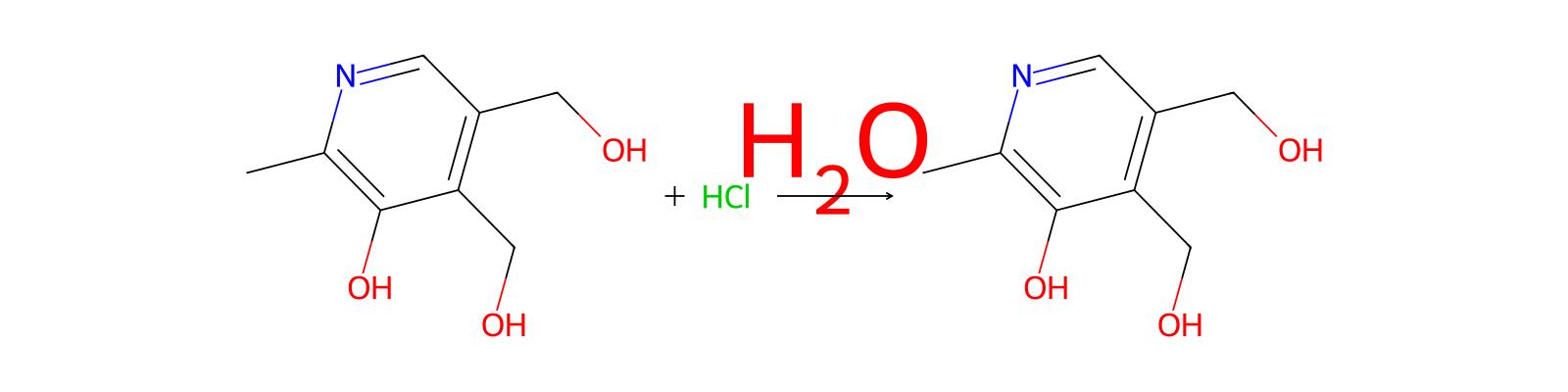
[CH3:1][C:2]1[N:7]=[CH:6][C:5]([CH2:8][OH:9])=[C:4]([CH2:10][OH:11])[C:3]=1[OH:12].Cl>O>[CH3:1][C:2]1[N:7]=[CH:6][C:5]([CH2:8][OH:9])=[C:4]([CH2:10][OH:11])[C:3]=1[OH:12]Komponenten
3
Edukt 1

Produkt 1

Reagenzien, Katalysatoren, Lösungsmittel 1

Versuchsvorschrift
In a second alternative and preferred workup, the reaction mixture (following complete conversion to compound (C)) is cooled to 20° C. and diluted with water (approximately 2.80 L of water for every 1 kg of starting pyridoxine HCl). After phase separation the organic phase is washed with water. The combined aqueous phases are reextracted twice with TBME. The combined TBME phases are washed once with saturated NaHCO3-solution and once with diluted brine. The MTBE-product solution is concentrated to a concentration of about 50% and stored at room temperature until it is further converted. If this second alternative workup is used, the volume of MTBE in the synthetic step is preferably reduced by about 26%.