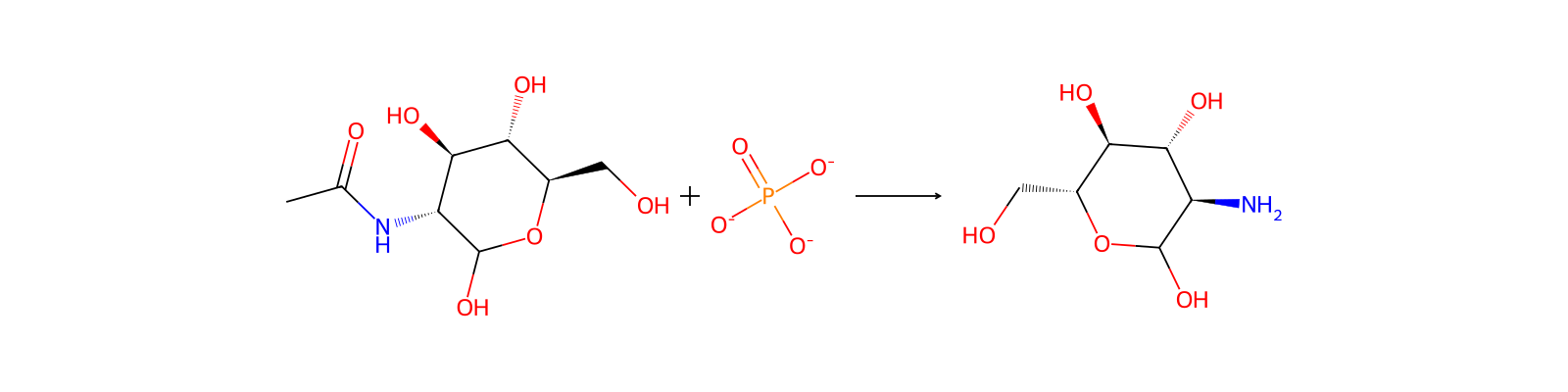
N-Acetyl-β-D-glucosamin
N-Acetyl-D-Glucosamine

Grundinformationen
- CAS
7512-17-6- Standard-SMILES
CC(=O)N[C@H]1C(O)O[C@H](CO)[C@@H](O)[C@@H]1O- InChIKey
OVRNDRQMDRJTHS-RTRLPJTCSA-N- Summenformel
- C8H15NO6
- Durchschnittliche Molmasse
- 221,21 g/mol
- Monoisotopische Masse
- 221,0899372
Überblick
N-acetyl-D-glucosamine is the D isomer of N-acetylglucosamine. It has a role as a bacterial metabolite. It is a N-acetyl-D-hexosamine and a N-acetylglucosamine.
Namen und Bezeichner
- Bevorzugter Name
- N-Acetyl-D-Glucosamine
- IUPAC
- N-[(3R,4R,5S,6R)-2,4,5-trihydroxy-6-(hydroxymethyl)oxan-3-yl]acetamide
- Lokaler Name
- N-Acetyl-β-D-glucosamin
- Englischer Name
- N-Acetyl-D-Glucosamine
- Summenformel
- C8H15NO6
- Molmasse
- 221.21
Namen und Synonyme
2-acetamido-2-deoxy-D-glucopyranoseGlcNAc2-Deoxy-2-Acetamido-D-Glucopyranosen-acetyl-glucosamine2-acetamido-2-deoxy-glucose2-Deoxy-2-Acetamido-Glucose2-Acetamido-2-Deoxy-Glucopyranose2-Deoxy-2-Acetamido-Glucopyranose2-acetamido-2-deoxy-glucopyranoside2-Deoxy-2-Acetamido-Glucopyranoside2-acetamido-2-deoxy-D-glucopyranoside2-Deoxy-2-Acetamido-D-Glucopyranoside
Weitere Namen anzeigen
N-ACETYLGLUCOSAMINEacetylglucosamineN-Acetyl-D-glucosaminN-Acetyl-beta-D-glucosamineNADGAcetyl chitin2-Acetamido-D-glucose
2-Acetamido-2-Deoxy-D-Glucose2-Deoxy-2-Acetamido-D-GlucoseD-GlcNAcGlcNAc (SNFG)N-Acetyl-D-GlucosamineSNFG:GlcNAcN-AcetylchitosamineN-Acetyl-D-glucosamine-Agarose
Datenbank-Bezeichner
- CAS
7512-17-6- PubChem CID
- 439174
- DTXSID
DTXSID901045903- ChEMBL
CHEMBL240524- ChEBI
CHEBI:506227- Nikkaji
- J35.752I
Eigenschaften
Berechnete Struktureigenschaften
- XLogP
- -1,7
- Polarare Oberfläche (TPSA)
- 119 Ų
- H-Brücken-Donoren
- 5
- H-Brücken-Akzeptoren
- 6
- Frei drehbare Bindungen
- 2
- Schwere Atome
- 15
- Formalladung
- 0
- Komplexität
- 235
Experimentelle und physikochemische Eigenschaften
LogP-2.1
Solubility
167 mg/mL
>33.2 [ug/mL] (The mean of the results at pH 7.4)
Melting Point210 °C
Physical DescriptionSolid
Collision Cross Section
147.3 Ų [M+H]+ [CCS Type: DT; Method: single field calibrated with Agilent tune mix (Agilent)]
160.36 Ų [M+Na]+ [CCS Type: DT; Method: stepped-field]
Physikochemische Eigenschaften
- Schmelzpunkt
- 211 °C · 211 °C (dec.) (lit.)
- Dampfdruck
- 8 Pa · 8Pa at 20℃
- Brechungsindex
- 39 to · +39.0 to +42.0 ° (C=1, H2O)
- storage temp.
- -20 °C · -20°C
- Löslichkeit
- Soluble in concentrated hydrochloric acid, sulfuric acid, phosphoric acid and formic acid. Insoluble in water, dilute acids, dilute alkalis, concentrated alkalis and organic solvents.
- Siedepunkt
- 636.4 · 636.4±55.0 °C(Predicted)
- Dichte
- 1.54 g/cm3 · 1.54 g/cm3
- pka
- 13.04 · 13.04±0.20(Predicted)
- Aggregatzustand
- saline suspension
- Farbe
- white to off-white
- Biologische Quelle
- crab (red)
- Wasserlöslichkeit
- 2 O: · H2O: 50 mg/mL colorless to faint yellow solution, clear to very slightly hazy
- Merck
- 14 · 14,4458
- BRN
- 1727589 · 1727589
- Stabilität
- Stable. Incompatible with strong oxidizing agents.
- InChI
- 1S/C8H15NO6/c1-3(11)9-5-7(13)6(12)4(2-10)15-8(5)14/h4-8,10,12-14H,2H2,1H3,(H,9,11)/t4-,5-,6-,7-,8/m1/s1
- InChIKey
- OVRNDRQMDRJTHS-ROGOILFBSA-N
- SMILES
- CC(=O)N[C@H]1C(O)O[C@H](CO)[C@@H](O)[C@@H]1O
- LogP
- -2.2 at · -2.2 at 23.7℃
- CAS Datenbank
- 7512 · 7512-17-6(CAS DataBase Reference)
- EPA chemische Informationen
- N-Acetylglucosamine (7512-17-6)
Sicherheit und Regulatorisches
Sicherheitsangaben dienen nur zur Orientierung und ersetzen weder das Sicherheitsdatenblatt (SDB) des Lieferanten noch geltende Vorschriften oder eine fachliche Bewertung.
Sicherheitsdaten
- F
- 3-10
- wgk
- 3
- tsca
- TSCA listed
- hs_code
- 29329985
- RTECS-Nr.
- LZ6651000
- risk_code
- 36/37/38
- hazard_code
- Xi
- hazard_note
- Irritant
- safety_code
- 24/25-36-26-22
- Speicherklasse
- 11 - Combustible Solids
Chemie und Industrie
Pharmakologische Informationen
Tissue LocationsIntestine
Cellular LocationsCytoplasm
Metabolite PathwaysAmino Sugar Metabolism
Anwendungen
BeschreibungN-Acetyl-D-Glucosamine is the N-acetyl derivative of glucosamine.Chemically it is an amide between glucosamine and acetic acid. A single N-acetlyglucosamine moiety linked to serine or threonine residues on nuclear and cytoplasmic proteins -O-GlcNAc, is an ubiquitous post-translational protein modification. O-GlcNAc modified proteins are involved in sensing the nutrient status of the surrounding cellular environment and adjusting the activity of cellular proteins accordingly. O-GlcNAc regulates cellular responses to hormones such as insulin, initiates a protective response to stress, modulates a cell's capacity to grow and divide, and regulates gene transcription. In humans, it exists in skin, cartilage and blood vessel as a component of hyaluronic acid, and bone tissue, cornea and aorta as a component of keratan sulfate. N-Acetyl-D-glucosamine (D-GlcNAc) is a derivitized glucose monomer found in polymers of bacterial cell walls, chitin, hyaluronic acids and various glycans. It is also synthesized in the glycosylation pathway as uridine diphosphate (UDP-GlcNAc), which can then be released following degradation of glycosylated proteins.D-GlcNAc is used to identify, differentiate and characterize N-acetyl-β-D-hexoaminidase(s). It is also used in the treatment of osteoarthritis and inflammatory bowel disease (IBD), including ulcerative colitis and Crohn's disease. Further, it is used as a substrate in sialic acid production, cosmetics and in drug development research.
VerwendenN-Acetyl-D-glucosamine is used in the identification and characterization of N-acetyl-beta-D-hexoaminidase. It is also used in the treatment of osteoarthritis and inflammatory bowel disease (IBD), including ulcerative colitis and Crohn's disease. Further, it is used as a substrate in sialic acid production, cosmetics and in drug development research.
VerwendenN-acetyl-D-Glucosamine (GlcNAc) is a monosaccharide derivative of glucose. It is released by the action of O-GlcNAcase, in mammalian systems from proteins that have been post-translationally modified with O-GlcNAc.D-GlcNAc enhances the proliferation and collagen expression of fibroblasts, reduces hyperpigmentation and is therefore considered a valuable ingredient in cosmetics for improving skin wrinkles and color.Important substrate for the production of sialic acids.Used in multiple other applications in drug development and food supplement, based on a newly described bio-wave model.
Vor- und nachgelagerte Produkte
Nachgelagerte Produkte
Ergänzende Hinweise
DefinitionChEBI: N-acetyl-D-glucosamine is the D isomer of N-acetylglucosamine. It has a role as a bacterial metabolite. It is a N-acetylglucosamine and a N-acetyl-D-hexosamine.
Zugehörige Reaktionen
38


Notizen zur Verbindung
Wird geladen…