
HRID 356790als Edukt
Diclofenac sodium
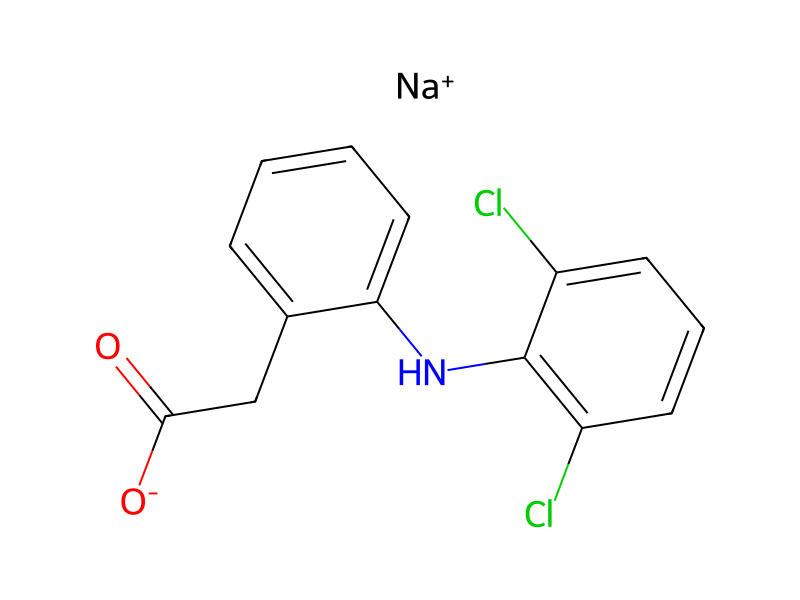
15307-79-6O=C([O-])Cc1ccccc1Nc1c(Cl)cccc1Cl.[Na+]KPHWPUGNDIVLNH-UHFFFAOYSA-MDiclofenac sodium is the sodium salt of diclofenac. It contains a diclofenac(1-).
15307-79-6DTXSID3037208CHEMBL1034Breast Feeding; Lactation; Milk, Human; Analgesic Agents; Anti-inflammatory Agents, Nonsteroidal
FDA approved drugs -> Active ingredient
FDA approved drugs -> Active ingredient
Sicherheitsangaben dienen nur zur Orientierung und ersetzen weder das Sicherheitsdatenblatt (SDB) des Lieferanten noch geltende Vorschriften oder eine fachliche Bewertung.
Danger
H301 (96.7%): Toxic if swallowed [Danger Acute toxicity, oral]
P203, P260, P261, P264, P264+P265, P270, P271, P273, P280, P301+P316, P302+P352, P304+P340, P305+P351+P338, P316, P318, P319, P321, P330, P332+P317, P337+P317, P362+P364, P391, P403+P233, P405, and P501 (click each P-code to see the statement)
Aggregated GHS information provided per 243 reports by companies from 43 notifications to the ECHA C&L Inventory. Each notification may be associated with multiple companies.
Status: Active Update: 27-05-2019 https://echa.europa.eu/registration-dossier/-/registered-dossier/13423
Diclofenac sodium: Does not have an individual approval but may be used under an appropriate group standard
The antiinflammatory effects of diclofenac are believed to be due to inhibition of both leukocyte migration and the enzyme cylooxygenase (COX-1 and COX-2), leading to the peripheral inhibition of prostaglandin synthesis. As prostaglandins sensitize pain receptors, inhibition of their synthesis is responsible for the analgesic effects of diclofenac. Antipyretic effects may be due to action on the hypothalamus, resulting in peripheral dilation, increased cutaneous blood flow, and subsequent heat dissipation.
Hepatic. Route of Elimination: Diclofenac is eliminated through metabolism and subsequent urinary and biliary excretion of the glucuronide and the sulfate conjugates of the metabolites. Little or no free unchanged diclofenac is excreted in the urine. Approximately 65% of the dose is excreted in the urine and approximately 35% in the bile as conjugates of unchanged diclofenac plus metabolites. Half Life: 2 hours
DICLOFENAC SODIUM
Cyclooxygenase Inhibitors [MoA]; Nonsteroidal Anti-inflammatory Drug [EPC]; Anti-Inflammatory Agents, Non-Steroidal [CS]; Decreased Prostaglandin Production [PE]
DICLOFENAC SODIUM 1%
Cyclooxygenase Inhibitors [MoA]; Anti-Inflammatory Agents, Non-Steroidal [CS]; Decreased Prostaglandin Production [PE]; Nonsteroidal Anti-inflammatory Drug [EPC]
DICLOFENAC SODIUM D/R
Cyclooxygenase Inhibitors [MoA]; Nonsteroidal Anti-inflammatory Drug [EPC]; Decreased Prostaglandin Production [PE]; Anti-Inflammatory Agents, Non-Steroidal [CS]
Anti-inflammatory agents that are non-steroidal in nature. In addition to anti-inflammatory actions, they have analgesic, antipyretic, and platelet-inhibitory actions. They act by blocking the synthesis of prostaglandins by inhibiting cyclooxygenase, which converts arachidonic acid to cyclic endoperoxides, precursors of prostaglandins. Inhibition of prostaglandin synthesis accounts for their analgesic, antipyretic, and platelet-inhibitory actions; other mechanisms may contribute to their anti-inflammatory effects.
Compounds or agents that combine with cyclooxygenase (PROSTAGLANDIN-ENDOPEROXIDE SYNTHASES) and thereby prevent its substrate-enzyme combination with arachidonic acid and the formation of eicosanoids, prostaglandins, and thromboxanes.


CHEBI:4509Drug Induced Liver Injury Rank (DILIrank 2.0)
Diclofenac sodium
vMost-DILI-concern
8
Warnings & precautions
DOI:10.1016/j.drudis.2016.02.015
BeschreibungDiclofenac is a non-steroidal anti-inflammatory drug (NSAID) and COX inhibitor (IC50s = 0.9-2.7 and 1.5-20 μM, for human COX-1 and COX-2, respectively). It is also an active metabolite of diclofenac methyl ester and diclofenac amide . Diclofenac inhibits release of arachidonic acid (Item Nos. 90010 | 90010.1 | 10006607) induced by A23187 in isolated rat peritoneal neutrophils and macrophages (IC50s = 60 and 10 μM, respectively). Transdermal administration of diclofenac inhibits carrageenan-induced paw edema in rats. Formulations containing diclofenac have been used in the treatment of pain associated with osteoarthritis, rheumatoid arthritis, and ankylosing spondylitis.
HistoryDiclofenac sodium is a classic nonsteroidal anti-inflammatory drug (NSAID), known for its potent antipyretic, analgesic, and anti-inflammatory effects, and is marketed under brand names such as Voltaren. Its discovery and widespread use have had a profound impact on the treatment of pain and inflammation.Discovery and Patent (1965): Diclofenac sodium was synthesized by a team of researchers Rudolf Pfister and Alfred Sallmann at the Swiss pharmaceutical company Ciba-Geigy AG (now part of Novartis) while searching for a highly active and well-tolerated NSAID. The compound was patented in 1965.First Market Launch (1973): After extensive preclinical and clinical trials, diclofenac sodium was first marketed globally in 1973 under the brand name Voltaren. Its design philosophy is based on clear principles and aims to be an effective cyclooxygenase (COX) inhibitor.
VerwendenDiclofenac sodium is a nonsteroidal anti-inflammatory compound and cyclooxygenase (COX) inhibitor. Oxidation of diclofenac sodium produces the metabolite 4'-hydroxy diclofenac) which demonstrates specific inhibition of Cox-2. Inhibition of Cox by diclofenac and 4'-hydroxy diclofenac suppresses prostaglandin E2 synthesis, producing anti-inflammatory and analgesic effects. Diclofenac is also shown to stabilize the native tetrameric conformation of transthyretin (TTR) fibrils, preventing the formation of insoluble amyloidogenic TTR deposits. Diclofenac Sodium is a substrate of CYP2C9. It is also used as an inhibitor of Cox-1 and Cox-2.
DefinitionChEBI: Diclofenac sodium is the sodium salt of diclofenac. It contains a diclofenac(1-).