Reaktionsgleichung

[C:1]1([SH:7])[CH:6]=[CH:5][CH:4]=[CH:3][CH:2]=1.[C:8]([O:12][CH2:13][CH:14]1[O:16][CH2:15]1)(=[O:11])[CH:9]=[CH2:10].[OH-].[K+].C(S)(S)CC.Cl>CC(O)C.O>[C:1]1([S:7][CH2:10][CH2:9][C:8]([O:12][CH2:13][CH:14]2[O:16][CH2:15]2)=[O:11])[CH:6]=[CH:5][CH:4]=[CH:3][CH:2]=1Komponenten
Edukt 5

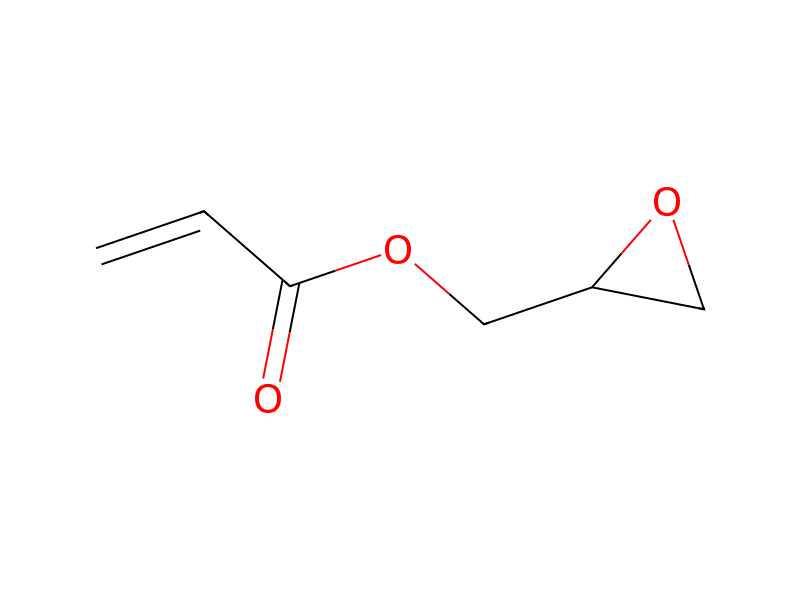



Produkt 1

Reagenzien, Katalysatoren, Lösungsmittel 2


Versuchsvorschrift
2,3-epoxypropyl 3-(phenylthio)propionate was prepared by adding 11.0 grams (0.1 moles) of benzenethiol to a solution of 12.8 grams of 2,3-epoxypropyl acrylate with 10 drops of Triton B® in 50 milliliters of 2-propanol. The addition was carried out over a period of 5 minutes during which the temperature of the reaction mixture rose to 54° C. The mixture was then stirred for 3.5 hours at ambient temperature. To this reaction mixture was added 0.5 grams of potassium hydroxide. After the potassium hydroxide had dissolved there was added 5.4 grams of propanedithiol and the reaction mixture was stirred for 3.5 hours. The mixture was then poured into a solution of 5 milliliters of concentrated hydrochloric acid in 100 milliliters of water. The organic oil was separated by extraction with toluene and toluene was then removed from the extract by rotary evaporator. There was obtained 26.6 grams (0.091 moles) of a viscous liquid shown by its NMR spectrum to be 2,9 -dihydroxy-4,7-dithia-5-methyldecamethylene bis[3-(phenylthio)propionate].
Aufarbeitung
- additionThe addition
- customrose to 54° C
- stirringthe reaction mixture was stirred for 3.5 hours
- customThe organic oil was separated by extraction with toluene and toluene
- customwas then removed from the
- extractionextract by rotary evaporator
Quellen und Nachweise
- ORD-Eintrag
- ord-8dcfcab87e294d2abdffaaa2b37c6418
- Quelldatensatz
- uspto-grants-1981_03
- Patentnummer
- US04254020
Verknüpfte Notizen
Wird geladen…