Reaktionsgleichung

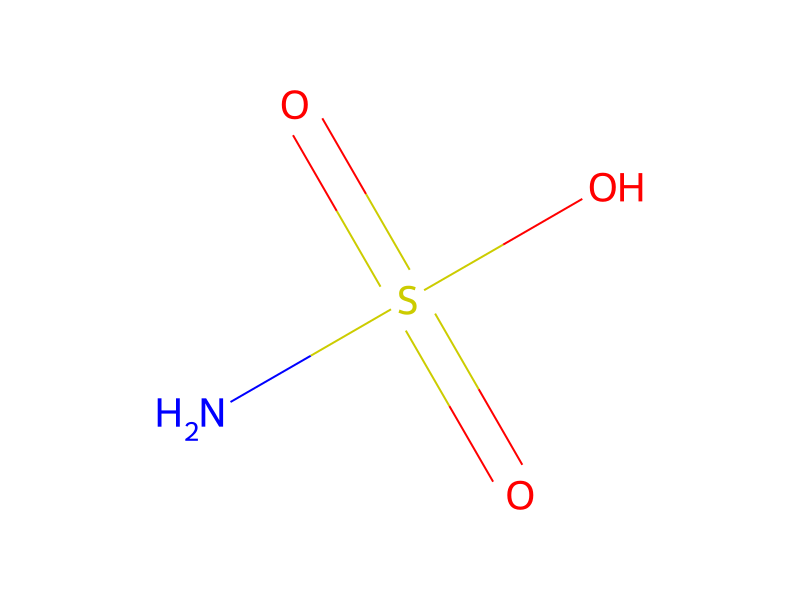
[S:1](=[O:5])(=[O:4])([O-:3])[NH2:2].[NH4+:6].[S:7](=[O:11])(=[O:10])([OH:9])[NH2:8].O.[OH-].[K+:14]>>[S:1]([NH:2][S:7]([O-:11])(=[O:10])=[O:9])([O-:3])(=[O:5])=[O:4].[NH4+:8].[NH4+:6].[S:1]([NH:2][S:7]([O-:11])(=[O:10])=[O:9])([O-:3])(=[O:5])=[O:4].[K+:14].[K+:14]Komponenten




Versuchsvorschrift
Diammonium imidodisulfate was prepared by adding 114 grams (1.0 mole) of ammonium sulfamate to 97 grams (1.0 mole) of sulfamic acid in a 1-liter beaker. The mixture was heated on a hot plate with constant stirring. At about 130° C. a stirrable slurry was obtained and at about 155° C. an exothermic reaction began, forming a solid. When the solid cooled, it was dissolved in about 375 grams of 45 percent potassium hydroxide. Water was added to bring the total volume to 800 milliliters. The solution was filtered and then heated under vacuum to expel ammonia. Upon cooling, concentrated hydrochloric acid was carefully added to the solution to adjust the mixture to pH 7.5. A precipitate was obtained and upon filtering, about 150 grams of potassium imidodisulfate was obtained.
Aufarbeitung
- temperatureThe mixture was heated on a hot plate with constant stirring
- customAt about 130° C. a stirrable slurry was obtained and at about 155° C.
- customan exothermic reaction
- customforming a solid
- temperatureWhen the solid cooled
- filtrationThe solution was filtered
- temperatureheated under vacuum
- temperatureUpon cooling
- additionconcentrated hydrochloric acid was carefully added to the solution
- customA precipitate was obtained
- filtrationupon filtering
Quellen und Nachweise
- ORD-Eintrag
- ord-ac000f4974a4464091ad3d331db322e5
- Quelldatensatz
- uspto-grants-1980_05
- Patentnummer
- US04201687
Verknüpfte Notizen
Wird geladen…