StartseiteMCPWorkbenchSkills
StartseiteWorkbenchBenachrichtigungenMein Bereich
llms.txt · MCP-AnleitungDatenschutz · Nutzungsbedingungen · Supportv1.8.3
  1. Startseite
  2. /Reaktion

Potassium Phosphate, Tribasic → Methyl 5-cyclopropyl-4-((4,4-difluorocyclohexyl)oxy)-2-fluorobenzoate

HRID 1849823
Drucken

Reaktionsgleichung

Reaktionsgleichung von HRID 1849823
Cl[C:2]1[C:3]([O:13][CH:14]2[CH2:19][CH2:18][C:17]([F:21])([F:20])[CH2:16][CH2:15]2)=[CH:4][C:5]([F:12])=[C:6]([CH:11]=1)[C:7]([O:9][CH3:10])=[O:8].[CH:22]1(B(O)O)[CH2:24][CH2:23]1.P([O-])([O-])([O-])=O.[K+].[K+].[K+].F[B-](F)(F)F.C1(P(C2CCCCC2)C2CCCCC2)CCCCC1>C1(C)C=CC=CC=1.O.C([O-])(=O)C.[Pd+2].C([O-])(=O)C.[Pd]>[CH:22]1([C:2]2[C:3]([O:13][CH:14]3[CH2:19][CH2:18][C:17]([F:21])([F:20])[CH2:16][CH2:15]3)=[CH:4][C:5]([F:12])=[C:6]([CH:11]=2)[C:7]([O:9][CH3:10])=[O:8])[CH2:24][CH2:23]1
KomponentenVersuchsvorschriftAufarbeitungQuellen und NachweiseNotizen zur Reaktion

Komponenten

9

Edukt 4

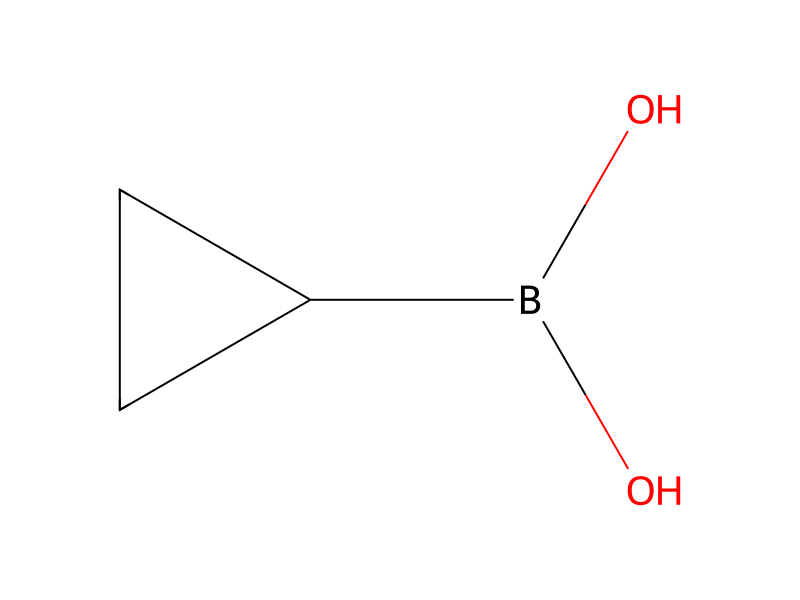
HCID 62657Potassium Phosphate, TribasicHCID 2760897Cyclopropylboronic acidHCID 20066521Tri(cyclohexyl)phosphine tetrafluoroborateHCID 86703689Methyl 5-chloro-4-((4,4-difluorocyclohexyl)oxy)-2-fluorobenzoate

Produkt 1

HCID 86703711Methyl 5-cyclopropyl-4-((4,4-difluorocyclohexyl)oxy)-2-fluorobenzoate
Ausbeute 76 %

Reagenzien, Katalysatoren, Lösungsmittel 4

HCID 23938PalladiumKatalysatorHCID 167845palladium(II) acetateKatalysatorHCID 962WaterLösungsmittelHCID 1140TolueneLösungsmittel

Versuchsvorschrift

To an argon-degassed solution of methyl 5-chloro-4-((4,4-difluoro-cyclohexyl)oxy)-2-fluorobenzoate (0.394 g, 1.22 mmol) in toluene (15 mL) and water (3 mL) was added cyclopropylboronic acid (0.639 g, 7.44 mmol), tribasic potassium phosphate (0.826 g, 3.89 mmol), tricyclohexylphosphine tetrafluoroborate (0.30 g, 0.97 mmol), and palladium acetate trimer (0.108 g, 0.481 mmol Pd). The mixture was heated to reflux under an argon atmosphere for 21 hours, cooled to ambient temperature. The mixture was filtered through a pad of diatomaceous earth that was rinsed with ethyl acetate (100 mL). The filtrate was washed with a 2:1 mixture of saturated aqueous ammonium chloride and water (150 mL), brine (150 mL), dried over anhydrous magnesium sulfate, filtered, and concentrated in vacuo to dryness. The residue was purified by column chromatography with a gradient of ethyl acetate in hexanes (0-10%) to afford the title compound as a light yellow syrup (0.30 g, 76%): 1H NMR (300 MHz, CDCl3) δ 7.46 (d, J=8.4 Hz, 1H), 6.55 (d, J=12.6 Hz, 1H), 4.57 (br s, 1H), 3.86 (s, 3H), 2.44-1.88 (m, 9H), 0.93-0.86 (m, 2H), 0.64-0.59 (m, 2H); 19F NMR (282 MHz, CDCl3) 8-92.3 (d, J=238 Hz, 1F), −102.3 (d, J=237 Hz, 1F), −109.4 (s, 1F); MS (ES+) m/z 329.1 (M+1).

Aufarbeitung

  1. temperatureThe mixture was heated
  2. temperatureto reflux under an argon atmosphere for 21 hours
  3. filtrationThe mixture was filtered through a pad of diatomaceous earth that
  4. washwas rinsed with ethyl acetate (100 mL)
  5. washThe filtrate was washed with a 2:1 mixture of saturated aqueous ammonium chloride and water (150 mL), brine (150 mL)
  6. dry with materialdried over anhydrous magnesium sulfate
  7. filtrationfiltered
  8. concentrationconcentrated in vacuo to dryness
  9. customThe residue was purified by column chromatography with a gradient of ethyl acetate in hexanes (0-10%)

Quellen und Nachweise

ORD-Eintrag
ord-903df91565774a099188c5070f0b5fa4
Quelldatensatz
uspto-grants-2015_02
DOI
10.6084/m9.figshare.5104873.v1
Patentnummer
US08952169B2

Notizen zur Reaktion

Auf dieser SeiteKomponentenVersuchsvorschriftAufarbeitungQuellen und NachweiseNotizen zur Reaktion