Reaktionsgleichung

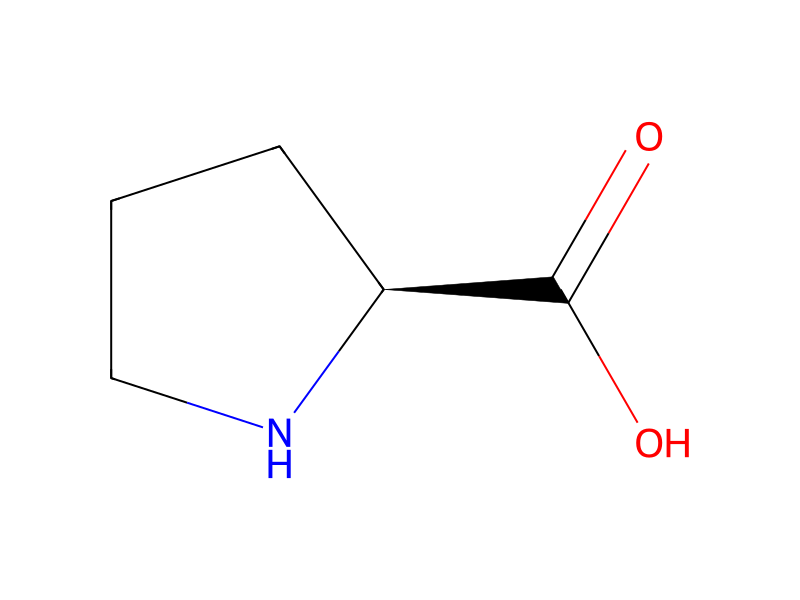
[NH:1]1[CH2:8][CH2:7][CH2:6][C@H:2]1[C:3]([OH:5])=[O:4].[OH-].[Na+].[CH3:11][C:12]1[CH:17]=[CH:16][C:15]([S:18](Cl)(=[O:20])=[O:19])=[CH:14][CH:13]=1>O.CCOCC>[CH3:11][C:12]1[CH:17]=[CH:16][C:15]([S:18]([N:1]2[CH2:8][CH2:7][CH2:6][C@H:2]2[C:3]([OH:5])=[O:4])(=[O:20])=[O:19])=[CH:14][CH:13]=1Komponenten
Edukt 3


Produkt 1

Reagenzien, Katalysatoren, Lösungsmittel 2


Versuchsvorschrift
In this example, L-proline (11.5 g; 0.10 mole) and caustic soda (8.0 g; 0.2 moles) are dissolved in 100 ml water, and a solution of p-methylphenylsulfonyl chloride (20.9 g) dissolved in ether (80 ml) is added thereto with vigorous stirring under cooling in an ice bath (5°-10° C.). After reaction for about 5 hours, the reaction mixture is left standing, and the upper ether layer is removed. The remaining aqueous layer is admixed with 2N hydrochloric acid to adjust the pH to 3-4. After being left standing in a cool place (0°-5° C.), the deposited crystals are filtered off. The crystals are recrystallized from an aqueous 60% ethanol solution (about 200 ml), whereby p-methylphenylsulfonyl-L-proline (compound number 15; 20.1 g; m.p. 57°-59° C.) was obtained. Yield: 70%.
Aufarbeitung
- additionis added
- temperatureunder cooling in an ice bath (5°-10° C.)
- customAfter reaction for about 5 hours
- waitthe reaction mixture is left
- customthe upper ether layer is removed
- waitAfter being left
- customstanding in a cool place (0°-5° C.)
- filtrationthe deposited crystals are filtered off
- customThe crystals are recrystallized from an aqueous 60% ethanol solution (about 200 ml)
Quellen und Nachweise
- ORD-Eintrag
- ord-13e9f9304d2b430b92bb2a939109ab3f
- Quelldatensatz
- uspto-grants-1980_08
- Patentnummer
- US04217130
Verknüpfte Notizen
Wird geladen…