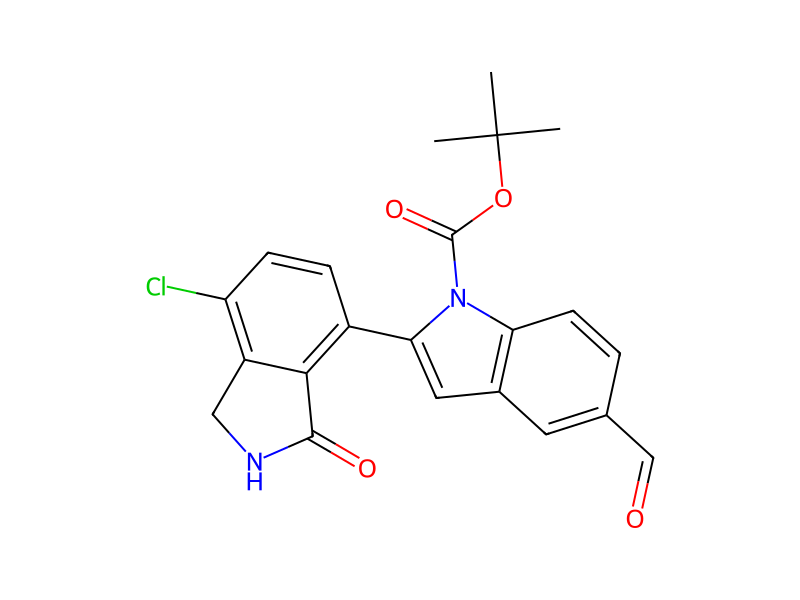
In a similar manner to Step 2 of Example 6, 4-chloro-7-[1-(tert-butoxycarbonyl)-5-formylindol-2-yl]isoindolinone (20.7 mg, 0.0504 mmol) was dissolved in acetonitrile (1 mL), and the solution was treated with 1-(2-hydroxyethyl)piperazine (28 mg, 0.22 mmol), acetic acid (0.232 mL, 4.05 mmol) and sodium triacetoxyborohydride (116 mg, 0.547 mmol). The reaction mixture was added with water and sodium carbonate, followed by extracting with ethyl acetate. The organic layer was washed with saturated brine and dried over anhydrous sodium sulfate. The solvent was evaporated under reduced pressure to obtain 4-chloro-7-(1-(tert-butoxycarbonyl)-5-[4-(2-hydroxyethyl)piperazin-1-ylmethyl]indol-2-yl)isoindolinone (29.6 mg).