Reaktionsgleichung

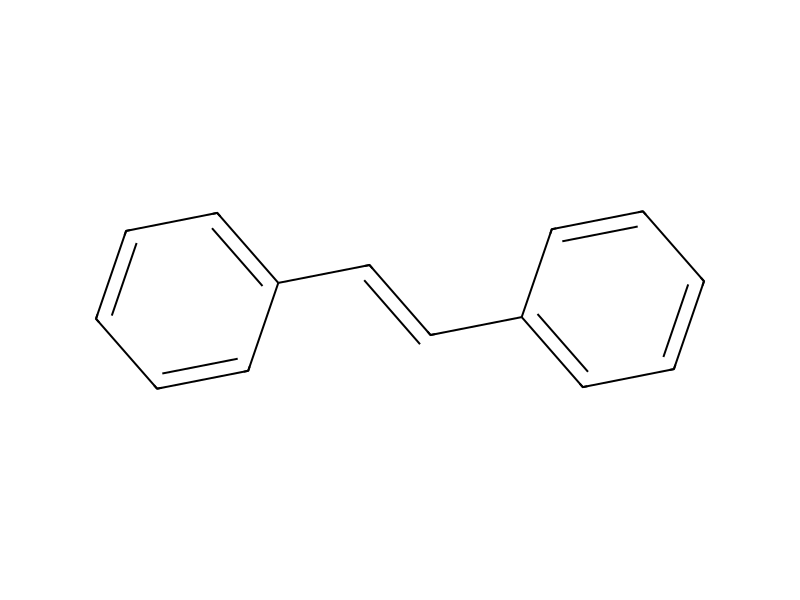
[CH:1]1[CH:6]=[CH:5][C:4](/[CH:7]=[CH:8]/Br)=[CH:3][CH:2]=1.[I-].[C:11]1([Zn+])[CH:16]=[CH:15][CH:14]=[CH:13][CH:12]=1>[Pd].C(F)(F)(C(F)(F)C(F)(F)F)C(F)(F)C(F)(F)C(F)(F)F.C(#N)C.C1COCC1.C1C=CC(/C=C/C(/C=C/C2C=CC=CC=2)=O)=CC=1.C1C=CC(/C=C/C(/C=C/C2C=CC=CC=2)=O)=CC=1.C1C=CC(/C=C/C(/C=C/C2C=CC=CC=2)=O)=CC=1.[Pd].[Pd]>[C:4]1(/[CH:7]=[CH:8]/[C:11]2[CH:16]=[CH:15][CH:14]=[CH:13][CH:12]=2)[CH:5]=[CH:6][CH:1]=[CH:2][CH:3]=1Komponenten
Edukt 2


Produkt 1
Reagenzien, Katalysatoren, Lösungsmittel 5





Versuchsvorschrift
In an illustrative example, a coupling reaction was conducted between (E)-2-bromostyrene (PhCH═CHBr) and phenylzinc iodide (PhZnI) promoted by a fluorous palladium catalyst. The catalyst was prepared from Pd2(dba)3 and the known fluorous phosphine (p-C6F13CH2CH2C6H4)3P. A mixture of the catalyst in FC-72 was contacted in a U-tube with a first organic phase containing (E)-2-bromostyrene in acetonitrile and a second organic phase containing phenylzinc iodide in THF. After one day at ambient temperature, each organic phase was removed and subjected to standard aqueous workup. Unreacted (E)-2-bromostyrene was recovered from the first organic phase while the coupled reaction product, (E)-stilbene (PhCH═CHPh) was isolated from the second organic phase.
Aufarbeitung
- customeach organic phase was removed
- customwas recovered from the first organic phase while the coupled reaction product
Quellen und Nachweise
- ORD-Eintrag
- ord-4807387aed194981af52ac32c94e23b4
- Quelldatensatz
- uspto-grants-2005_05
- Patentnummer
- US06897331B2
Verknüpfte Notizen
Wird geladen…