Diisopropylethylamine → HCID 86675758, Verbindung
Reaktionsgleichung

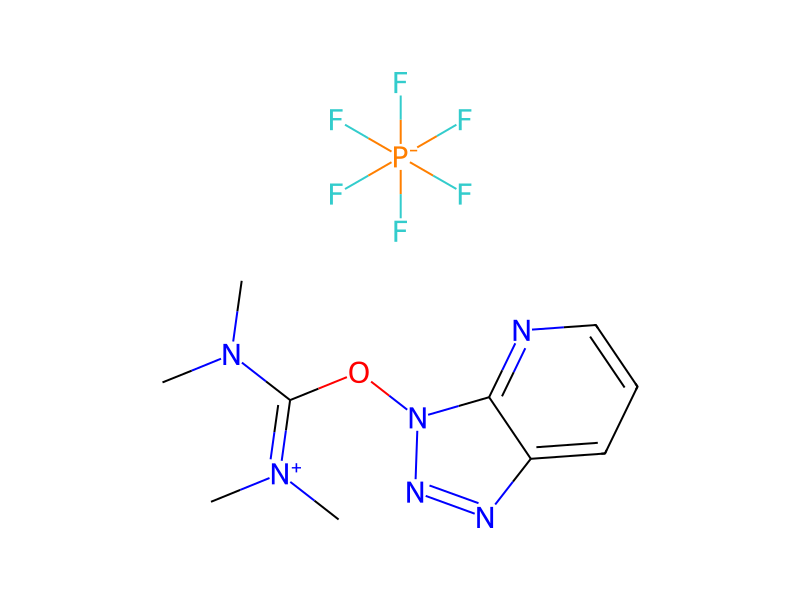
[Cl:1][C:2]1[C:10]([F:11])=[CH:9][C:5]([C:6]([OH:8])=O)=[C:4]([F:12])[CH:3]=1.C(N(CC)C(C)C)(C)C.F[P-](F)(F)(F)(F)F.C[N+](C)=C(N(C)C)ON1C2N=CC=CC=2N=N1.[F:46][CH:47]([F:50])[CH2:48][NH2:49]>ClCCCl.ClC(Cl)C>[Cl:1][C:2]1[C:10]([F:11])=[CH:9][C:5]([C:6]([NH:49][CH2:48][CH:47]([F:50])[F:46])=[O:8])=[C:4]([F:12])[CH:3]=1Komponenten
Edukt 4



Produkt 1

Reagenzien, Katalysatoren, Lösungsmittel 2


Versuchsvorschrift
A solution of 4-chloro-2,5-difluorobenzoic acid (1.28 g, 6.64 mmol), N,N-diisopropylethylamine (3.5 mL, 20 mmol), and N,N,N′,N′-tetramethyl-O-(7-azabenzotriazol-1-yl)uronium hexafluorophosphate (3.07 g, 8.07 mmol) in 1,2-dichloroethane (20 mL) was stirred for 10 min. at room temperature prior to the addition of a solution of 2,2-difluoroethanamine (538 mg, 6.64 mmol) in dichloroethane (2 mL). The resulting solution was stirred for 1 h. at room temperature. LCMS data indicated that the major reaction component was the desired product. The crude reaction mixture was concentrated under reduced pressure. The residue was purified by flash chromatography on a silica gel column with methanol in dichloromethane (0-10%) to afford the desired product. LCMS (M+H)+: m/z=256.0.
Quellen und Nachweise
- ORD-Eintrag
- ord-9edbfee4724b47e5aa5846bb08a7355f
- Quelldatensatz
- uspto-grants-2014_04
- Patentnummer
- US08691807B2
Notizen zur Reaktion
Wird geladen…